Hsu Shu-Chun, Chung Jing-Gung
Department of Nutrition, China Medical University, Taichung 40402, Taiwan.
Department of Biological Science and Technology, China Medical University, Taichung 40402, Taiwan.
Biomedicine (Taipei). 2012 Sep;2(3):108-116. doi: 10.1016/j.biomed.2012.03.003. Epub 2012 May 11.
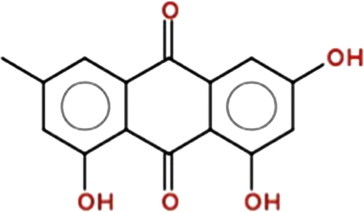
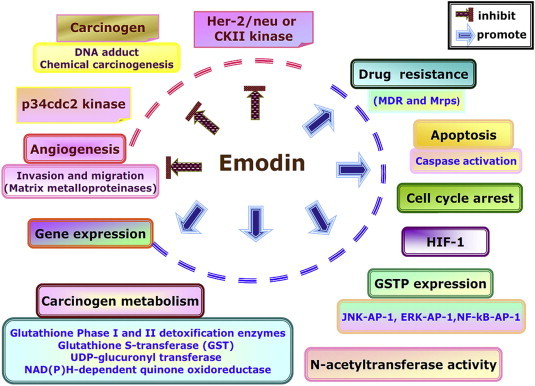
Traditional Chinese Medicine (TCM) is widely used in clinical research due to its low toxicity, low number of side effects, and low cost. Many components of common fruits and vegetables play well-documented roles as chemopreventive or chemotherapeutic agents that suppress tumorigenesis. Anthraquinones are commonly extracted from the Polygonaceae family of plants, e.g., and . Some of the major chemical components of anthraquinone and its derivatives, such as aloe-emodin, danthron, emodin, chrysophanol, physcion, and rhein, have demonstrated potential anticancer properties. This review evaluates the pharmacological effects of emodin, a major component of . In particular, emodin demonstrates anti-neoplastic, anti-inflammatory, anti-angiogenesis, and toxicological potential for use in pharmacology, both and Emodin demonstrates cytotoxic effects (e.g., cell death) through the arrest of the cell cycle and the induction of apoptosis in cancer cells. The overall molecular mechanisms of emodin include cell cycle arrest, apoptosis, and the promotion of the expression of hypoxia-inducible factor 1α, glutathione S-transferase P, N-acetyltransferase, and glutathione phase I and II detoxification enzymes while inhibiting angiogenesis, invasion, migration, chemical-induced carcinogen-DNA adduct formation, HER2/neu, CKII kinase, and p34cdc2 kinase in human cancer cells. Hopefully, this summary will provide information regarding the actions of emodin in cancer cells and broaden the application potential of chemotherapy to additional cancer patients in the future.
由于其低毒性、低副作用发生率和低成本,中药在临床研究中得到广泛应用。常见水果和蔬菜的许多成分作为化学预防或化学治疗剂发挥着有充分文献记载的作用,可抑制肿瘤发生。蒽醌类化合物通常从蓼科植物中提取,例如……蒽醌及其衍生物的一些主要化学成分,如芦荟大黄素、丹蒽醌、大黄素、 Chrysophanol、 大黄酚和大黄酸,已显示出潜在的抗癌特性。本综述评估了……的主要成分大黄素的药理作用。特别是,大黄素在药理学中显示出抗肿瘤、抗炎、抗血管生成和毒理学潜力,……大黄素通过使癌细胞的细胞周期停滞和诱导凋亡来表现出细胞毒性作用(例如细胞死亡)。大黄素的总体分子机制包括细胞周期停滞、凋亡,以及促进缺氧诱导因子1α、谷胱甘肽S-转移酶P、N-乙酰转移酶以及谷胱甘肽I相和II相解毒酶的表达,同时抑制人癌细胞中的血管生成、侵袭、迁移、化学诱导的致癌物-DNA加合物形成、HER2/neu、CKII激酶和p34cdc2激酶。希望本综述将提供有关大黄素在癌细胞中的作用的信息,并在未来扩大化疗对更多癌症患者的应用潜力。