Fatima Sehrish, Manzoor Iram, Joya Aneeqa Mumtaz, Arif Shehzeen, Qayyum Sadia
Sehrish Fatima, Students of 4 Year MBBS, Community Medicine, Akhtar Saeed Medical and Dental College, Lahore, Pakistan.
Prof. Dr. Iram Manzoor, MBBS, FCPS, MSC, MCPS-HPE. Director Medical Education, HOD of Community Medicine, Akhtar Saeed Medical and Dental College, Lahore, Pakistan.
Pak J Med Sci. 2020 Mar-Apr;36(3):581-585. doi: 10.12669/pjms.36.3.1370.
To estimate frequency of stunting and associated factors in children aged less than five years in a tertiary care hospital of Lahore.
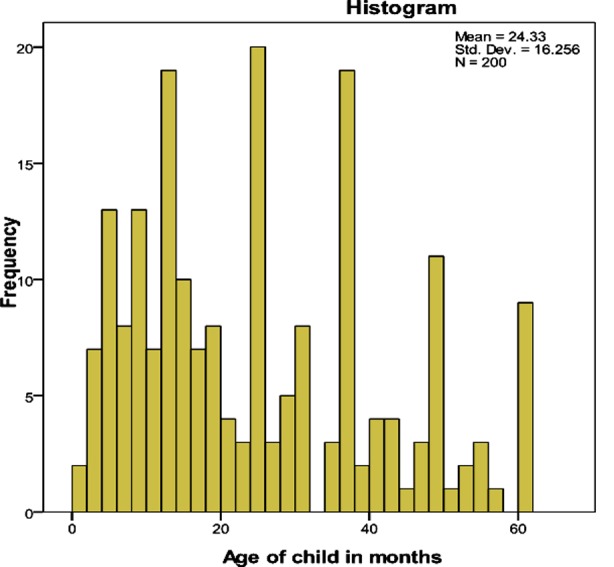
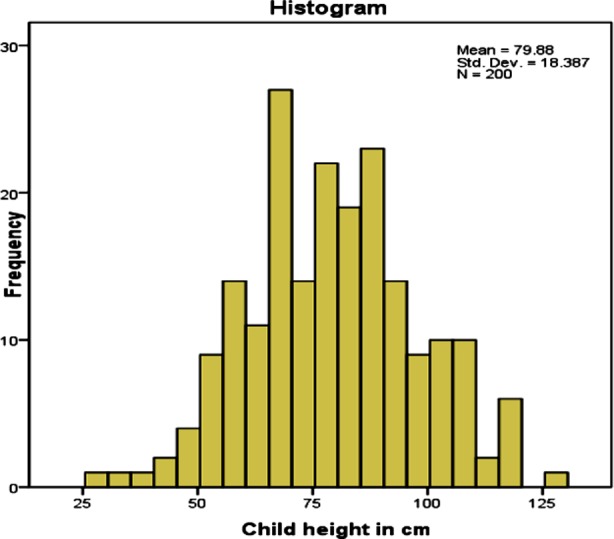
An Analytical cross-sectional study was conducted in Pediatrics Outpatient Department at Akhtar Saeed Trust Teaching Hospital, Lahore from December 2017 to July 2018. Two hundred children of ages under five years coming to outdoor for treatment of minor ailments were included after informed consent from their parents. Non-probability, convenient sampling technique was used to collect sample. Data collected and analyzed on SPSS version 19. To find out association of stunting with multiple qualitative variables, chi-square test was applied and p-value was fixed at ≤ 0.05 to be significant.
Out of 200 children screened in OPD, 42 (21.0%) were found to be stunted. The total percentage of stunting in male children was 28 (66.6%) and in female children were 14 (33.3%). Stunting was significantly associate with male gender (p=0.047), joint family system (p=0.049), low literacy level in mothers (p=0.031), unvaccinated status (p=0.003) and history of bottle feeding (p=0.037).
The frequency of stunting in children less than five years of age is 42 (21.0%). The significant risk factors associated with stunting were found as male gender (p= 0.047), joint family system (p=0.049), low maternal education (p=0.031), unvaccinated status(p=0.03).
评估拉合尔一家三级护理医院中5岁以下儿童发育迟缓的发生率及相关因素。
2017年12月至2018年7月,在拉合尔阿赫塔尔·赛义德信托教学医院的儿科门诊进行了一项分析性横断面研究。在获得其父母的知情同意后,纳入了200名前来门诊治疗小病的5岁以下儿童。采用非概率、方便抽样技术收集样本。数据在SPSS 19版上进行收集和分析。为了找出发育迟缓与多个定性变量之间的关联,应用了卡方检验,将p值设定为≤0.05具有显著性。
在门诊筛查的200名儿童中,有42名(21.0%)被发现发育迟缓。男童发育迟缓的总百分比为28名(66.6%),女童为14名(33.3%)。发育迟缓与男性性别(p = 0.047)、联合家庭系统(p = 0.049)、母亲低识字水平(p = 0.031)、未接种疫苗状态(p = 0.003)和奶瓶喂养史(p = 0.037)显著相关。
5岁以下儿童发育迟缓的发生率为42名(21.0%)。与发育迟缓相关的显著风险因素为男性性别(p = 0.047)、联合家庭系统(p = 0.049)、母亲低教育水平(p = 0.031)、未接种疫苗状态(p = 0.03)。