• 文献检索
  • 文档翻译
  • 深度研究
  • 学术资讯
  • Suppr Zotero 插件Zotero 插件
  • 邀请有礼
  • 套餐&价格
  • 历史记录
应用&插件
Suppr Zotero 插件Zotero 插件浏览器插件Mac 客户端Windows 客户端微信小程序
定价
高级版会员购买积分包购买API积分包
服务
文献检索文档翻译深度研究API 文档MCP 服务
关于我们
关于 Suppr公司介绍联系我们用户协议隐私条款
关注我们

Suppr 超能文献

核心技术专利:CN118964589B侵权必究
粤ICP备2023148730 号-1Suppr @ 2026

文献检索

告别复杂PubMed语法,用中文像聊天一样搜索,搜遍4000万医学文献。AI智能推荐,让科研检索更轻松。

立即免费搜索

文件翻译

保留排版,准确专业,支持PDF/Word/PPT等文件格式,支持 12+语言互译。

免费翻译文档

深度研究

AI帮你快速写综述,25分钟生成高质量综述,智能提取关键信息,辅助科研写作。

立即免费体验

基于互联网的、同伴提供信息的干预措施在印度男男性行为者中促进 HIV 检测和 condom 使用(CHALO!):试点随机对照试验。

An Internet-Based, Peer-Delivered Messaging Intervention for HIV Testing and Condom Use Among Men Who Have Sex With Men in India (CHALO!): Pilot Randomized Comparative Trial.

机构信息

Division of General Internal Medicine, Department of Medicine, Albert Einstein College of Medicine, Montefiore Health System, Bronx, NY, United States.

The Humsafar Trust, Mumbai, India.

出版信息

JMIR Public Health Surveill. 2020 Apr 16;6(2):e16494. doi: 10.2196/16494.

DOI:10.2196/16494
PMID:32297875
原文链接:https://pmc.ncbi.nlm.nih.gov/articles/PMC7193444/
Abstract

BACKGROUND

Leveraging internet-based communication tools (eg, messaging apps, SMS text messaging, and email) may be an effective avenue for delivery of HIV prevention messages to men who have sex with men (MSM) in India, but there are limited models for such internet-based interventions.

OBJECTIVE

The CHALO! pilot was an online educational and behavioral intervention aimed to determine the feasibility, acceptability, and preliminary impact of a peer-delivered, internet-based messaging intervention for HIV testing and consistent condom use for MSM in India. The messages addressed barriers to HIV testing and condom use and were theoretically based on the information-motivation-behavioral skills model.

METHODS

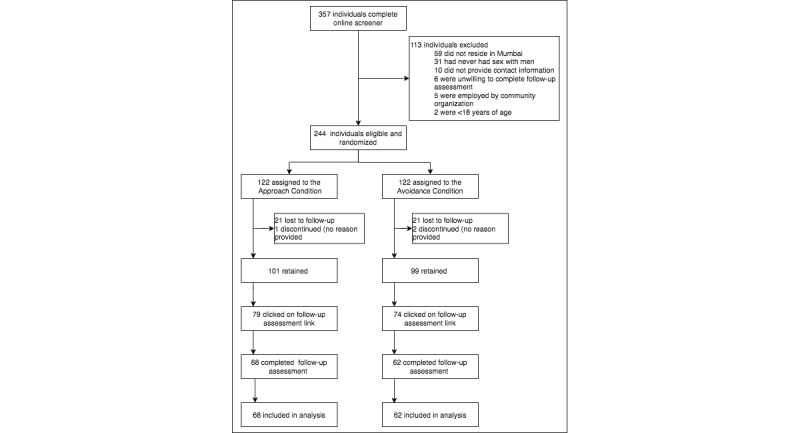
Between February and March 2015, we recruited, enrolled, and randomized 244 participants via online advertisements on mobile dating apps and Facebook. Eligible men (18 years or older, sexually active with other men, and self-reported HIV-negative or unknown status) were randomized to receive educational and motivational messages framed as either approach (ie, a desirable outcome to be achieved) or avoidance (an undesirable outcome to be avoided) over 12 weeks via internet-based messaging platforms. Participants completed online surveys at baseline and immediately postintervention.

RESULTS

Participants were similar across arms with respect to sociodemographic and behavioral characteristics. Over 82.0% (200/244) of participants were retained (ie, viewed final messages), and 52.3% (130/244) of them completed the follow-up survey. Of those completing the follow-up survey, 82.3% (107/130) liked or strongly liked participating in CHALO!. The results showed a significant increase in self-reported HIV testing in the past 6 months from baseline to follow-up (41/130, 31.5% to 57/130, 43.8%; P=.04). When including those who reported intentions to test, this percentage increased from 44.6% (58/130) at baseline to 65.4% (85/130) at follow-up (P<.01). When examining intentions to test among those without prior HIV testing, intentions increased from 32% (16/50) of the sample at baseline to 56% (28/50) of the sample at follow-up (P=.02). Condom use during anal sex did not significantly change from baseline to follow-up. HIV testing and condom use did not significantly differ between approach and avoidance conditions at follow-up.

CONCLUSIONS

As one of the first studies of an online HIV prevention intervention for Indian MSM, CHALO! was feasible to implement by a community-based organization, was acceptable to participants, and demonstrated potential to improve HIV testing rates.

摘要

背景

利用基于互联网的通讯工具(例如,消息应用程序、短信和电子邮件)可能是向印度男男性接触者(MSM)传递艾滋病毒预防信息的有效途径,但针对此类基于互联网的干预措施,目前还没有太多的模型。

目的

CHALO!试验是一项在线教育和行为干预措施,旨在确定一种由同伴提供的、基于互联网的信息传递干预措施对于在印度进行艾滋病毒检测和坚持使用安全套的 MSM 的可行性、可接受性和初步效果。这些信息针对的是艾滋病毒检测和使用安全套的障碍,并且在理论上基于信息-动机-行为技能模型。

方法

在 2015 年 2 月至 3 月期间,我们通过移动约会应用程序和 Facebook 上的在线广告招募、纳入并随机分配了 244 名参与者。符合条件的男性(18 岁或以上,与其他男性发生过性行为,且自我报告艾滋病毒阴性或未知)被随机分配到 12 周内通过互联网消息平台接收以实现(即,要实现的理想结果)或避免(要避免的不理想结果)为框架的教育和激励信息。参与者在基线和干预后立即完成在线调查。

结果

参与者在社会人口统计学和行为特征方面在各个组之间相似。超过 82.0%(200/244)的参与者保留了(即,查看了最后一条消息),其中 52.3%(130/244)完成了随访调查。在完成随访调查的参与者中,82.3%(107/130)喜欢或非常喜欢参与 CHALO!。结果显示,与基线相比,过去 6 个月内自我报告的艾滋病毒检测率从 41/130(31.5%)显著增加到 57/130(43.8%)(P=.04)。当包括那些报告有检测意向的人时,这一比例从基线时的 44.6%(58/130)增加到随访时的 65.4%(85/130)(P<.01)。在检查那些没有进行过艾滋病毒检测的人的检测意向时,在基线时的 32%(16/50)增加到随访时的 56%(28/50)(P=.02)。在肛交过程中使用安全套的比例从基线到随访没有显著变化。在随访时,艾滋病毒检测和使用安全套在实现和避免条件下没有显著差异。

结论

作为印度 MSM 在线艾滋病毒预防干预措施的首批研究之一,CHALO!由一个社区组织实施是可行的,参与者对其也可接受,并显示出提高艾滋病毒检测率的潜力。
https://cdn.ncbi.nlm.nih.gov/pmc/blobs/d908/7193444/6a634090f441/publichealth_v6i2e16494_fig1.jpg

相似文献

1
An Internet-Based, Peer-Delivered Messaging Intervention for HIV Testing and Condom Use Among Men Who Have Sex With Men in India (CHALO!): Pilot Randomized Comparative Trial.基于互联网的、同伴提供信息的干预措施在印度男男性行为者中促进 HIV 检测和 condom 使用(CHALO!):试点随机对照试验。
JMIR Public Health Surveill. 2020 Apr 16;6(2):e16494. doi: 10.2196/16494.
2
A Pilot Randomized Controlled Trial of an Integrated In-person and Mobile Phone Delivered Counseling and Text Messaging Intervention to Reduce HIV Transmission Risk among Male Sex Workers in Chennai, India.一项在印度钦奈针对男男性行为者的基于手机的综合咨询和短信干预以减少 HIV 传播风险的随机对照试验
AIDS Behav. 2017 Nov;21(11):3172-3181. doi: 10.1007/s10461-017-1884-5.
3
Optimal strategies to improve uptake of and adherence to HIV prevention among young people at risk for HIV acquisition in the USA (ATN 149): a randomised, controlled, factorial trial.优化策略以提高美国艾滋病毒感染风险青少年人群对艾滋病毒预防的接受度和依从性(ATN 149):一项随机对照、析因试验。
Lancet Digit Health. 2024 Mar;6(3):e187-e200. doi: 10.1016/S2589-7500(23)00252-2.
4
Enhancing retention of an Internet-based cohort study of men who have sex with men (MSM) via text messaging: randomized controlled trial.通过短信增强对男男性行为者(MSM)基于互联网队列研究的保留率:随机对照试验。
J Med Internet Res. 2013 Aug 27;15(8):e194. doi: 10.2196/jmir.2756.
5
Evaluation of a Text Messaging-Based Human Papillomavirus Vaccination Intervention for Young Sexual Minority Men: Results from a Pilot Randomized Controlled Trial.基于短信的人乳头瘤病毒疫苗接种干预措施对年轻性少数男性的评估:一项试点随机对照试验的结果。
Ann Behav Med. 2021 Apr 7;55(4):321-332. doi: 10.1093/abm/kaaa056.
6
Strengthening resilience to reduce HIV risk in Indian MSM: a multicity, randomised, clinical efficacy trial.增强韧性以降低印度男男性行为者的 HIV 风险:一项多城市、随机、临床疗效试验。
Lancet Glob Health. 2021 Apr;9(4):e446-e455. doi: 10.1016/S2214-109X(20)30547-7.
7
The Annual American Men's Internet Survey of Behaviors of Men Who Have Sex With Men in the United States: 2017 Key Indicators Report.《美国年度男性互联网调查:2017 年美国男男性行为者行为关键指标报告》。
JMIR Public Health Surveill. 2020 Apr 13;6(2):e16847. doi: 10.2196/16847.
8
Behavioral economics-based incentives supported by mobile technology on HIV knowledge and testing frequency among Latino/a men who have sex with men and transgender women: Protocol for a randomized pilot study to test intervention feasibility and acceptability.基于行为经济学的激励措施,借助移动技术,对拉丁裔男男性行为者和跨性别女性的艾滋病毒知识及检测频率的影响:一项随机试点研究的方案,以测试干预措施的可行性和可接受性
Trials. 2018 Oct 5;19(1):540. doi: 10.1186/s13063-018-2867-1.
9
Using Digital Communication Technology to Increase HIV Testing Among Men Who Have Sex With Men and Transgender Women: Systematic Review and Meta-Analysis.利用数字通信技术增加男男性行为者和跨性别女性中的艾滋病毒检测:系统评价和荟萃分析
J Med Internet Res. 2020 Jul 28;22(7):e14230. doi: 10.2196/14230.
10
The Effect of a Text Messaging Based HIV Prevention Program on Sexual Minority Male Youths: A National Evaluation of Information, Motivation and Behavioral Skills in a Randomized Controlled Trial of Guy2Guy.基于短信的 HIV 预防项目对性少数男性青年的影响:对 Guy2Guy 随机对照试验中信息、动机和行为技能的全国评估
AIDS Behav. 2018 Oct;22(10):3335-3344. doi: 10.1007/s10461-018-2118-1.

引用本文的文献

1
Effectiveness of Digital Health Interventions in Promoting the Pre-Exposure Prophylaxis (PrEP) Care Continuum among Men who Have Sex With Men (MSM): A Systematic Review of Randomized Controlled Trials.数字健康干预措施在促进男男性行为者(MSM)暴露前预防(PrEP)护理连续过程中的有效性:随机对照试验的系统评价
Curr HIV/AIDS Rep. 2025 Mar 18;22(1):25. doi: 10.1007/s11904-025-00733-4.
2
The CHALO! 2.0 mHealth-Based Multilevel Intervention to Promote HIV Testing and Linkage-to-Care Among Men Who Have Sex with Men in Mumbai, India: Protocol for a Randomized Controlled Trial.CHALO!2.0 基于移动医疗的多层次干预措施,以促进印度孟买男男性行为者进行 HIV 检测和关联护理:一项随机对照试验方案。
JMIR Res Protoc. 2024 Nov 5;13:e59873. doi: 10.2196/59873.
3

本文引用的文献

1
Electronic and other new media technology interventions for HIV care and prevention: a systematic review.电子和其他新媒体技术干预在艾滋病护理和预防中的应用:系统评价。
J Int AIDS Soc. 2020 Jan;23(1):e25439. doi: 10.1002/jia2.25439.
2
Design Considerations for Implementing eHealth Behavioral Interventions for HIV Prevention in Evolving Sociotechnical Landscapes.实施电子健康行为干预以预防艾滋病毒在不断变化的社会技术环境中的设计考虑因素。
Curr HIV/AIDS Rep. 2019 Aug;16(4):335-348. doi: 10.1007/s11904-019-00455-4.
3
Acceptability and Preliminary Efficacy of an Online HIV Prevention Intervention for Single Young Men Who Have Sex with Men Seeking Partners Online: The myDEx Project.
Digital, Crowdsourced, Multilevel Intervention to Promote HIV Testing Among Men Who Have Sex With Men: Cluster Randomized Controlled Trial.数字化、众包、多层次干预措施促进男男性行为者的 HIV 检测:集群随机对照试验。
J Med Internet Res. 2023 Oct 30;25:e46890. doi: 10.2196/46890.
4
A scoping review of lesbian, gay, bisexual, transgender, queer, and intersex (LGBTQI+) people's health in India.对印度女同性恋、男同性恋、双性恋、跨性别者、酷儿及双性人(LGBTQI+)群体健康状况的范围界定性综述。
PLOS Glob Public Health. 2023 Apr 20;3(4):e0001362. doi: 10.1371/journal.pgph.0001362. eCollection 2023.
5
A Smartphone-Based Pilot HIV Prevention Intervention () among Transgender Women who Engage in Sex Work in India: Efficacy of a Pre- and Post-Test Quasi-Experimental Trial.一项针对印度从事性工作的跨性别女性的基于智能手机的艾滋病毒预防干预试点研究:一项前后测准实验性试验的效果
Venereology (Basel). 2023 Feb 16;2(1):30-42. doi: 10.3390/venereology2010003.
6
Demand creation for HIV testing services: A systematic review and meta-analysis.需求创造促进艾滋病毒检测服务:系统评价和荟萃分析。
PLoS Med. 2023 Mar 21;20(3):e1004169. doi: 10.1371/journal.pmed.1004169. eCollection 2023 Mar.
7
HIV Testing by Gender Identity Among Sexually Active Transgender-, Intersex-, and Hijra Individuals Reached Online in India.在印度,通过性活跃的跨性别者、间性人和希吉拉人在线身份进行艾滋病毒检测。
AIDS Behav. 2023 Sep;27(9):3150-3156. doi: 10.1007/s10461-023-04035-x. Epub 2023 Mar 15.
8
Factors Associated with Commercial Sex Behavior among Male College Students Who Engaged in Temporary Heterosexual Behavior in Zhejiang Province, China.中国浙江省从事临时性异性性行为的男大学生商业性行为相关因素分析。
Biomed Res Int. 2022 Dec 30;2022:4319194. doi: 10.1155/2022/4319194. eCollection 2022.
9
Addressing Health Inequities in Digital Clinical Trials: A Review of Challenges and Solutions From the Field of HIV Research.解决数字临床试验中的健康不平等问题:从 HIV 研究领域看挑战与解决方案。
Epidemiol Rev. 2022 Dec 21;44(1):87-109. doi: 10.1093/epirev/mxac008.
10
Simulating Facebook Advertisements to Establish Cost per New HIV Diagnosis Using Routine and Targeted Models in a Local Population.模拟脸书广告,利用当地人群的常规和靶向模型确定每例新HIV诊断病例的成本。
Healthcare (Basel). 2022 Jun 26;10(7):1195. doi: 10.3390/healthcare10071195.
在线预防 HIV 干预措施对单身男男性行为者(MSM)网络寻找性伴侣的可接受性和初步疗效:myDEx 项目。
AIDS Behav. 2019 Nov;23(11):3064-3077. doi: 10.1007/s10461-019-02426-7.
4
Implementation of eHealth Interventions Across the HIV Care Cascade: a Review of Recent Research.实现艾滋病护理连续体中的电子健康干预措施:对近期研究的综述。
Curr HIV/AIDS Rep. 2018 Dec;15(6):403-413. doi: 10.1007/s11904-018-0415-y.
5
Substance Use, Mental Health, HIV Testing, and Sexual Risk Behavior Among Men Who Have Sex With Men in the State of Maharashtra, India.印度马哈拉施特拉邦男男性行为者的物质使用、心理健康、艾滋病毒检测及性风险行为
AIDS Educ Prev. 2018 Apr;30(2):96-107. doi: 10.1521/aeap.2018.30.2.96.
6
Barriers to HIV Testing Among Men Who Have Sex With Men in India Reached Online: Implications for Interventions.印度男男性行为者在线进行艾滋病毒检测的障碍:对干预措施的启示
J Acquir Immune Defic Syndr. 2018 Aug 1;78(4):e30-e34. doi: 10.1097/QAI.0000000000001698.
7
A Systematic Review of Behavioral Interventions to Reduce Condomless Sex and Increase HIV Testing for Latino MSM.一项关于减少拉丁裔男男性行为者无保护性行为并增加其艾滋病毒检测的行为干预措施的系统评价。
J Immigr Minor Health. 2018 Oct;20(5):1261-1276. doi: 10.1007/s10903-017-0682-5.
8
Social Media Interventions to Promote HIV Testing, Linkage, Adherence, and Retention: Systematic Review and Meta-Analysis.促进艾滋病毒检测、转介、依从性和留存率的社交媒体干预措施:系统评价与荟萃分析
J Med Internet Res. 2017 Nov 24;19(11):e394. doi: 10.2196/jmir.7997.
9
A Pilot Randomized Controlled Trial of an Integrated In-person and Mobile Phone Delivered Counseling and Text Messaging Intervention to Reduce HIV Transmission Risk among Male Sex Workers in Chennai, India.一项在印度钦奈针对男男性行为者的基于手机的综合咨询和短信干预以减少 HIV 传播风险的随机对照试验
AIDS Behav. 2017 Nov;21(11):3172-3181. doi: 10.1007/s10461-017-1884-5.
10
Condom use peer norms and self-efficacy as mediators between community engagement and condom use among Chinese men who have sex with men.在中国男男性行为者中,使用避孕套的同伴规范和自我效能感作为社区参与与使用避孕套之间的中介因素。
BMC Public Health. 2017 Aug 7;17(1):641. doi: 10.1186/s12889-017-4662-4.