Department of Civil Engineering, Faculty of Engineering, Ferdowsi University of Mashhad, Mashhad, Razavi Khorasan, Iran.
Department of Statistics, Faculty of Mathematical Sciences, Ferdowsi University of Mashhad, Mashhad, Razavi Khorasan, Iran.
PLoS One. 2020 Apr 17;15(4):e0231182. doi: 10.1371/journal.pone.0231182. eCollection 2020.
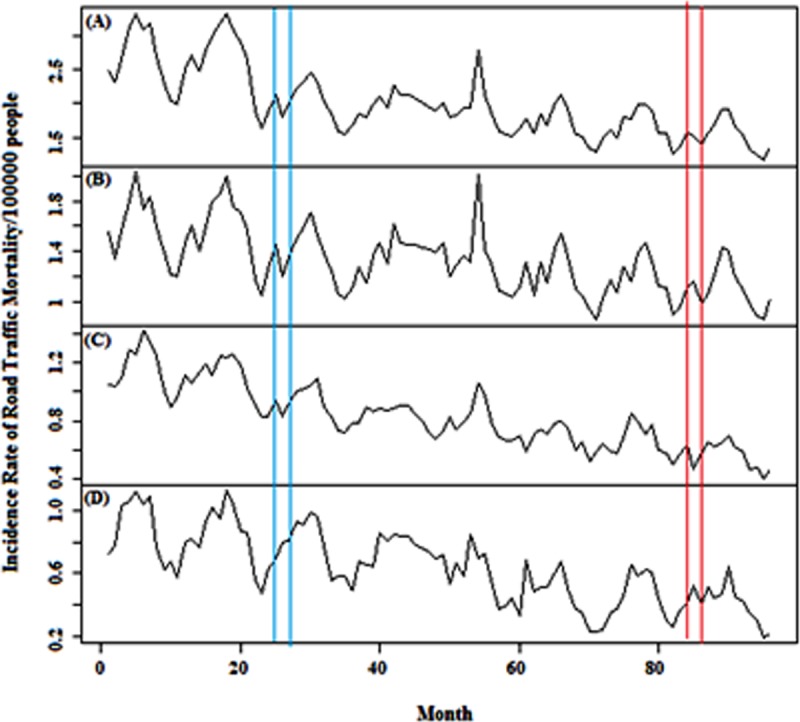
Road traffic law enforcement was implemented on 1st April 2011 (the first intervention) and traffic ticket fines have been increased on 1st March 2016 (the second intervention) in Iran. The aim of the current study was to evaluate the effects of the law enforcement on reduction in the incidence rate of road traffic fatality (IRRTF), the incidence rate of road traffic injuries (IRRTI) and the incidence rate of rural road traffic offenses (IRRRTO) in Iran.
Interrupted time series analysis was conducted to evaluate the impact of law enforcement and increased traffic tickets fines. Monthly data of fatality on urban, rural and local rural roads, injuries with respect to gender and traffic offenses namely speeding, illegal overtaking and tailgating were investigated separately for the period 2009-2016.
Results showed a reduction in the incidence rate of total road traffic fatality (IRTRTF), the incidence rate of rural road traffic fatality (IRRRTF) and the incidence rate of urban road traffic fatality (IRURTF) by -21.44% (-39.3 to -3.59, 95% CI), -21.25% (-31.32 to -11.88, 95% CI) and -26.75% (-37.49 to -16, 95% CI) through the first intervention which resulted in 0.383, 0.255 and 0.222 decline in casualties per 100 000 population, respectively. Conversely, no reduction was found in the incidence rate of local rural road traffic fatality (IRLRRTF) and the IRRTI. Second intervention was found to only affect the IRURTF with -26.75% (-37.49 to -16, 95% CI) which led to 0.222 casualties per 100 000 population. In addition, a reduction effect was observed on the incidence rate of illegal overtaking (IRIO) and the incidence rate of speeding (IRS) with -42.8% (-57.39 to -28.22, 95% CI) and -10.54% (-21.05 to -0.03, 95% CI which implied a decrease of 415.85 and 1003.8 in monthly traffic offenses per 100 000 vehicles), respectively.
Time series analysis suggests a decline in IRTRTF, IRRRTF, and IRURTF caused by the first intervention. However, the second intervention found to be only effective in IRURTF, IRIO, and IRS with the implication that future initiatives should be focused on modifying the implementation of the traffic interventions.
道路交通执法于 2011 年 4 月 1 日(第一次干预)实施,交通罚单罚款于 2016 年 3 月 1 日(第二次干预)增加。本研究的目的是评估执法对伊朗道路交通事故死亡率(IRRTF)、道路交通事故受伤率(IRRTI)和农村道路交通事故发生率(IRRRTO)降低的影响。
采用中断时间序列分析评估执法和增加交通罚单罚款的影响。分别对 2009-2016 年期间城市、农村和当地农村道路的死亡率、性别相关的伤害率以及超速、非法超车和尾随等交通违法行为的发生率进行了月度数据调查。
结果表明,总道路交通事故死亡率(IRTRTF)、农村道路交通事故死亡率(IRRRTF)和城市道路交通事故死亡率(IRURTF)分别下降了 21.44%(-39.3 至-3.59,95%CI)、21.25%(-31.32 至-11.88,95%CI)和 26.75%(-37.49 至-16,95%CI),导致每 10 万人的伤亡人数分别下降了 0.383、0.255 和 0.222。相反,地方农村道路交通事故死亡率(IRLRRTF)和 IRRTI 没有下降。第二次干预仅影响 IRURTF,下降了 26.75%(-37.49 至-16,95%CI),导致每 10 万人的伤亡人数减少了 0.222。此外,观察到非法超车发生率(IRIO)和超速发生率(IRS)的减少效果分别为-42.8%(-57.39 至-28.22,95%CI)和-10.54%(-21.05 至-0.03,95%CI),这意味着每月每 10 万辆车辆的交通违法行为减少了 415.85 和 1003.8。
时间序列分析表明,第一次干预导致 IRTRTF、IRRRTF 和 IRURTF 下降。然而,第二次干预仅对 IRURTF、IRIO 和 IRS 有效,这意味着未来的举措应侧重于修改交通干预措施的实施。