Wang Jian, Huang Ao, Wang Yu-Peng, Yin Yue, Fu Pei-Yao, Zhang Xin, Zhou Jian
Department of Liver Surgery & Transplantation, Liver Cancer Institute, Zhongshan Hospital, Fudan University; Key Laboratory of Carcinogenesis and Cancer Invasion (Fudan University), Ministry of Education, Shanghai 200032, China.
Institute of Biomedical Sciences, Fudan University, Shanghai 200032, China.
Ann Transl Med. 2020 Mar;8(5):237. doi: 10.21037/atm.2019.12.154.
To evaluate the feasibility of predicting tumor recurrence of hepatocellular carcinoma (HCC) patients after curative hepatectomy by detection of circulating tumor DNA (ctDNA) through droplet digital PCR (ddPCR).
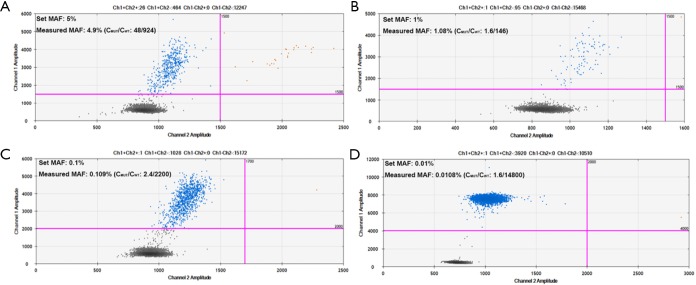
HCC patients receiving surgical treatment were enrolled and peripheral blood samples before and after hepatectomy were collected. Four hotspot mutants, -rs28934571 (c.747G>T), -rs1242535815 (c.1-124C>T), -rs121913412 (c.121A>G) and -rs121913407 (c.133T>C) were selected to detect ctDNA and the mutant allele frequency (MAF) was calculated accordingly. The matched peripheral blood mononuclear cells (PBMCs) were used for Sanger sequencing. The clinicopathologic information of the patients was retrospectively analyzed and the predictive abilities for postoperative recurrence of different clinicopathologic parameters and ctDNA were compared.
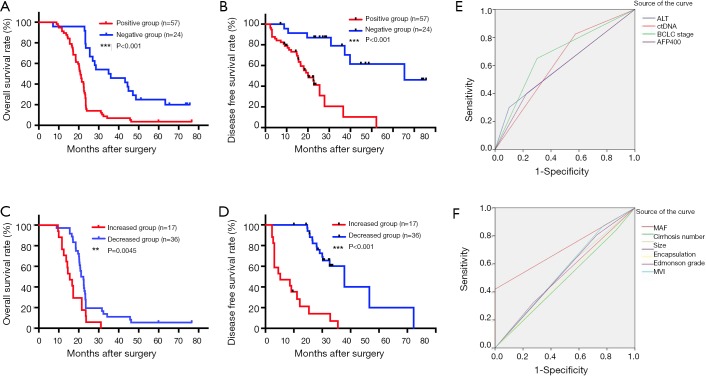
Eighty-one patients were enrolled and 70.4% (57/81) of them had detectable ctDNA before hepatectomy. Positive preoperative ctDNA status was related to larger tumor size (P=0.001), multiple tumor lesions (P=0.001), microvascular invasion (MVI) (P<0.001), advanced BCLC stages (P<0.001) and shorter disease free survival (DFS) (P<<0.001) and overall survival (OS) (P<<0.001). Multivariate analysis showed that detectable ctDNA was the independent risk factor for postoperative recurrence. Moreover, receiver operating characteristic (ROC) curves proved that ctDNA possessed the second largest area under the curve (AUC) in foretelling postoperative recurrence right after BCLC stage. For patients after surgery, the alterations of MAF were also correlated to postsurgical recurrence. Patients with increased MAF had more incidences of MVI (P=0.016) and recurrence (P<0.001). At the same time, Kaplan-Meier curves revealed a significant shorter DFS and OS in the patients with increased MAF compared to the patients with decreased MAF (P<0.001 and P=0.0045, respectively) and ROC curves showed MAF to possess the greatest AUC among all the indices for postoperative recurrence.
Digital droplets PCR assessment of specific gene combination through ctDNA possesses potential prognostic value in HCC patients undergoing surgical treatment.
通过液滴数字PCR(ddPCR)检测循环肿瘤DNA(ctDNA),评估肝细胞癌(HCC)患者根治性肝切除术后肿瘤复发的预测可行性。
纳入接受手术治疗的HCC患者,收集肝切除术前、后的外周血样本。选择4个热点突变位点,即-rs28934571(c.747G>T)、-rs1242535815(c.1-124C>T)、-rs121913412(c.121A>G)和-rs121913407(c.133T>C)检测ctDNA,并计算突变等位基因频率(MAF)。匹配的外周血单个核细胞(PBMC)用于Sanger测序。回顾性分析患者的临床病理信息,比较不同临床病理参数和ctDNA对术后复发的预测能力。
纳入81例患者,其中70.4%(57/81)在肝切除术前可检测到ctDNA。术前ctDNA阳性状态与肿瘤较大(P=0.001)、多发肿瘤病灶(P=0.001)、微血管侵犯(MVI)(P<0.001)、BCLC分期较晚(P<0.001)以及无病生存期(DFS)较短(P<<0.001)和总生存期(OS)较短(P<<0.001)相关。多因素分析显示,可检测到的ctDNA是术后复发的独立危险因素。此外,受试者工作特征(ROC)曲线证明,ctDNA在预测术后复发方面的曲线下面积(AUC)仅次于BCLC分期。对于术后患者,MAF的变化也与术后复发相关。MAF升高的患者MVI发生率更高(P=0.016),复发率更高(P<0.001)。同时,Kaplan-Meier曲线显示,MAF升高的患者与MAF降低的患者相比,DFS和OS显著缩短(分别为P<0.001和P=0.0045),ROC曲线显示MAF在所有术后复发指标中AUC最大。
通过ctDNA对特定基因组合进行数字液滴PCR评估对接受手术治疗的HCC患者具有潜在的预后价值。