Biophysics Graduate Group, University of California at Berkeley, Berkeley, CA 94720, USA.
Biophysics Graduate Group, University of California at Berkeley, Berkeley, CA 94720, USA; Department of Molecular and Cellular Biology, University of California at Berkeley, Berkeley, CA 94720, USA; Physics Department, University of California at Berkeley, Berkeley, CA 94720, USA.
Trends Biochem Sci. 2020 May;45(5):440-453. doi: 10.1016/j.tibs.2020.02.002. Epub 2020 Mar 5.
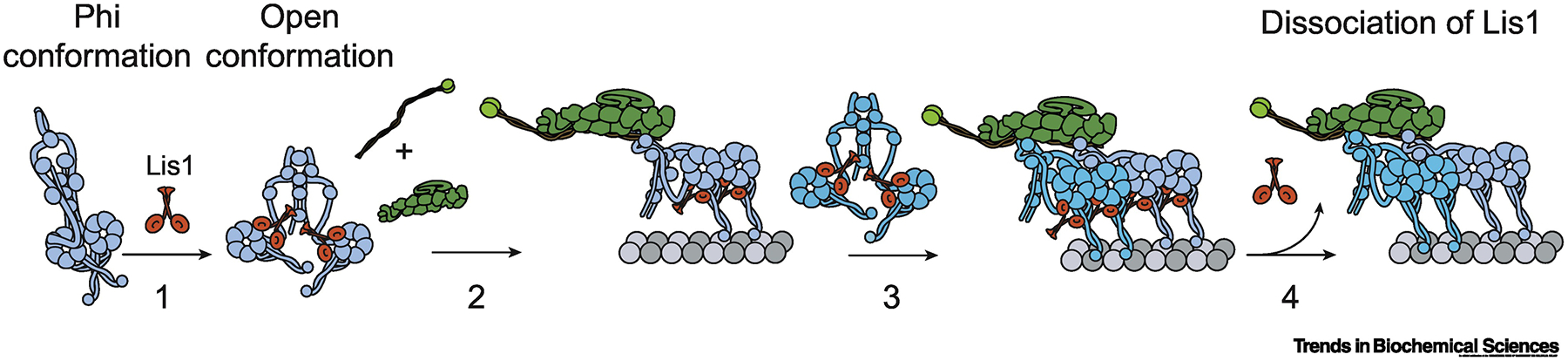
Cytoplasmic dynein is an AAA motor that drives the transport of many intracellular cargoes towards the minus end of microtubules (MTs). Previous in vitro studies characterized isolated dynein as an exceptionally weak motor that moves slowly and diffuses on an MT. Recent studies altered this view by demonstrating that dynein remains in an autoinhibited conformation on its own, and processive motility is activated when it forms a ternary complex with dynactin and a cargo adaptor. This complex assembles more efficiently in the presence of Lis1, providing an explanation for why Lis1 is a required cofactor for most cytoplasmic dynein-driven processes in cells. This review describes how dynein motility is activated and regulated by cargo adaptors and accessory proteins.
细胞质动力蛋白是一种 AAA 马达,可将许多细胞内货物朝着微管(MT)的负端运输。以前的体外研究将分离的动力蛋白描述为一种非常弱的马达,其移动缓慢且在 MT 上扩散。最近的研究改变了这种观点,表明动力蛋白自身保持自动抑制构象,当它与动力蛋白和货物衔接蛋白形成三元复合物时,就会发生连续运动。该复合物在 Lis1 的存在下更有效地组装,这解释了为什么 Lis1 是细胞中大多数细胞质动力蛋白驱动过程所必需的辅助因子。本文综述了货物衔接蛋白和辅助蛋白如何激活和调节动力蛋白的运动。