Khachfe Hussein H, Chahrour Mohamad, Sammouri Julie, Salhab Hamza, Makki Bassel Eldeen, Fares Mohamad
General Surgery, American University of Beirut Medical Center, Beirut, LBN.
Surgery, American University of Beirut Medical Center, Beirut, LBN.
Cureus. 2020 Mar 18;12(3):e7313. doi: 10.7759/cureus.7313.
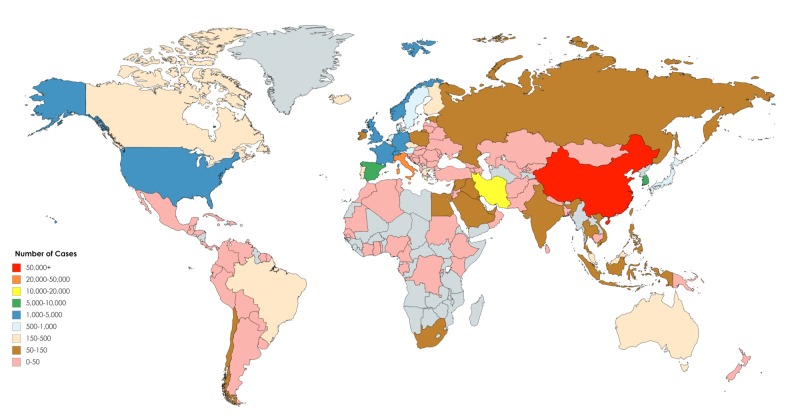
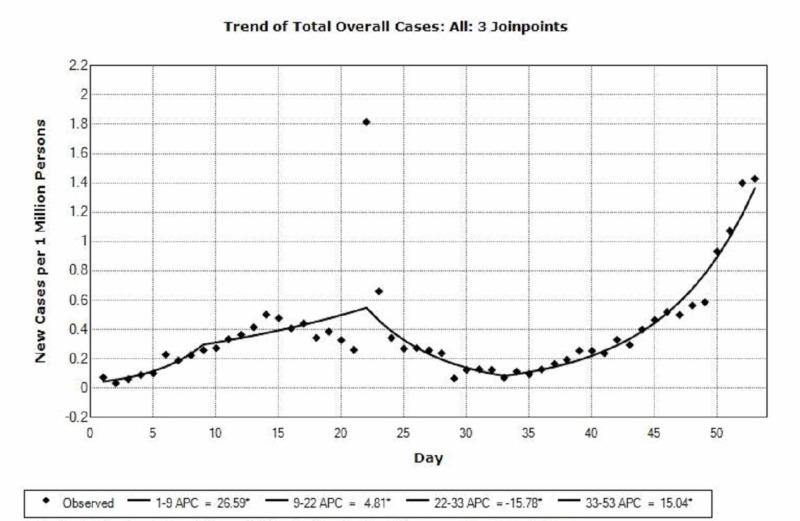
Background The outbreak of the novel coronavirus disease in 2019 (COVID-19) caused a major public health crisis worldwide and challenged healthcare systems across the six continents. The high infectivity of the disease led many governments to adopt strict regulations and measures with the aim of containing its spread. The purpose of this study is to assess the incidence, severity, and territorial expansion of COVID-19. Methods Data from the World Health Organization was screened, and COVID-19 situation reports were extracted from January 21 up till March 14 (inclusive). Our data included the total number of cases, total number of new cases, total number of cured cases, and total number of related deaths. Percentage change of cases over the days of our study were calculated using the Joinpoint regression, with a significance level set at greater than 0.05. Results The total number of COVID-19 cases reached 156,622, with 5,845 subsequent deaths. China, Italy, and Iran have the highest number of cases worldwide. During the first 22 days, the incidence rate of COVID-19 increased significantly to reach 1.81 cases per million persons (p<0.001). That was followed by a significant decrease over the next 11 days (p<0.001) to reach 0.071 cases per million persons. A steady rise then followed, which saw a significant increase in incidence rate to 1.429 cases per million persons (p<0.001). Percentages of death and cured cases varied across the different countries; nevertheless, death percentages have generally been decreasing since the start of the crisis. Conclusion Adopting precautionary regulations such as social isolation, increasing sanitation, and employing strict quarantine measures have proved to be beneficial in containing the virus. Further research needs to be conducted to help discover therapeutic modalities and improve outcomes.
背景 2019 年新型冠状病毒病(COVID-19)的爆发在全球引发了重大公共卫生危机,并对六大洲的医疗系统构成了挑战。该疾病的高传染性导致许多政府采取严格的法规和措施,旨在遏制其传播。本研究的目的是评估 COVID-19 的发病率、严重程度和地域扩展情况。方法 筛选了世界卫生组织的数据,并提取了 1 月 21 日至 3 月 14 日(含)的 COVID-19 情况报告。我们的数据包括病例总数、新增病例总数、治愈病例总数和相关死亡总数。使用 Joinpoint 回归计算我们研究期间病例数的百分比变化,显著性水平设定为大于 0.05。结果 COVID-19 病例总数达到 156,622 例,随后有 5,845 人死亡。中国、意大利和伊朗是全球病例数最多的国家。在最初的 22 天里,COVID-19 的发病率显著上升,达到每百万人 1.81 例(p<0.001)。随后在接下来的 11 天里显著下降(p<0.001),降至每百万人 0.071 例。接着是稳步上升,发病率显著增加至每百万人 1.429 例(p<0.001)。不同国家的死亡和治愈病例百分比各不相同;然而,自危机开始以来,死亡百分比总体上一直在下降。结论 事实证明,采取诸如社会隔离、加强卫生和实施严格检疫措施等预防法规有助于遏制病毒。需要进一步开展研究,以帮助发现治疗方法并改善治疗效果。