Research and Extension Center in Health Surveillance, State University of Feira de Santana, Feira de Santana, Brazil.
Department of Community Health, School of Medicine, Federal University of Ceará, Fortaleza, Brazil.
Am J Trop Med Hyg. 2020 Jun;102(6):1214-1216. doi: 10.4269/ajtmh.20-0276.
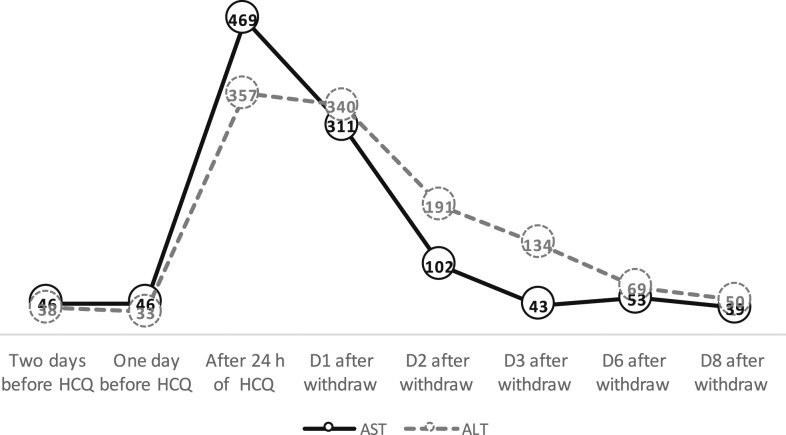
Hydroxychloroquine (HCQ) has been used for the treatment of novel coronavirus disease (COVID-19) cases. However, evidence of efficacy remains limited, and adverse events can be associated with its use. Here, we report a case of a patient with severe COVID-19 who, after being administered HCQ, exhibited a 10-fold increase in serum levels of transaminases, followed by a rapid decrease after HCQ was withdrawn. Considering the significantly increased use of HCQ during the COVID-19 pandemic, this case alerts us to the potential for HCQ to be associated with hepatotoxicity and the need to monitor liver function during HCQ therapy.
羟氯喹(HCQ)已被用于治疗新型冠状病毒病(COVID-19)病例。然而,其疗效的证据仍然有限,并且使用时可能会出现不良反应。在这里,我们报告了一例重症 COVID-19 患者,在给予 HCQ 后,其血清转氨酶水平升高了 10 倍,随后在停用 HCQ 后迅速下降。考虑到 COVID-19 大流行期间 HCQ 的使用显著增加,该病例提醒我们 HCQ 可能与肝毒性有关,需要在 HCQ 治疗期间监测肝功能。