Kaushik Aman Chandra, Mehmood Aamir, Wei Dong-Qing, Dai Xiaofeng
Wuxi School of Medicine, Jiangnan University, Wuxi, China.
School of Life Sciences and Biotechnology, Shanghai Jiao Tong University, Shanghai, China.
Front Mol Biosci. 2020 Apr 7;7:47. doi: 10.3389/fmolb.2020.00047. eCollection 2020.
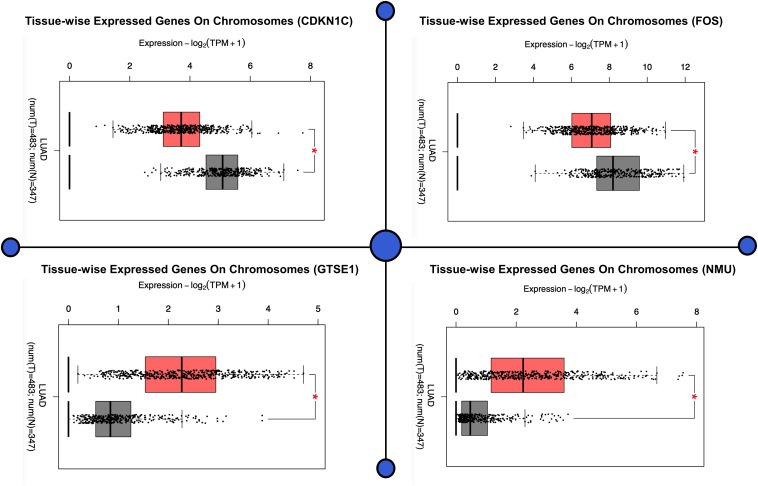
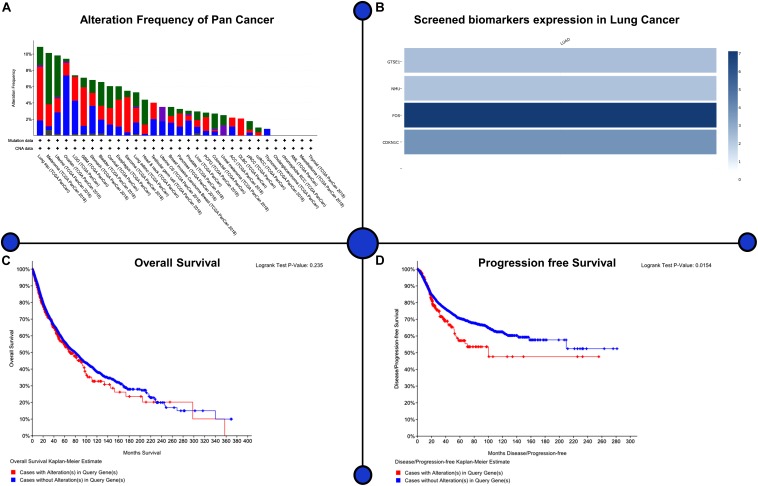
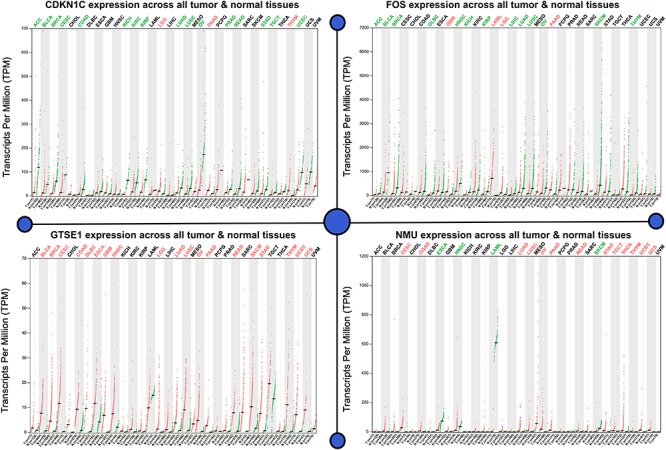
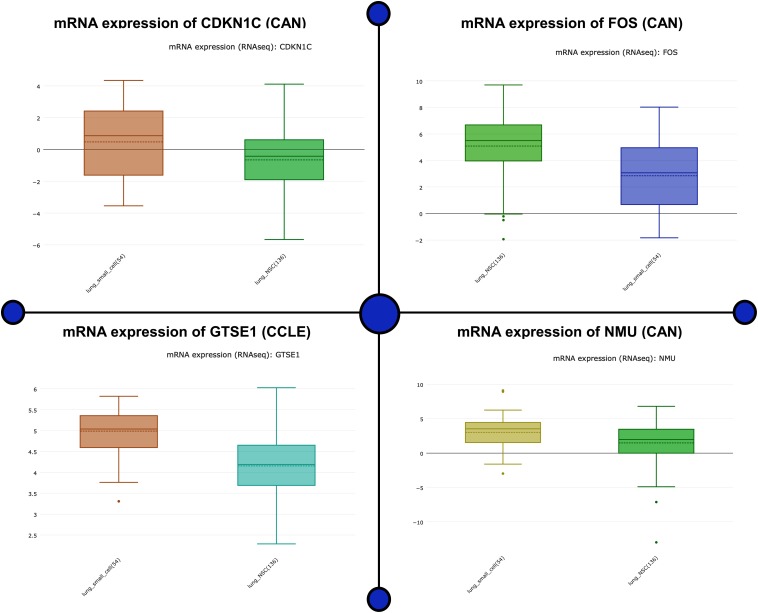
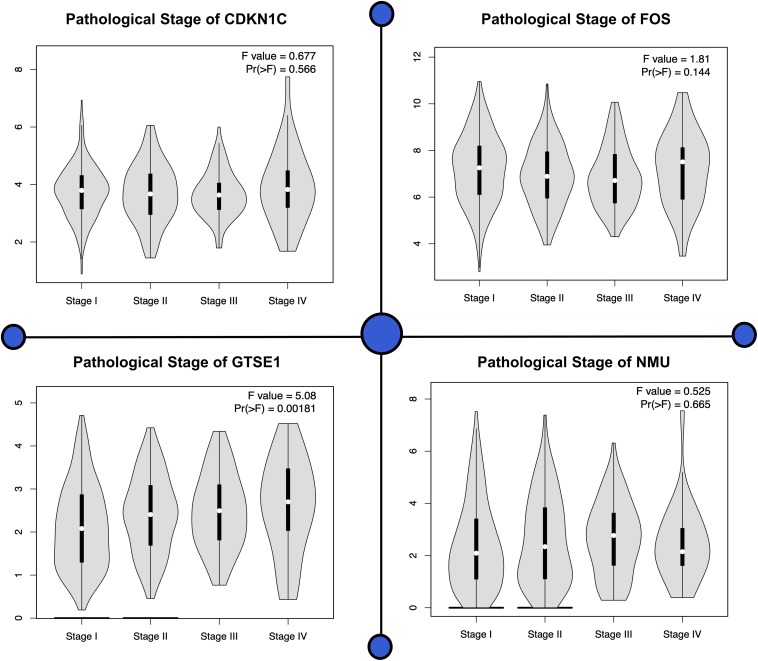
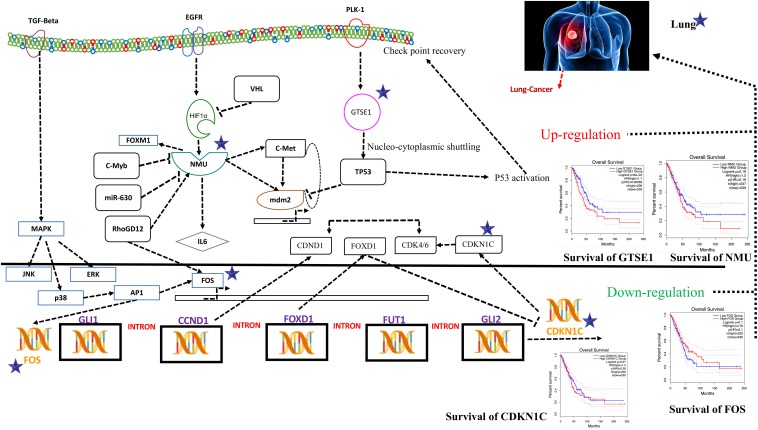
This study aims to achieve a clearer and stronger understanding of all the mechanisms involved in the occurrence as well as in the progression of lung cancer along with discovering trustworthy prognostic markers. We combined four gene expression profiles (GSE19188, GSE19804, GSE101929, and GSE18842) from the GEO database and screened the commonly differentially expressed genes (CDEGs). We performed differentially expressed group analysis on CDEGs, alteration and mutational analysis, and expression level verification of core differential genes. Systems biology discoveries in our examination are predictable with past reports. Curiously, our examination revealed that screened biomarker adjustments, for the most part, coexist in lung cancer. After screening 952 CDEGs, we found that the up-regulation of neuromedin U (NMU) and GTSE1 in the case of lung cancer is related to poor prognosis. On the other hand, FOS CDKN1C expression is associated with poor prognosis and is responsible for the down-regulation of CDKN1C and FOS. Changes in these qualities are on free pathways to lung cancer and are not usually of combined quality variety. Even though biomarkers were related to both survival occasions in our examination, it gives us another point of view while playing out the investigation of hereditary changes and clinical highlights employing information mining. Based on our results, we found potential and prospective clinical applications in GTSE1, NMU, FOS, and CDKN1C to act as prognostic markers in case of lung cancer.
本研究旨在更清晰、更深入地了解肺癌发生及进展过程中涉及的所有机制,并发现可靠的预后标志物。我们整合了来自基因表达综合数据库(GEO)的四个基因表达谱(GSE19188、GSE19804、GSE101929和GSE18842),并筛选出共同差异表达基因(CDEGs)。我们对CDEGs进行了差异表达组分析、改变和突变分析以及核心差异基因的表达水平验证。我们研究中的系统生物学发现与过去的报道一致。奇怪的是,我们的研究表明,筛选出的生物标志物变化大多在肺癌中共存。在筛选出952个CDEGs后,我们发现肺癌患者中神经降压素U(NMU)和GTSE1的上调与预后不良有关。另一方面,FOS和CDKN1C的表达与预后不良有关,并且导致CDKN1C和FOS的下调。这些基因的变化在肺癌的发生途径中是独立的,通常不是联合基因变异。尽管在我们的研究中生物标志物与两种生存情况都相关,但在利用数据挖掘进行遗传变化和临床特征研究时,它为我们提供了另一个视角。基于我们的研究结果,我们发现GTSE1、NMU、FOS和CDKN1C在肺癌中作为预后标志物具有潜在的临床应用前景。