Clinic of Small Animal Internal Medicine, Centre for Clinical Veterinary Medicine, Ludwig-Maximilians-University, Munich, Germany.
Gastrointestinal Laboratory, Department of Small Animal Clinical Sciences, College of Veterinary Medicine and Biomedical Sciences, Texas A&M University, College Station, Texas, USA.
J Vet Intern Med. 2020 May;34(3):1166-1176. doi: 10.1111/jvim.15775. Epub 2020 Apr 23.
Despite limited evidence of efficacy, antibiotic treatment is still frequently prescribed in dogs with uncomplicated acute diarrhea (AD).
To assess whether amoxicillin-clavulanic acid has a clinical benefit, an effect on the fecal microbiome, and the proportion of amoxicillin-resistant Escherichia coli in dogs with AD.
Sixteen dogs with AD of <3 days duration.
Prospective, placebo-controlled, double-blinded study. Clinical scores were compared between client-owned dogs randomly assigned to an antibiotic (AG) or a placebo (PG) group. The intestinal microbiome was analyzed using quantitative PCR assays. Amoxicillin-resistant fecal E. coli were assessed semiquantitatively with microbiological methods.
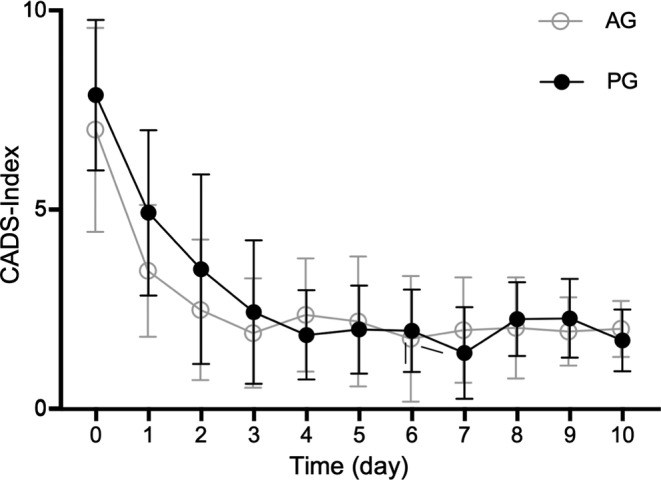
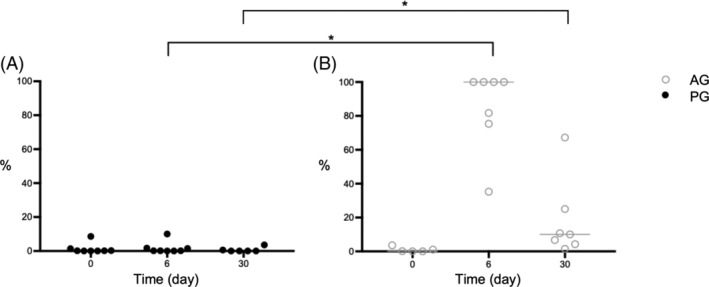
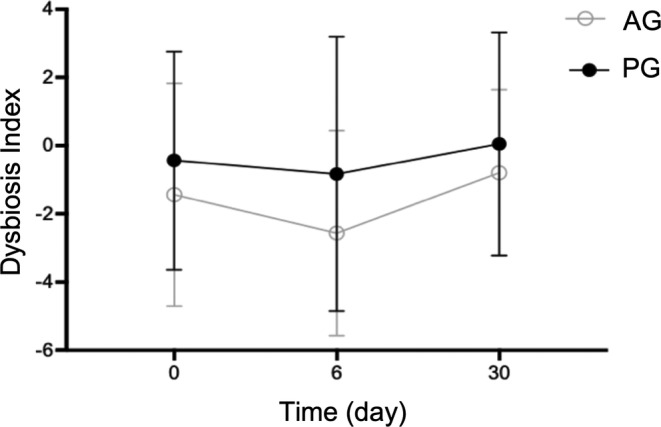
There was no difference in clinical recovery between treated dogs or controls (CADS index day 10: AG group median: 2 (range: 1-3; CI [1.4; 2.6]); PG group median: 1.6 (range: 1-3; CI [1.1; 2.4]); P > .99). All dogs gained normal clinical scores (CADS index ≤3) after 1 to 6 days (median 2 days) after presentation. There was no significant difference in the fecal dysbiosis index (during treatment: AG mean -2.6 (SD 3.0; CI [-5.1; 0.0]); PG mean -0.8 (SD 4.0; CI [-4.2; 2.5]; P > .99) or its bacterial taxa. The proportion of resistant fecal E. coli increased (to median: 100%; range: 35%-100%) during treatment with amoxicillin-clavulanic acid and was still increased (median: 10%; range 2%-67%) 3 weeks after treatment, both of which were significantly higher proportions than in the placebo group for both time points (during treatment AG median 100% versus PG median 0.2% (P < .001); after treatment AG median 10% versus PG median 0.0% (P = .002)).
Our study suggests that treatment with amoxicillin-clavulanic acid confers no clinical benefit to dogs with AD, but predisposes the development of amoxicillin-resistant E. coli, which persist for as long as 3 weeks after treatment. These findings support international guideline recommendations that dogs with diarrhea should not be treated with antimicrobials unless there are signs of sepsis.
尽管抗生素治疗的疗效有限,但在患有单纯性急性腹泻(AD)的犬中,抗生素治疗仍经常被开处。
评估阿莫西林克拉维酸在 AD 犬中的临床获益、对粪便微生物组的影响,以及产酶耐药大肠埃希菌的比例。
16 只患有持续时间<3 天的 AD 的犬。
前瞻性、安慰剂对照、双盲研究。通过比较随机分配至抗生素(AG)或安慰剂(PG)组的患犬的临床评分,评估临床恢复情况。使用定量 PCR 检测分析肠道微生物组。使用微生物学方法半定量评估产酶耐药粪便大肠埃希菌。
治疗犬与对照组之间的临床恢复情况无差异(CADS 指数第 10 天:AG 组中位数为 2(范围:1-3;CI [1.4;2.6]);PG 组中位数为 1.6(范围:1-3;CI [1.1;2.4]);>.99)。所有犬在就诊后 1 至 6 天(中位数 2 天)内临床评分均恢复正常(CADS 指数≤3)。粪便失调指数无显著差异(治疗期间:AG 组均值-2.6(SD 3.0;CI [-5.1;0.0]);PG 组均值-0.8(SD 4.0;CI [-4.2;2.5]);>.99)或其细菌分类群。在接受阿莫西林克拉维酸治疗期间,产酶耐药粪便大肠埃希菌的比例增加(中位数:100%;范围:35%-100%),且在治疗后 3 周仍持续增加(中位数:10%;范围 2%-67%),在这两个时间点,产酶耐药粪便大肠埃希菌的比例均显著高于安慰剂组(治疗期间 AG 中位数 100%比 PG 中位数 0.2%(P<0.001);治疗后 AG 中位数 10%比 PG 中位数 0.0%(P=0.002))。
本研究表明,阿莫西林克拉维酸治疗对 AD 犬无临床获益,但易导致产酶耐药大肠埃希菌的发生,且该耐药菌在治疗后 3 周仍持续存在。这些发现支持国际指南建议,除非存在脓毒症迹象,否则不应使用抗菌药物治疗腹泻犬。