de Souza Renata Bacila Morais Dos Santos, Fernandes Eduarda Lorena, Araújo Santos Lorenna Nicole, da Silva Lima Laiane, Silva Heloísa Lara, Putarov Thaila Cristina, de Oliveira Simone Gisele, Félix Ananda Portella
Department of Animal Science, Federal University of Paraná, Curitiba, Paraná, Brazil.
Biorigin (Açucareira Quatá S.A.), Lençóis Paulistas, São Paulo, Brazil.
PLoS One. 2025 Sep 8;20(9):e0331843. doi: 10.1371/journal.pone.0331843. eCollection 2025.
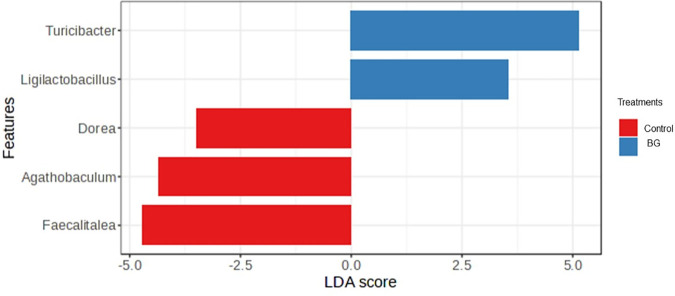
This study aimed to assess the impact of yeast beta-1,3/1,6-glucans (BG) on apparent digestibility coefficients (ADC) of nutrients, intestinal fermentative metabolites, fecal microbiota profile, and immune and antioxidant variables in puppies before and after surgical challenge. Two treatments were evaluated: control, without, and test, with oral supplementation of 65 mg/kg body weight/day of purified BG from Saccharomyces cerevisiae for 120 days. For this, 16 growing Beagle dogs were distributed in a completely randomized design (n = 8/treatment). On day 31, dogs were submitted to spay or neutering surgery. Diet ADC and fecal characteristics analyses were performed on days 55-60. Fecal (days 0, 15, 30, 34, and 60) and blood (days 0, 30, 34, and 60) samples were collected to evaluate intestinal fermentative metabolites, fecal IgA and microbiota, intestinal permeability, and immune and antioxidant variables. On day 80, all dogs were vaccinated for rabies and blood samples were collected on day 120 to determine antibody titers. The supplementation of BG promoted an increase in fecal IgA concentrations on day 15 (P < 0.05) and an increase in fecal concentrations of butyrate (P < 0.05) when day 30 minus day 0 were compared. Dogs of the BG group presented higher fecal concentrations of serotonin (day 15), spermidine (days 15, 30, and 34), and a reduction in tyramine, histamine, and cadaverine on day 60 (P < 0.001). BG consumption promoted an increase in richness and a clear differentiation in the fecal microbiota profile on days 34 and 60 (P < 0.05). BG group also presented an increase in fecal Faecalibacterium, Blautia, and Turicibacter on day 34 (P < 0.05). Reduced glutathione and catalase activities were higher in the BG group (P < 0.05), regardless of the day. In conclusion, the supplementation of BG does not alter the ADC of nutrients, beneficially modulates the intestinal functionality, and stimulates the activity of antioxidant enzymes in growing dogs submitted to a surgical challenge.
本研究旨在评估酵母β-1,3/1,6-葡聚糖(BG)对手术应激前后幼犬营养物质表观消化率(ADC)、肠道发酵代谢产物、粪便微生物群谱以及免疫和抗氧化指标的影响。评估了两种处理方式:对照组,不添加;试验组,口服补充65毫克/千克体重/天的酿酒酵母纯化BG,持续120天。为此,将16只生长中的比格犬采用完全随机设计进行分组(每组n = 8只)。在第31天,对犬进行绝育手术。在第55 - 60天进行日粮ADC和粪便特征分析。收集粪便样本(第0、15、30、34和60天)和血液样本(第0、30、34和60天),以评估肠道发酵代谢产物、粪便IgA和微生物群、肠道通透性以及免疫和抗氧化指标。在第80天,所有犬接种狂犬病疫苗,并在第120天采集血液样本以测定抗体滴度。补充BG可使第15天粪便IgA浓度升高(P < 0.05),并且当比较第30天减去第0天的情况时,粪便丁酸盐浓度升高(P < 0.05)。BG组犬在第15天粪便中血清素浓度较高,在第15、30和34天精胺浓度较高,并且在第60天酪胺、组胺和尸胺浓度降低(P < 0.001)。食用BG可使第34天和60天粪便微生物群的丰富度增加且菌群谱明显分化(P < 0.05)。BG组在第34天粪便中粪杆菌属、布劳特氏菌属和Turicibacter菌属也有所增加(P < 0.05)。无论在哪一天,BG组的还原型谷胱甘肽和过氧化氢酶活性均较高(P < 0.05)。总之,补充BG不会改变营养物质的ADC,有益地调节肠道功能,并刺激接受手术应激的生长犬体内抗氧化酶的活性。