Wintner Oren, Hirsch-Attas Nivi, Schlossberg Miriam, Brofman Fani, Friedman Roy, Kupervaser Meital, Kitsberg Danny, Buxboim Amnon
Department of Cell and Developmental Biology The Alexander Silberman Institute of Life Sciences The Hebrew University of Jerusalem Jerusalem 9190401 Israel.
Alexander Grass Center for Bioengineering The Rachel and Selim Benin School of Computer Science and Engineering Jerusalem 9190416 Israel.
Adv Sci (Weinh). 2020 Mar 5;7(8):1901222. doi: 10.1002/advs.201901222. eCollection 2020 Apr.
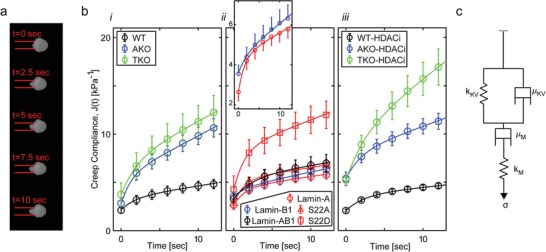
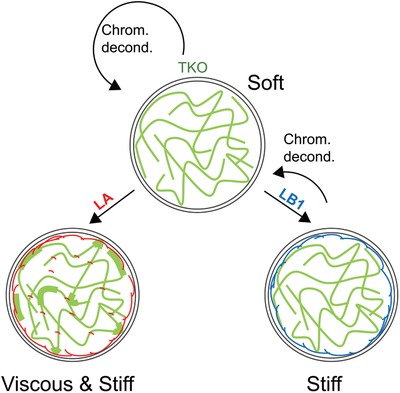
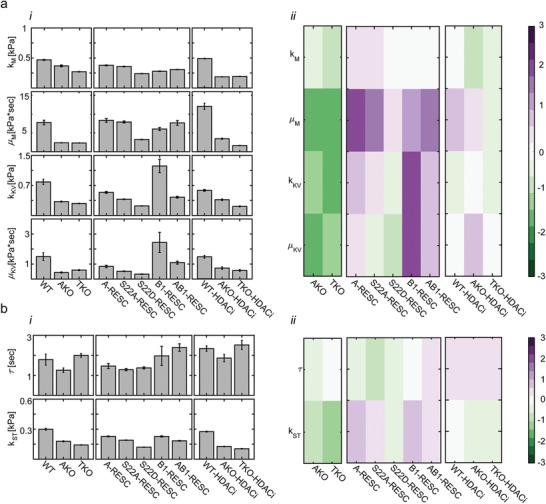
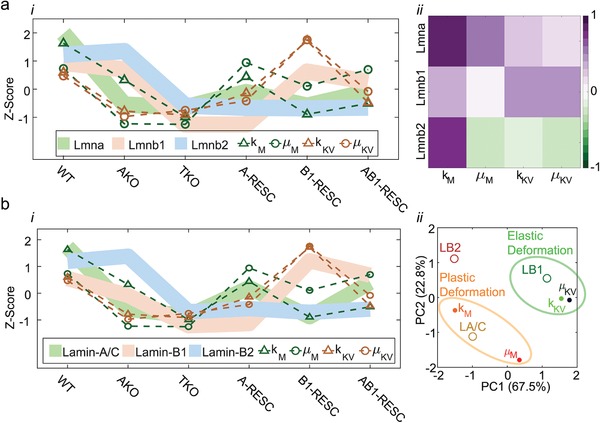
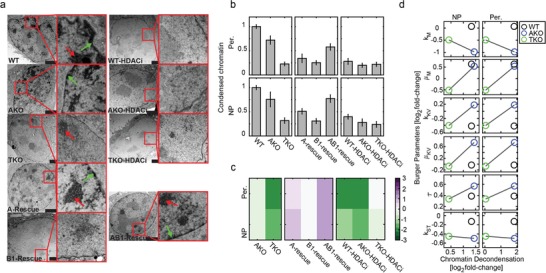
The cell nucleus is constantly subjected to externally applied forces. During metazoan evolution, the nucleus has been optimized to allow physical deformability while protecting the genome under load. Aberrant nucleus mechanics can alter cell migration across narrow spaces in cancer metastasis and immune response and disrupt nucleus mechanosensitivity. Uncovering the mechanical roles of lamins and chromatin is imperative for understanding the implications of physiological forces on cells and nuclei. Lamin-knockout and -rescue fibroblasts and probed nucleus response to physiologically relevant stresses are generated. A minimal viscoelastic model is presented that captures dynamic resistance across different cell types, lamin composition, phosphorylation states, and chromatin condensation. The model is conserved at low and high loading and is validated by micropipette aspiration and nanoindentation rheology. A time scale emerges that separates between dominantly elastic and dominantly viscous regimes. While lamin-A and lamin-B1 contribute to nucleus stiffness, viscosity is specified mostly by lamin-A. Elastic and viscous association of lamin-B1 and lamin-A is supported by transcriptional and proteomic profiling analyses. Chromatin decondensation quantified by electron microscopy softens the nucleus unless lamin-A is expressed. A mechanical framework is provided for assessing nucleus response to applied forces in health and disease.
细胞核不断受到外部施加的力。在后生动物进化过程中,细胞核经过优化,既能在承受负荷时保护基因组,又能具备物理可变形性。异常的细胞核力学特性会改变癌细胞转移和免疫反应中细胞在狭窄空间内的迁移,并破坏细胞核的机械敏感性。揭示核纤层蛋白和染色质的机械作用对于理解生理力对细胞和细胞核的影响至关重要。我们构建了核纤层蛋白敲除和挽救的成纤维细胞,并探究了细胞核对生理相关应激的反应。我们提出了一个最小粘弹性模型,该模型能够捕捉不同细胞类型、核纤层蛋白组成、磷酸化状态和染色质凝聚状态下的动态阻力。该模型在低负荷和高负荷下均保持不变,并通过微量移液器吸液和纳米压痕流变学进行了验证。一个时间尺度出现了,它区分了主要为弹性和主要为粘性的状态。虽然核纤层蛋白A和核纤层蛋白B1对细胞核硬度有贡献,但粘性主要由核纤层蛋白A决定。转录组和蛋白质组分析支持了核纤层蛋白B1和核纤层蛋白A的弹性和粘性关联。通过电子显微镜定量的染色质解聚使细胞核变软,除非表达核纤层蛋白A。我们提供了一个力学框架,用于评估健康和疾病状态下细胞核对施加力的反应。