Mulens-Arias Vladimir, Rojas José Manuel, Barber Domingo F
Department of Immunology and Oncology, and NanoBiomedicine Initiative, Centro Nacional de Biotecnología (CNB)-CSIC, Darwin 3, Cantoblanco, 28049 Madrid, Spain.
Animal Health Research Center (CISA-INIA), Instituto Nacional de Investigación y Tecnología Agraria y Alimentaria, Valdeolmos, 28049 Madrid, Spain.
Nanomaterials (Basel). 2020 Apr 27;10(5):837. doi: 10.3390/nano10050837.
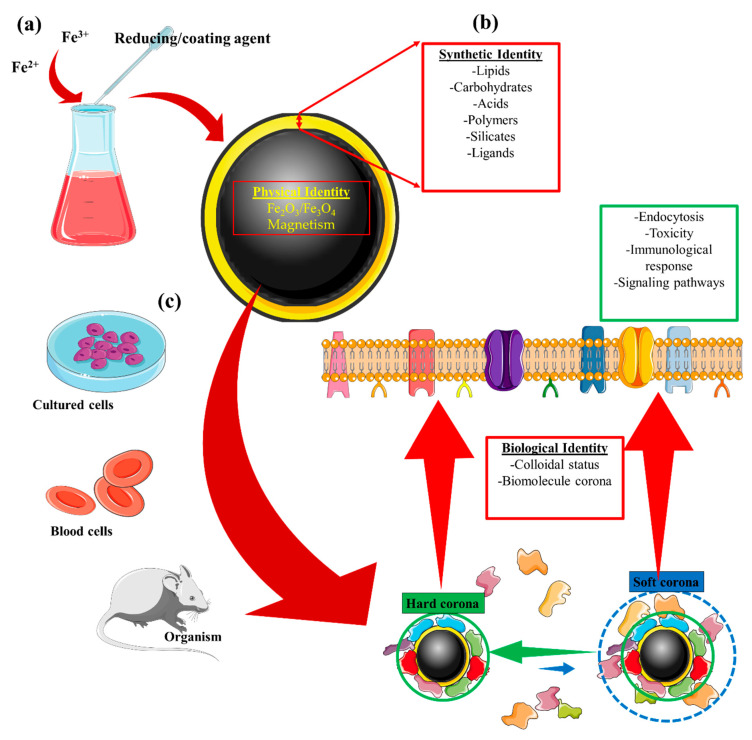
Over the last 20 years, iron oxide nanoparticles (IONPs) have been the subject of increasing investigation due to their potential use as theranostic agents. Their unique physical properties (physical identity), ample possibilities for surface modifications (synthetic identity), and the complex dynamics of their interaction with biological systems (biological identity) make IONPs a unique and fruitful resource for developing magnetic field-based therapeutic and diagnostic approaches to the treatment of diseases such as cancer. Like all nanomaterials, IONPs also interact with different cell types in vivo, a characteristic that ultimately determines their activity over the short and long term. Cells of the mononuclear phagocytic system (macrophages), dendritic cells (DCs), and endothelial cells (ECs) are engaged in the bulk of IONP encounters in the organism, and also determine IONP biodistribution. Therefore, the biological effects that IONPs trigger in these cells (biological identity) are of utmost importance to better understand and refine the efficacy of IONP-based theranostics. In the present review, which is focused on anti-cancer therapy, we discuss recent findings on the biological identities of IONPs, particularly as concerns their interactions with myeloid, endothelial, and tumor cells. Furthermore, we thoroughly discuss current understandings of the basic molecular mechanisms and complex interactions that govern IONP biological identity, and how these traits could be used as a stepping stone for future research.
在过去20年里,氧化铁纳米颗粒(IONPs)因其作为治疗诊断剂的潜在用途而受到越来越多的研究。它们独特的物理性质(物理特性)、丰富的表面修饰可能性(合成特性)以及与生物系统相互作用的复杂动态过程(生物特性),使IONPs成为开发基于磁场的治疗和诊断方法以治疗癌症等疾病的独特且富有成效的资源。与所有纳米材料一样,IONPs在体内也会与不同类型的细胞相互作用,这一特性最终决定了它们在短期和长期内的活性。单核吞噬系统(巨噬细胞)、树突状细胞(DCs)和内皮细胞(ECs)的细胞在生物体中大量接触IONPs,也决定了IONPs的生物分布。因此,IONPs在这些细胞中引发的生物学效应(生物特性)对于更好地理解和优化基于IONP的治疗诊断学的疗效至关重要。在本综述中,我们聚焦于抗癌治疗,讨论了关于IONPs生物特性的最新发现,特别是它们与髓样细胞、内皮细胞和肿瘤细胞的相互作用。此外,我们深入探讨了目前对支配IONP生物特性的基本分子机制和复杂相互作用的理解,以及这些特性如何能够作为未来研究的垫脚石。