Department of Microbiology, College of Medicine, The Catholic University of Korea, Seoul, Republic of Korea.
Chungbuk Veterinary Service Laboratory, Chungju, Republic of Korea.
Sci Rep. 2020 Apr 29;10(1):7241. doi: 10.1038/s41598-020-64125-x.
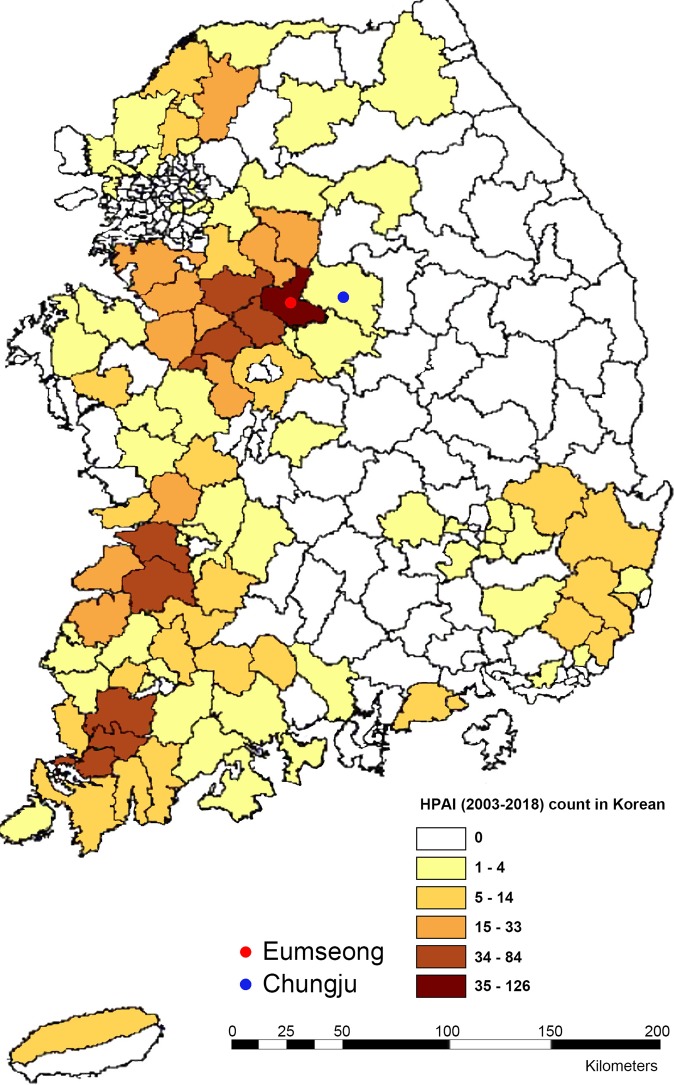
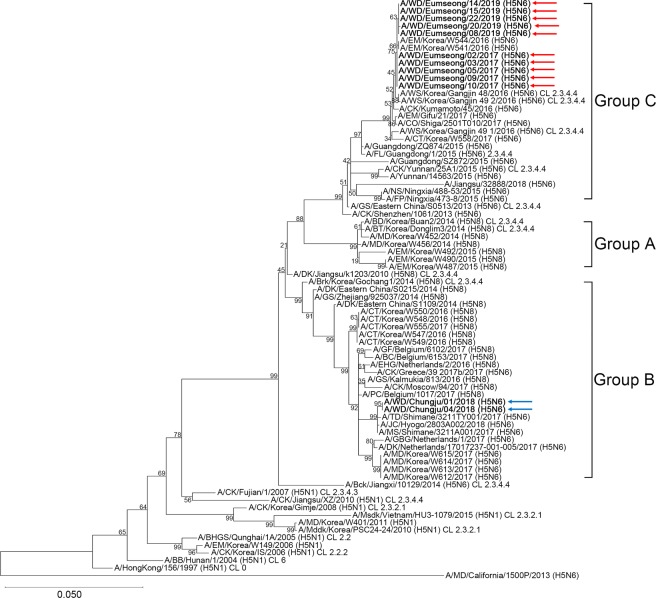
The outbreaks of the highly pathogenic avian influenza (HPAI) in 2016-2017 and 2017-2018, caused by novel reassortant clade 2.3.4.4 H5N6 viruses, resulted in the loss of one billion birds in South Korea. Here, we characterized the H5N6 viruses isolated from wild birds in South Korea from December 2017 to August 2019 by next-generation sequencing. The results indicated that clade 2.3.4.4 H5N6 viruses isolated in 2017 and 2019 shared almost identical nucleotide sequences with the HPAI H5N6 viruses from 2016 in South Korea. This repeated detection of evolutionarily identical H5N6 viruses in same region for more than three years may suggest indigenization of the HPAI H5N6 virus in South Korea. Phylogenetic analysis demonstrated that the clade 2.3.4.4 H5N6 viruses isolated in 2017 and 2019 were evolutionarily distinct from those isolated in 2018. Molecular analysis revealed that the H5N6 viruses isolated in 2017 and 2019 had features associated with an increased risk of human infection (e.g. a deletion at position 133 of HA and glutamic acid residue at position 92 of NS1). Overall, these genomic features of HPAI H5N6 viruses highlight the need for continuous monitoring of avian influenza viruses in wild migratory birds as well as in domestic birds.
2016-2017 年和 2017-2018 年,新型重配 clade 2.3.4.4 H5N6 病毒引发高致病性禽流感(HPAI)疫情,导致韩国一亿只禽类死亡。在此,我们通过下一代测序技术对韩国 2017 年 12 月至 2019 年 8 月期间从野生鸟类中分离出的 H5N6 病毒进行了特征分析。结果表明,2017 年和 2019 年分离出的 clade 2.3.4.4 H5N6 病毒与韩国 2016 年的 HPAI H5N6 病毒几乎具有相同的核苷酸序列。在同一地区连续三年以上检测到进化上相同的 H5N6 病毒,这可能表明韩国的 HPAI H5N6 病毒已本土化。系统发育分析表明,2017 年和 2019 年分离的 clade 2.3.4.4 H5N6 病毒与 2018 年分离的病毒在进化上存在差异。分子分析显示,2017 年和 2019 年分离的 H5N6 病毒具有与人感染风险增加相关的特征(例如 HA 第 133 位缺失和 NS1 第 92 位谷氨酸残基)。总之,这些 HPAI H5N6 病毒的基因组特征强调了需要对野生候鸟和家禽中的禽流感病毒进行持续监测。