Opriessnig Tanja, Forde Taya, Shimoji Yoshihiro
The Roslin Institute and The Royal (Dick) School of Veterinary Studies, University of Edinburgh, Midlothian, United Kingdom.
Department of Veterinary Diagnostic and Production Animal Medicine, College of Veterinary Medicine, Iowa State University, Ames, IA, United States.
Front Vet Sci. 2020 Apr 15;7:174. doi: 10.3389/fvets.2020.00174. eCollection 2020.
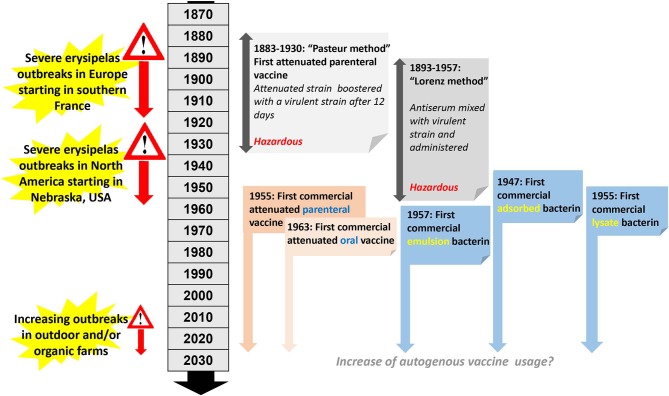
spp. comprise a group of small Gram-positive bacteria that can infect a variety of hosts including mammals, fish, birds, reptiles and insects. Among the eight species that have been described to date, only plays a major role in farmed livestock where it is the causative agent of erysipelas. also has zoonotic potential and can cause erysipeloid in humans with a clear occupational link to meat and fish industries. While there are 28 known serovars, over 80% of identified isolates belong to serovars 1 or 2. Vaccines to protect pigs against first became available in 1883 as a response to an epizootic of swine erysipelas in southern France. The overall vaccine repertoire was notably enlarged between the 1940s and 1960s following major outbreaks of swine erysipelas in the Midwest USA and has changed little since. Traditionally, serovar 1a or 2 isolates were inactivated (bacterins) or attenuated and these types of vaccines are still used today on a global basis. vaccines are most commonly used in pigs, poultry, and sheep where the bacterium can cause considerable economic losses. In addition, erysipelas vaccination is also utilized in selected vulnerable susceptible populations, such as marine mammals in aquariums, which are commonly vaccinated at regular intervals. While commercially produced erysipelas vaccines appear to provide good protection against clinical disease, in recent years there has been an increase in perceived vaccine failures in farmed animals, especially in organic outdoor operations. Moreover, clinical erysipelas outbreaks have been reported in animal populations not previously considered at risk. This has raised concerns over a possible lack of vaccine protection across various production species. This review focuses on summarizing the history and the present status of vaccines, the current knowledge on protection including surface antigens, and also provides an outlook into future directions for vaccine development.
猪丹毒杆菌属包含一组革兰氏阳性小细菌,可感染包括哺乳动物、鱼类、鸟类、爬行动物和昆虫在内的多种宿主。在迄今已描述的8个物种中,只有猪丹毒杆菌在养殖家畜中起主要作用,它是猪丹毒的病原体。猪丹毒杆菌也有人畜共患病的潜力,可在与肉类和渔业有明确职业关联的人群中引起类丹毒。虽然已知有28种猪丹毒杆菌血清型,但超过80%的已鉴定分离株属于血清型1或2。用于保护猪免受猪丹毒杆菌感染的疫苗于1883年首次问世,以应对法国南部的猪丹毒疫情。在20世纪40年代至60年代美国中西部发生猪丹毒大爆发后,疫苗种类显著增加,此后变化不大。传统上,血清型1a或2的猪丹毒杆菌分离株被灭活(制成菌苗)或减毒,这类疫苗至今仍在全球范围内使用。猪丹毒杆菌疫苗最常用于猪、家禽和绵羊,在这些动物中该细菌可造成相当大的经济损失。此外,猪丹毒疫苗也用于选定的易感染群体,如水族馆中的海洋哺乳动物,并通常定期进行接种。虽然商业生产的猪丹毒杆菌疫苗似乎能有效预防临床疾病,但近年来养殖动物中疫苗失效的情况有所增加,尤其是在有机户外养殖中。此外,在以前未被视为有风险的动物群体中也报告了猪丹毒临床疫情。这引发了人们对各种生产物种可能缺乏疫苗保护的担忧。本综述着重总结猪丹毒杆菌疫苗的历史和现状、目前关于包括表面抗原在内的保护机制的知识,并展望疫苗开发的未来方向。