Ruan Fang, Wang Yun-Fei, Chai Yun
Department of Gynecology, Affiliated Hospital of Jining Medical College, Jining, Shandong, China.
Technol Cancer Res Treat. 2020 Jan-Dec;19:1533033820914983. doi: 10.1177/1533033820914983.
This study aimed to investigate the diagnostic values of microRNA-21, microRNA-124, and macrophage colony-stimulating factor in patients with cervical cancer.
A total of 68 patients with cervical cancer admitted in our hospital (cervical cancer group) and 57 healthy individuals undergoing physical examinations (healthy group, also control group) were enrolled in this study. The expression of serum microRNA-21 and microRNA-124 was detected by quantitative reverse transcription polymerase chain reaction. The expression of serum macrophage colony-stimulating factor was detected by enzyme-linked immunosorbent assay. The diagnostic values of microRNA-21, microRNA-124, and macrophage colony-stimulating factor in cervical cancer were analyzed. The correlations between the expression of microRNA-21 and microRNA-124 with that of macrophage colony-stimulating factor were also analyzed.
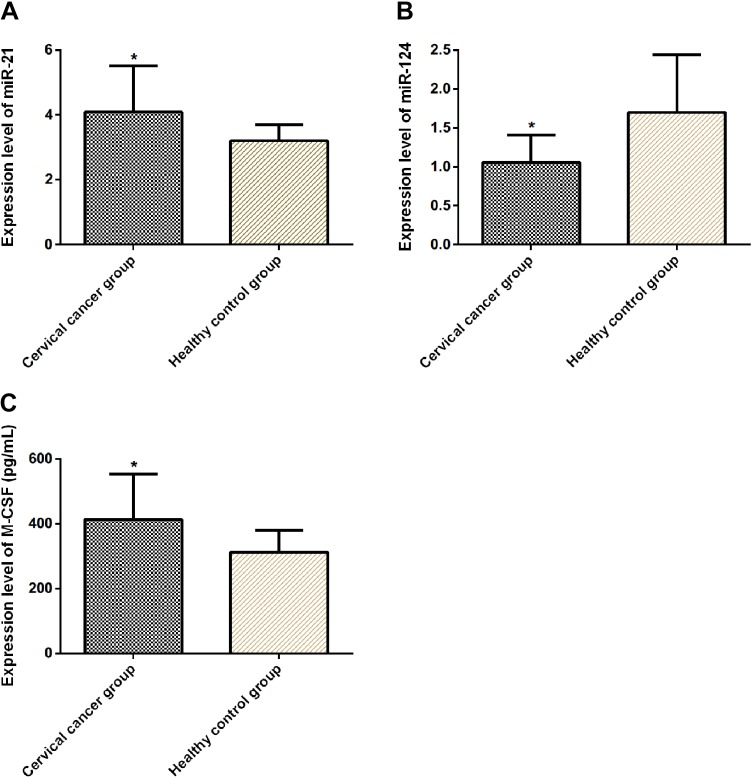
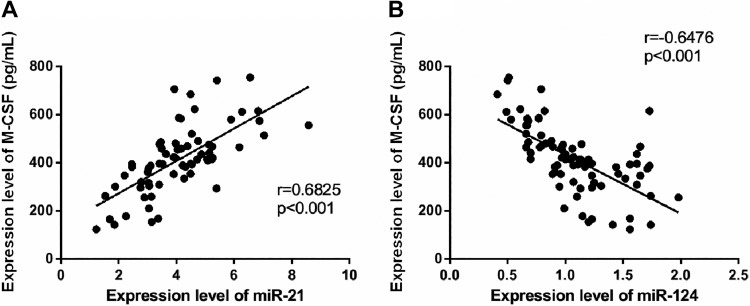
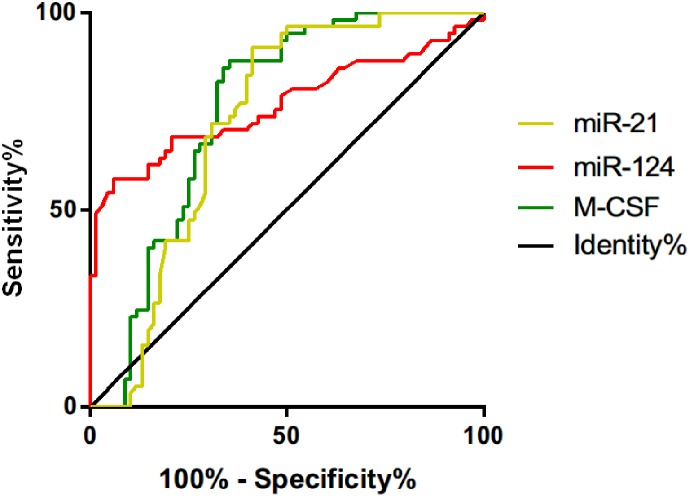
Compared to those in the healthy group, patients in the cervical cancer group had a higher expression of microRNA-21 and macrophage colony-stimulating factor ( < .05) but lower expression of microRNA-124 ( < .05). The expression of microRNA-21, microRNA-124, and macrophage colony-stimulating factor in the patients correlated with the tumor size, tumor node metastasis (TNM) staging, tumor differentiation, and the presence or absence of lymph node metastasis and human papillomavirus infection ( < .05). According to the receiver operating characteristic curves, the area under the curve of microRNA-21 for diagnosing cervical cancer was 0.723, the specificity was 58.82%, and the sensitivity was 91.23%. The area under the curve of microRNA-124 was 0.766, the specificity was 94.12%, and the sensitivity was 57.89%. The area under the curve of macrophage colony-stimulating factor was 0.754, the specificity was 64.71%, and the sensitivity was 87.72%. Pearson correlation analysis showed that the expression of microRNA-21 positively correlated with that of macrophage colony-stimulating factor ( = 0.6825, < .001), and the expression of microRNA-124 negatively correlated with that of macrophage colony-stimulating factor ( = -0.6476, < .001).
MicroRNA-21, microRNA-124, and macrophage colony-stimulating factor may be involved in the development and progression of cervical cancer. The detection of serum microRNA-21, microRNA-124, and macrophage colony-stimulating factor has good sensitivity and specificity in the diagnosis of cervical cancer.
本研究旨在探讨微小RNA - 21、微小RNA - 124和巨噬细胞集落刺激因子在宫颈癌患者中的诊断价值。
本研究纳入了我院收治的68例宫颈癌患者(宫颈癌组)和57例接受体检的健康个体(健康组,即对照组)。采用定量逆转录聚合酶链反应检测血清微小RNA - 21和微小RNA - 124的表达。采用酶联免疫吸附测定法检测血清巨噬细胞集落刺激因子的表达。分析微小RNA - 21、微小RNA - 124和巨噬细胞集落刺激因子在宫颈癌中的诊断价值。还分析了微小RNA - 21和微小RNA - 124的表达与巨噬细胞集落刺激因子表达之间的相关性。
与健康组相比,宫颈癌组患者微小RNA - 21和巨噬细胞集落刺激因子的表达较高(<0.05),而微小RNA - 124的表达较低(<0.05)。患者中微小RNA - 21、微小RNA - 124和巨噬细胞集落刺激因子的表达与肿瘤大小、肿瘤淋巴结转移(TNM)分期、肿瘤分化以及有无淋巴结转移和人乳头瘤病毒感染相关(<0.05)。根据受试者工作特征曲线,微小RNA - 21诊断宫颈癌的曲线下面积为0.723,特异性为58.82%,敏感性为91.23%。微小RNA - 124的曲线下面积为0.766,特异性为94.12%,敏感性为57.89%。巨噬细胞集落刺激因子的曲线下面积为0.754,特异性为64.71%,敏感性为87.72%。Pearson相关性分析表明,微小RNA - 21的表达与巨噬细胞集落刺激因子的表达呈正相关(r = 0.6825,P < 0.001),微小RNA - 124的表达与巨噬细胞集落刺激因子的表达呈负相关(r = -0.6476,P < 0.001)。
微小RNA - 21、微小RNA - 124和巨噬细胞集落刺激因子可能参与宫颈癌的发生和发展。检测血清微小RNA - 21、微小RNA - 124和巨噬细胞集落刺激因子在宫颈癌诊断中具有良好的敏感性和特异性。