Ronzon Tévécia, Sanjuán Ana I
European Commission, Joint Research Centre (JRC), Seville, Spain.
Agricultural Economics and Rural Policy Group, Wageningen University, the Netherlands.
J Clean Prod. 2020 May 1;254:119832. doi: 10.1016/j.jclepro.2019.119832.
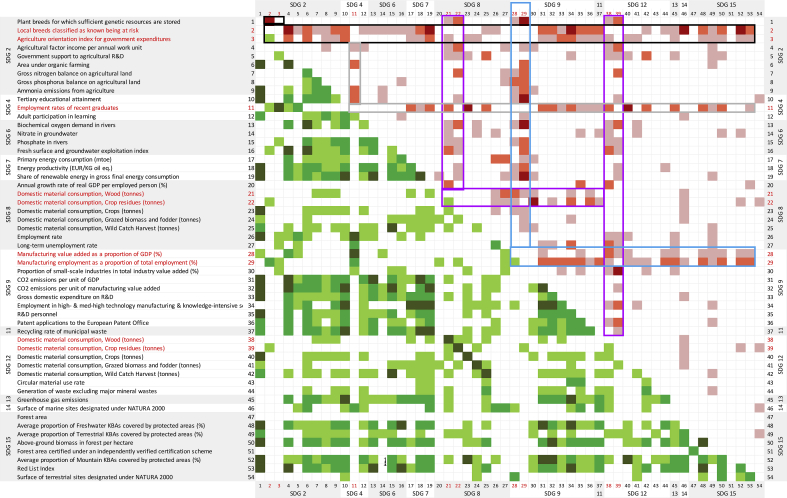
In October 2018, the European Union (EU) launched an updated bioeconomy strategy with the aim of encouraging the substitution of fossil carbon with biomass feedstock in the industry and in energy production while preserving ecosystem services. The objective of the paper is to analyse the links between the EU bioeconomy strategy and the Sustainable Development Goals (SDGs), and to assess what could be the main points of synergies and tensions between bioeconomy-related SDG targets. By semantically mapping the action plan of the 2018 EU bioeconomy strategy with the SDG targets, the paper finds that the bioeconomy strategy is aligned with 53 targets distributed in 12 of the 17 SDGs. Ex-post correlation analysis on bioeconomy-related SDGs indicators for 28 EU Member States (1990-2018) shows a predominance of synergies over trade-offs. More intense synergetic past developments (positive correlations) are found among clean energies (SDG 7), recycling (SDG 11), ecosystem preservation (SDG 15) and most of all other bioeconomy-related SDGs. Negative correlations are observed between agro-biodiversity (SDG 2), domestic material consumption of biomass (SDG 8 and 12), agriculture and industrial developments (SDG 2 and SDG 9) and a wide array of bioeconomy-related SDG indicators. The hotspots of strong correlations identified might be useful in further enrichment of ex-ante simulation models. From a policy coherence perspective, a wide range of policy instruments are already in place in the EU to foster synergies and may bring co-benefits. Policies oriented at preventing trade-offs are already in place but they have not overcome the antagonisms observed in this study yet. Change in practices, technical and technological innovations and the application of circular and 'cascading principles' are the most common fields of action.
2018年10月,欧盟(EU)发布了一项更新后的生物经济战略,旨在鼓励工业和能源生产领域用生物质原料替代化石碳,同时保护生态系统服务。本文的目的是分析欧盟生物经济战略与可持续发展目标(SDGs)之间的联系,并评估生物经济相关可持续发展目标指标之间协同增效和冲突的主要要点。通过将2018年欧盟生物经济战略的行动计划与可持续发展目标进行语义映射,本文发现生物经济战略与17个可持续发展目标中12个目标下的53个指标保持一致。对28个欧盟成员国(1990 - 2018年)生物经济相关可持续发展目标指标的事后相关性分析表明,协同增效作用总体上超过权衡取舍。在清洁能源(可持续发展目标7)、回收利用(可持续发展目标11)、生态系统保护(可持续发展目标15)以及其他大多数生物经济相关可持续发展目标之间,发现了过去更强烈的协同发展(正相关)。在农业生物多样性(可持续发展目标2)、生物质的国内物质消费(可持续发展目标8和12)、农业与工业发展(可持续发展目标2和可持续发展目标9)以及一系列生物经济相关可持续发展目标指标之间观察到负相关。所确定的强相关性热点可能有助于进一步完善事前模拟模型。从政策一致性的角度来看,欧盟已经出台了一系列政策工具来促进协同增效,并可能带来共同效益。旨在防止权衡取舍的政策已经出台,但尚未克服本研究中观察到的对抗性。实践变革、技术创新以及循环和“级联原则”的应用是最常见的行动领域。