Zhong Xiaowei, Liu Dianfeng, Jiang Ziping, Li Chengshun, Chen Lin, Xia Yidan, Liu Da, Yao Qunyan, Wang Dongxu
Laboratory Animal Center, College of Animal Science, Jilin University, Changchun, People's Republic of China.
Department of Hand Surgery, The First Hospital of Jilin University, Changchun, People's Republic of China.
Onco Targets Ther. 2020 Apr 20;13:3277-3287. doi: 10.2147/OTT.S246031. eCollection 2020.
Ten-eleven translocation (TET) enzymes that oxidize a 5-methylcytosine (5mC) to yield 5-hydroxymethylcytosine (5hmC) have been responsible for fine-tuning methylation patterns and exhibit role in epigenetic modifications. Chrysin, a natural flavone frequently present in honey, has been recognized to exhibit anti-tumor properties. In this study, we investigated the effects of Chrysin in the expression pattern of TET proteins in gastric cancer (GC) cells.
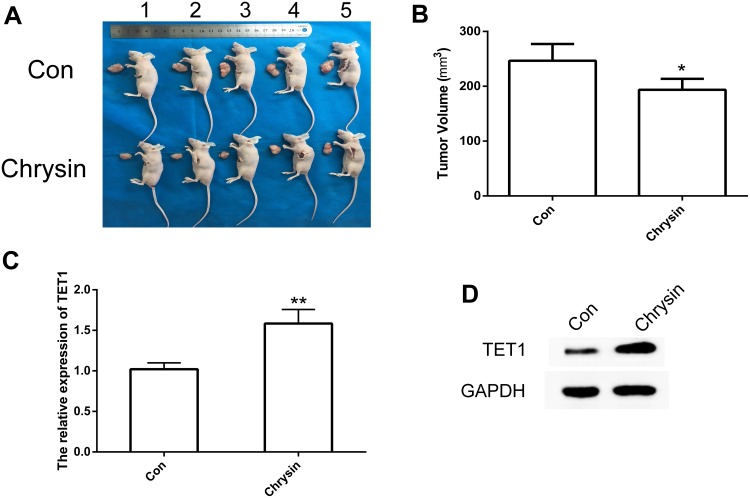
Using qRT-PCR and Western blot analysis, we analyzed the expression of TET1 in GC cells in vitro following treatment with Chrysin. Immunofluorescence staining detected the expression levels of 5mC and 5hmC. Flow cytometry, wound healing, and Matrigel invasion assays were performed to determine cell proliferation, cell cycle, apoptosis, and migration and invasion of GC cells following treatment with Chrysin, si-TET1, and TET1-KO. Furthermore, a xenograft model was developed to analyze the expression pattern of TET1 on tumor development in vivo.
qRT-PCR and Western blot assays indicated that treatment with Chrysin significantly promoted the expression of TET1 in GC cells. Immunofluorescence study further confirmed that TET1 and 5hmC levels were significantly enhanced following treatment with Chrysin in MKN45 cells. Moreover, our results suggested that Chrysin could noticeably induce cell apoptosis and inhibit cell migration and invasion. Further, knockdown and overexpression of TET1 were conducted to investigate whether TET1 expression affected cell apoptosis, and cell migration and invasion in MKN45 cells. The results indicated that overexpression of TET1 markedly promoted cell apoptosis and inhibited cell migration and invasion. Furthermore, the TET1 gene knocked out was generated using the CRISPR/Cas9 system. Our data suggested that TET1 expression was associated with GC tumor growth in vivo.
This study indicated that Chrysin exerted anti-tumor effects through the regulation of TET1 expression in GC and presented TET1 as a novel promising therapeutic target for GC therapy.
将5-甲基胞嘧啶(5mC)氧化生成5-羟甲基胞嘧啶(5hmC)的10-11易位(TET)酶负责微调甲基化模式,并在表观遗传修饰中发挥作用。白杨素是蜂蜜中常见的一种天然黄酮,已被认为具有抗肿瘤特性。在本研究中,我们研究了白杨素对胃癌(GC)细胞中TET蛋白表达模式的影响。
采用qRT-PCR和蛋白质免疫印迹分析,我们分析了白杨素处理后体外GC细胞中TET1的表达。免疫荧光染色检测5mC和5hmC的表达水平。进行流式细胞术、伤口愈合和基质胶侵袭试验,以确定白杨素、si-TET1和TET1-KO处理后GC细胞的增殖、细胞周期、凋亡以及迁移和侵袭情况。此外,建立了异种移植模型以分析TET1在体内肿瘤发生过程中的表达模式。
qRT-PCR和蛋白质免疫印迹分析表明,白杨素处理显著促进了GC细胞中TET1的表达。免疫荧光研究进一步证实,在MKN45细胞中,白杨素处理后TET1和5hmC水平显著升高。此外,我们的结果表明,白杨素可显著诱导细胞凋亡并抑制细胞迁移和侵袭。此外,对TET1进行敲低和过表达,以研究TET1表达是否影响MKN45细胞的凋亡以及细胞迁移和侵袭。结果表明,TET1过表达显著促进细胞凋亡并抑制细胞迁移和侵袭。此外,使用CRISPR/Cas9系统构建了TET1基因敲除细胞。我们的数据表明,TET1表达与体内GC肿瘤生长相关。
本研究表明,白杨素通过调节GC中TET1的表达发挥抗肿瘤作用,并将TET1作为GC治疗一个新的有前景的治疗靶点。