Ma Bingqiang, Ma Jianxun, Yang Yili, He Xueyuan, Pan Xinmin, Wang Zhan, Qian Yaowen
Department of General Surgery, Cancer Center, Key Laboratory for Diagnosis and Treatment of Gastrointestinal Cancer, Gansu Provincial Hospital, Lanzhou, Gansu Province, People's Republic of China.
Onco Targets Ther. 2020 Apr 22;13:3411-3423. doi: 10.2147/OTT.S238665. eCollection 2020.
miRNA, as a biological marker, had more and more attention in recent years due to the important role it plays in cancer. Currently, there are extensive studies on miRNAs, among which miR-330-3p is reported to be implicated in the pathophysiological processes of various cancers. However, little progress has been made in the mechanism of miR-330-3p in gastric cancer.
To explore the expression and relevant mechanism of miR-330-3p and PRRX1 in gastric cancer (GC).
Forty-five GC patients (study group), from whom paired GC and paracancerous tissues were collected, and another 45 healthy subjects (control group) who underwent physical examination during the same period were enrolled. In addition, GC cells and human gastric mucosa cells were purchased, and miR-330-3p-mimics, miR-330-3p-inhibitor, miR-NC, si-PRRX1, and sh-PRRX1 were transfected into MKN45, SGC7901 cell. QRT-PCR was employed to assess the miR-330-3p and PRRX1 expressions in the samples, and the cell expressions of PRRX1, GSK-3β, p-GSK-3β, β-catenin, p-β-catenin, cyclin D1, N-cadherin, E-cadherin and vimentin were evaluated by Western blot (WB). MTT, Transwell and wound-healing experiments were adopted to detect cell proliferation, invasion and migration.
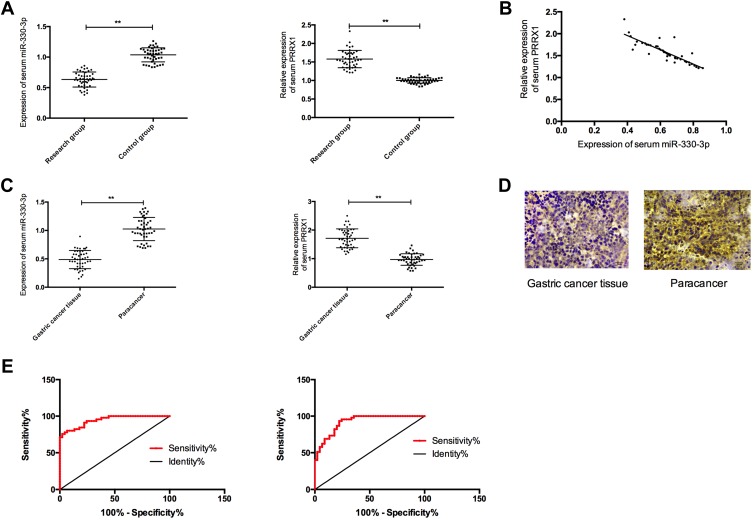
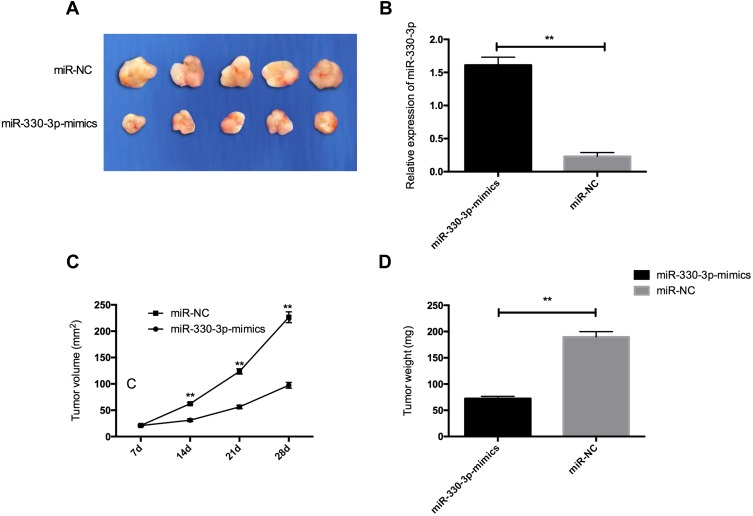
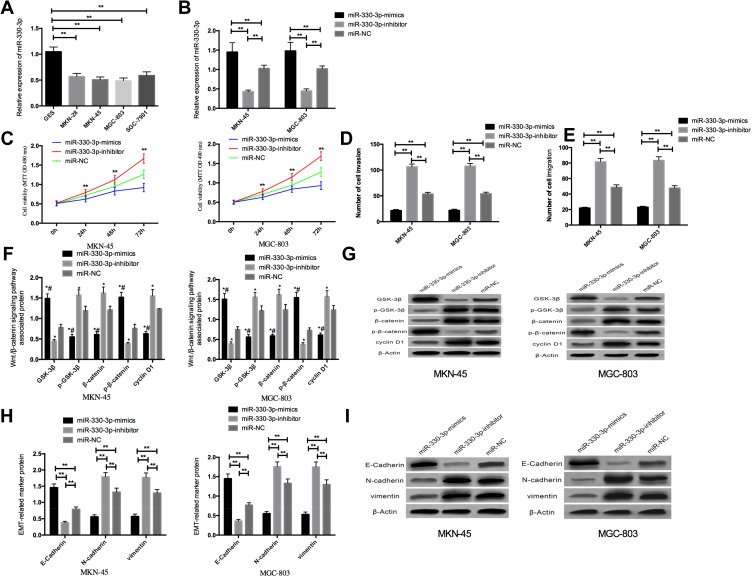
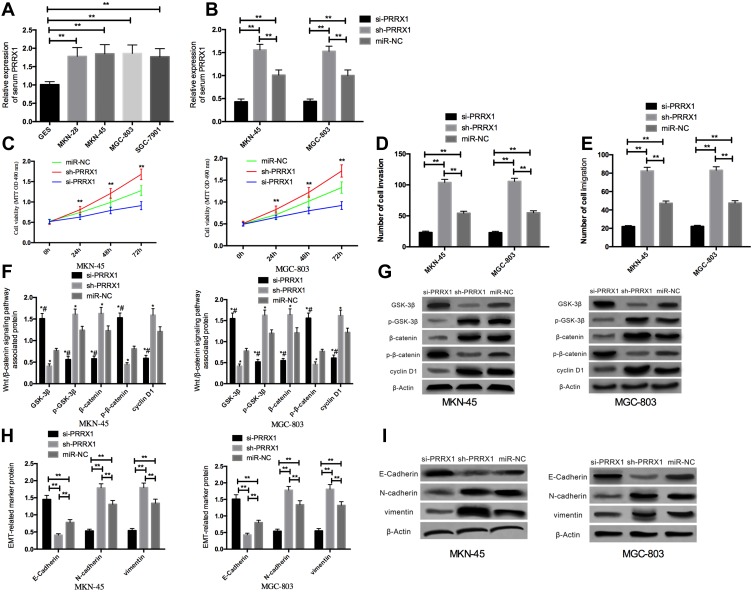
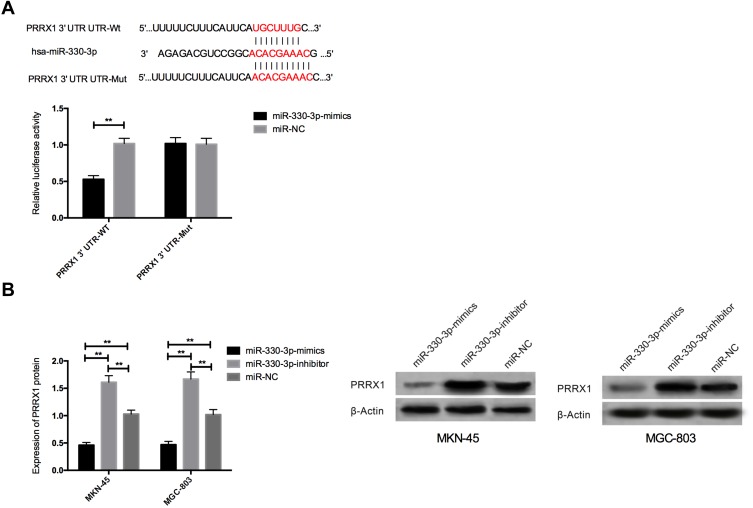
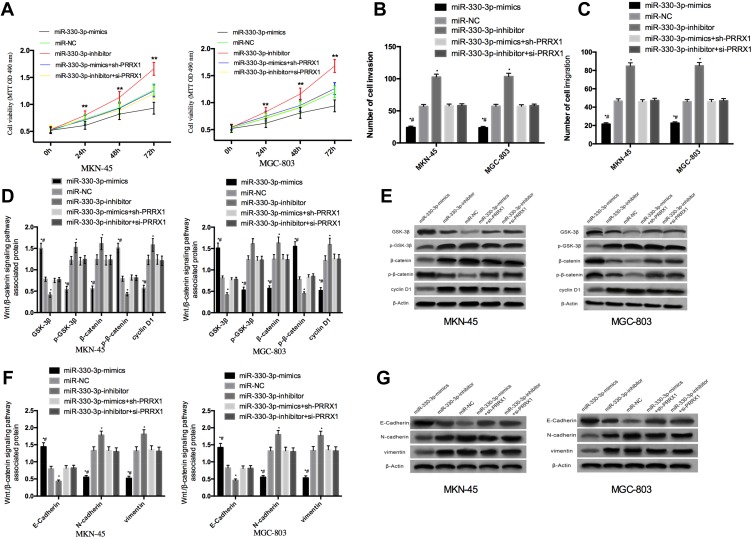
MiR-330-3p was under-expressed, while PRRX1 was highly expressed in the serum of patients, both of which had an area under the curve (AUC) of more than 0.9. MiR-330-3p and PRRX1 were associated with tumor diameter, TNM staging, lymph node metastasis and differentiation of GC patients. Overexpression of miR-330-3p and inhibition of PRRX1 expression could suppress epithelial-mesenchymal transition (EMT), proliferation, invasion and apoptosis of cells. What is more, WB assay showed that overexpressed miR-330-3p and inhibited PRRX1 could inhibit the expression levels of p-GSK-3β, β-catenin, cyclin D1, N-cadherin and vimentin proteins, while elevating GSK-3β, p-β-catenin and E-cadherin protein expressions. Dual-luciferase reporter assay confirmed that there was a targeting relation between miR-330-3p and PRRX1. Furthermore, rescue experiments revealed that the cell proliferation, invasion, migration did not differ significantly between co-transfected miR-330-3p-mimics+sh-PRRX1, miR-330-3p-inhibitor+si-PRRX1 groups of MKN45 and SGC7901 and the miR-NC group (without transfected sequences).
Overexpressed miR-330-3p can promote cell EMT, proliferation, invasion and apoptosis through inhibiting PRRX1-mediated Wnt/β-catenin signaling pathway, which is expected to be a potential therapeutic target for GC.
微小RNA(miRNA)作为一种生物标志物,近年来因其在癌症中发挥的重要作用而受到越来越多的关注。目前,对miRNA有广泛的研究,其中据报道miR-330-3p参与了各种癌症的病理生理过程。然而,miR-330-3p在胃癌中的作用机制进展甚微。
探讨miR-330-3p和脯氨酸丰富的同源盒蛋白1(PRRX1)在胃癌(GC)中的表达及相关机制。
选取45例GC患者(研究组),收集其配对的GC组织和癌旁组织,另选取同期进行体检的45例健康受试者(对照组)。此外,购买GC细胞和人胃黏膜细胞,将miR-330-3p模拟物、miR-330-3p抑制剂、miR阴性对照(miR-NC)、PRRX1小干扰RNA(si-PRRX1)和PRRX1短发夹RNA(sh-PRRX1)转染至MKN45、SGC7901细胞。采用实时定量聚合酶链反应(QRT-PCR)评估样本中miR-330-3p和PRRX1的表达,通过蛋白质免疫印迹法(WB)评估PRRX1、糖原合成酶激酶3β(GSK-3β)、磷酸化GSK-3β(p-GSK-3β)、β-连环蛋白、磷酸化β-连环蛋白(p-β-连环蛋白)、细胞周期蛋白D1、N-钙黏蛋白、E-钙黏蛋白和波形蛋白的细胞表达。采用MTT法、Transwell法和伤口愈合实验检测细胞增殖、侵袭和迁移能力。
miR-330-3p在患者血清中低表达,而PRRX1高表达,二者曲线下面积(AUC)均大于0.9。miR-330-3p和PRRX1与GC患者的肿瘤直径、TNM分期、淋巴结转移及分化程度相关。miR-330-3p过表达和PRRX1表达抑制可抑制细胞上皮-间质转化(EMT)、增殖、侵袭及凋亡。此外,WB检测显示,miR-330-3p过表达和PRRX1抑制可抑制p-GSK-3β、β-连环蛋白、细胞周期蛋白D1、N-钙黏蛋白和波形蛋白的蛋白表达水平,同时提高GSK-3β、p-β-连环蛋白和E-钙黏蛋白的蛋白表达。双荧光素酶报告基因检测证实miR-330-3p与PRRX1之间存在靶向关系。此外,挽救实验显示,MKN45和SGC7901细胞共转染miR-330-3p模拟物+sh-PRRX1、miR-330-3p抑制剂+si-PRRX1组与miR-NC组(未转染序列)相比,细胞增殖、侵袭、迁移能力差异无统计学意义。
miR-330-3p过表达可通过抑制PRRX1介导的Wnt/β-连环蛋白信号通路促进细胞EMT、增殖、侵袭及凋亡,有望成为GC的潜在治疗靶点。