School of Molecular Cell Biology and Biotechnology, Tel Aviv University, Ramat Aviv, Israel.
School of Molecular Cell Biology and Biotechnology, Tel Aviv University, Ramat Aviv, Israel
mBio. 2020 May 5;11(3):e00705-20. doi: 10.1128/mBio.00705-20.
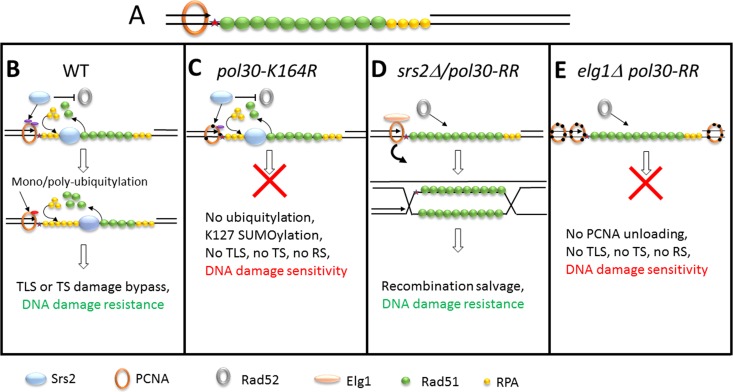
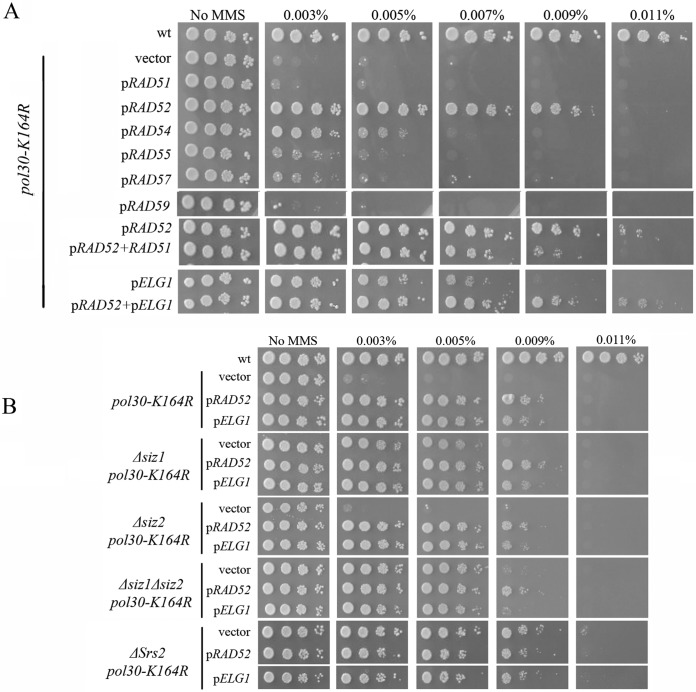
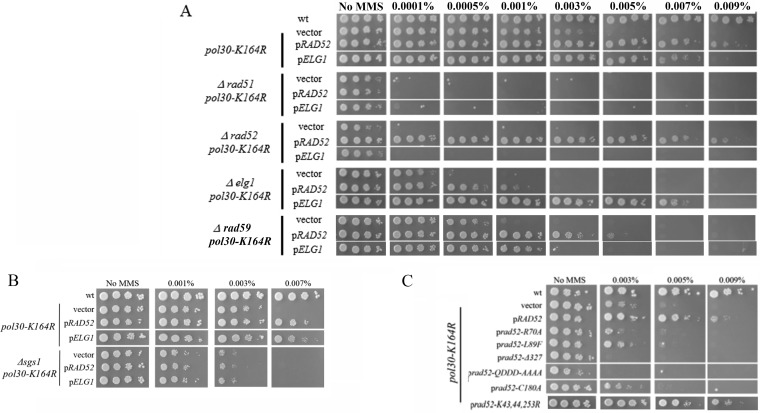
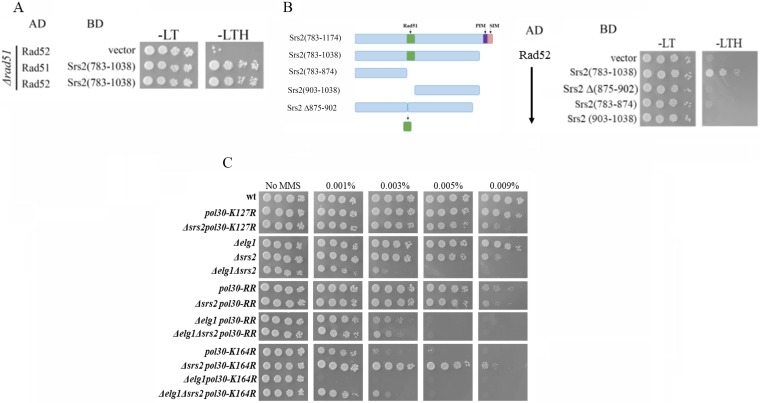
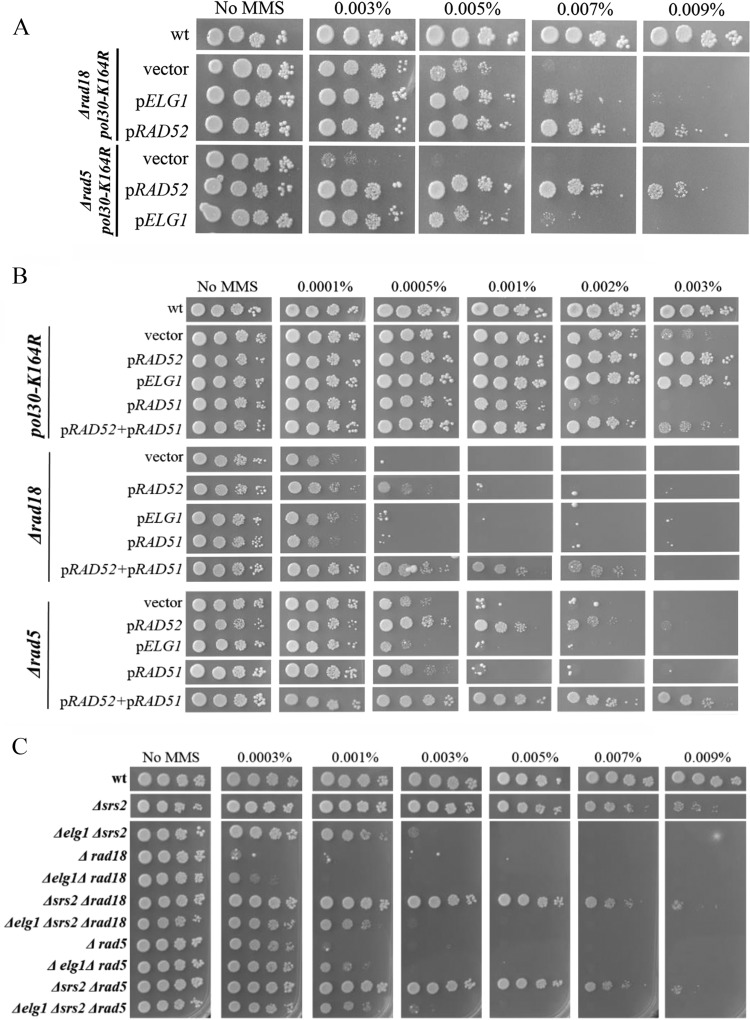
During DNA replication, stalling can occur when the replicative DNA polymerases encounter lesions or hard-to replicate regions. Under these circumstances, the processivity factor PCNA gets ubiquitylated at lysine 164, inducing the DNA damage tolerance (DDT) mechanisms that can bypass lesions encountered during DNA replication. PCNA can also be SUMOylated at the same residue or at lysine 127. Surprisingly, mutants display a higher degree of sensitivity to DNA-damaging agents than strains, unable to modify any of the lysines. Here, we show that in addition to translesion synthesis and strand-transfer DDT mechanisms, an alternative repair mechanism ("salvage recombination") that copies information from the sister chromatid is repressed by the recruitment of Srs2 to SUMOylated PCNA. Overexpression of Elg1, the PCNA unloader, or of the recombination protein Rad52 allows its activation. We dissect the genetic requirements for this pathway, as well as the interactions between Srs2 and Elg1. PCNA, the ring that encircles DNA maintaining the processivity of DNA polymerases, is modified by ubiquitin and SUMO. Whereas ubiquitin is required for bypassing lesions through the DNA damage tolerance (DDT) pathways, we show here that SUMOylation represses another pathway, salvage recombination. The Srs2 helicase is recruited to SUMOylated PCNA and prevents the salvage pathway from acting. The pathway can be induced by overexpressing the PCNA unloader Elg1, or the homologous recombination protein Rad52. Our results underscore the role of PCNA modifications in controlling the various bypass and DNA repair mechanisms.
在 DNA 复制过程中,当复制 DNA 聚合酶遇到损伤或难以复制的区域时,可能会发生停滞。在这种情况下,过程因子 PCNA 在赖氨酸 164 处被泛素化,诱导可以绕过 DNA 复制过程中遇到的损伤的 DNA 损伤容忍(DDT)机制。PCNA 也可以在同一残基或赖氨酸 127 处被 SUMO 化。令人惊讶的是,与 菌株相比, 突变体对 DNA 损伤剂的敏感性更高,无法修饰任何赖氨酸。在这里,我们表明,除了跨损伤合成和链转移 DDT 机制外,一种替代的修复机制(“挽救重组”),从姐妹染色单体复制信息,被 Srs2 募集到 SUMO 化的 PCNA 抑制。Elg1 的过表达,PCNA 卸载蛋白,或重组蛋白 Rad52 的过表达允许其激活。我们剖析了这种途径的遗传要求,以及 Srs2 和 Elg1 之间的相互作用。PCNA,环绕 DNA 的环,维持 DNA 聚合酶的连续性,被泛素和 SUMO 修饰。虽然泛素是通过 DNA 损伤容忍(DDT)途径绕过损伤所必需的,但我们在这里表明,SUMO 化抑制了另一种途径,挽救重组。Srs2 解旋酶被募集到 SUMO 化的 PCNA 上,并阻止挽救途径发挥作用。该途径可以通过过表达 PCNA 卸载蛋白 Elg1 或同源重组蛋白 Rad52 来诱导。我们的结果强调了 PCNA 修饰在控制各种旁路和 DNA 修复机制中的作用。