Department of Gastroenterology, Renmin Hospital of Wuhan University, Wuhan, Hubei, China.
Department of Information Center, Renmin Hospital of Wuhan University, Wuhan, Hubei, China.
Epidemiol Infect. 2020 May 6;148:e94. doi: 10.1017/S0950268820000977.
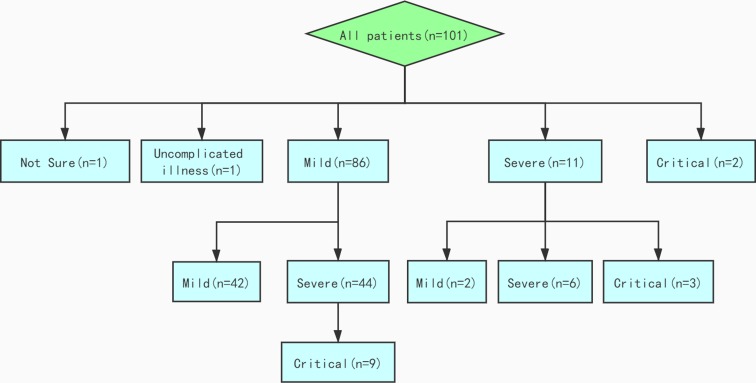
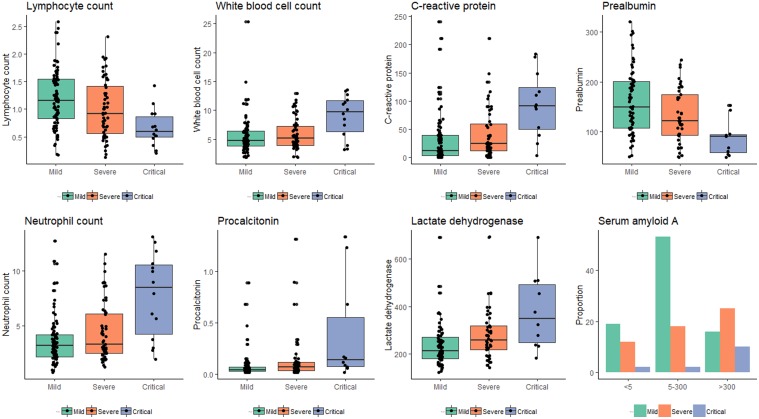
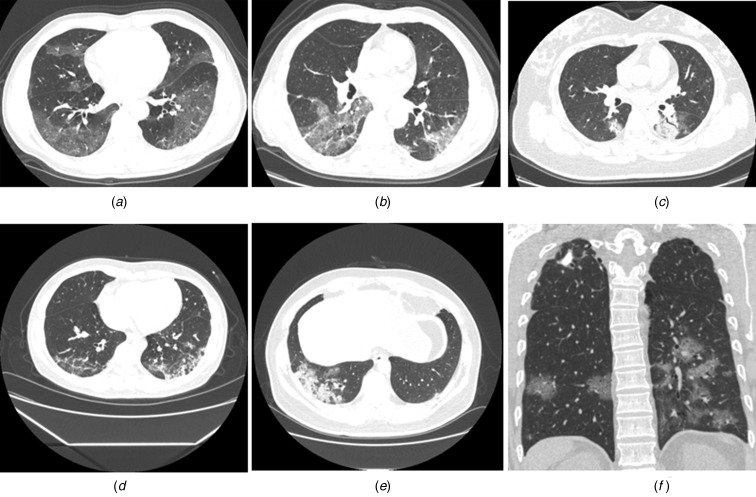
Coronavirus disease 2019 (COVID-19) patients were classified into four clinical stages (uncomplicated illness, mild, severe and critical pneumonia) depending on disease severity. We aim to investigate the corresponding clinical, radiological and laboratory characteristics between different clinical stages. A retrospective, single-centre study of 101 confirmed patients with COVID-19 at Renmin Hospital of Wuhan University from 2 January to 28 January 2020 was enrolled; follow-up endpoint was on 8 February 2020. Clinical data were collected and compared during the course of illness. The median age of the 101 patients was 51.0 years and 33.6% were medical staff. Fever (68%), cough (50%) and fatigue (23%) are the most common symptoms. About 26% patients underwent the mechanical ventilation and 98% patients were treated with antibiotics. Thirty-seven per cent patients were cured and 11 died. On admission, the number of patients with uncomplicated illness, mild, severe and critical pneumonia were 2 [2%], 86 [85%], 11 [11%] and 2 [2%]. Forty-four of the 86 mild pneumonia progressed to severe illness within 4 days, with nine patients worsened due to critical pneumonia within 4 days. Two of the 11 severe patients improved to mild condition while three others deteriorated. Significant differences were observed among groups of different clinical stages in numbers of influenced pulmonary segments (6 vs. 12 vs. 17, P < 0.001). A significantly upward trend was witnessed in ground-glass opacities overlapped with striped shadows (33% vs. 42% vs. 55% vs. 80%, P < 0.001), while pure ground-glass opacities gradually decreased as disease progressed (45% vs. 35% vs. 24% vs. 13%, P < 0.001) within 12 days. Lymphocytes, prealbumin and albumin showed a downtrend as disease progressed from mild to severe or critical condition, an uptrend was found in white blood cells, C-reactive protein, neutrophils and lactate dehydrogenase. The proportions of serum amyloid A > 300 mg/l in mild, severe and critical conditions were 18%, 46% and 71%, respectively.
新型冠状病毒肺炎(COVID-19)患者根据疾病严重程度分为四个临床阶段(轻症、普通型、重型和危重型)。我们旨在研究不同临床阶段之间相应的临床、影像学和实验室特征。本研究为回顾性、单中心研究,纳入 2020 年 1 月 2 日至 1 月 28 日期间在武汉大学人民医院确诊的 101 例 COVID-19 患者,随访终点为 2020 年 2 月 8 日。收集并比较患者在病程中的临床资料。101 例患者的中位年龄为 51.0 岁,33.6%为医务人员。最常见的症状是发热(68%)、咳嗽(50%)和乏力(23%)。约 26%的患者接受了机械通气,98%的患者接受了抗生素治疗。37%的患者治愈,11 例死亡。入院时,单纯型、普通型、重型和危重型患者分别为 2 例(2%)、86 例(85%)、11 例(11%)和 2 例(2%)。86 例普通型肺炎患者中,44 例在 4 天内进展为重型,9 例在 4 天内恶化至危重型。11 例重型患者中,2 例好转为普通型,3 例恶化。不同临床阶段患者受累肺段数差异有统计学意义(6 个 vs. 12 个 vs. 17 个,P<0.001)。磨玻璃影伴条索影(33% vs. 42% vs. 55% vs. 80%,P<0.001)逐渐增加,而单纯磨玻璃影逐渐减少(45% vs. 35% vs. 24% vs. 13%,P<0.001),在 12 天内。淋巴细胞、前白蛋白和白蛋白随病情从普通型向重型或危重型进展呈下降趋势,白细胞、C 反应蛋白、中性粒细胞和乳酸脱氢酶呈上升趋势。在普通型、重型和危重型患者中,血清淀粉样蛋白 A>300mg/L 的比例分别为 18%、46%和 71%。