Department of Microbiology, Infectious Diseases and Immunology, Charité - Universitätsmedizin Berlin, 12203, Berlin, Germany.
Jill Roberts Institute for Research in Inflammatory Bowel Disease, Joan and Sanford I. Weill Department of Medicine, Department of Microbiology and Immunology, Weill Cornell Medicine, Cornell University, New York, NY, 10021, USA.
Cell Res. 2020 Jun;30(6):475-491. doi: 10.1038/s41422-020-0323-8. Epub 2020 May 6.
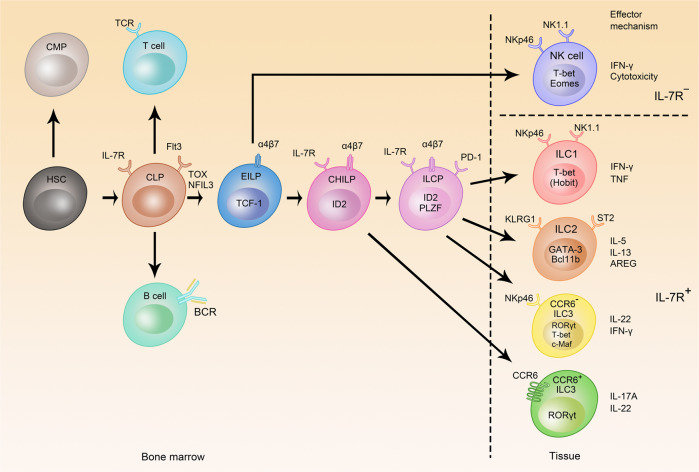
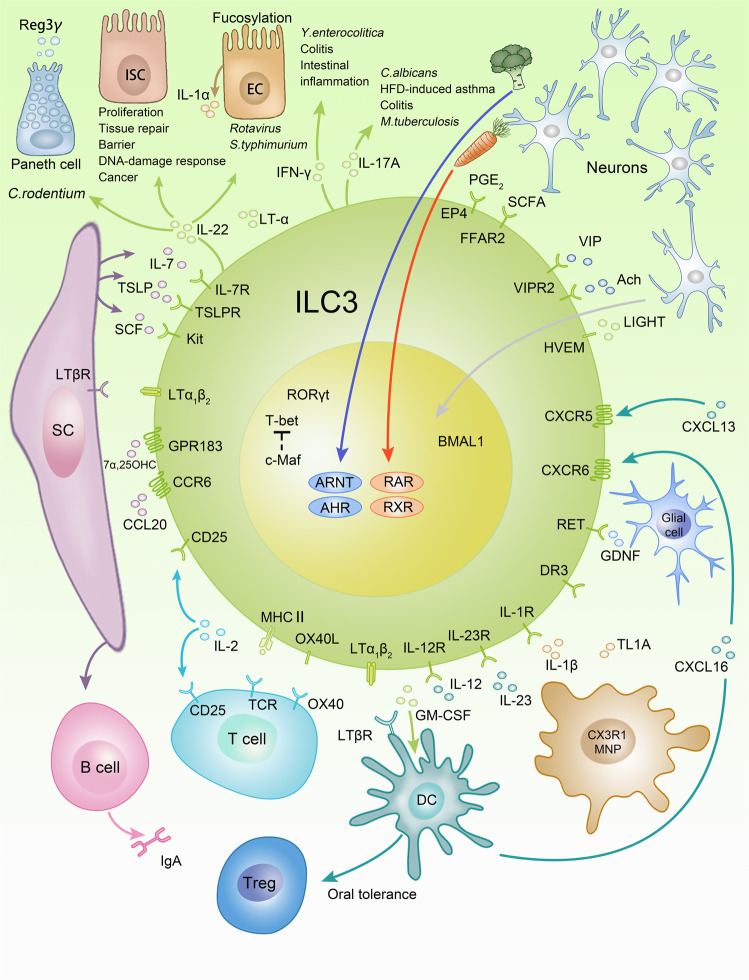
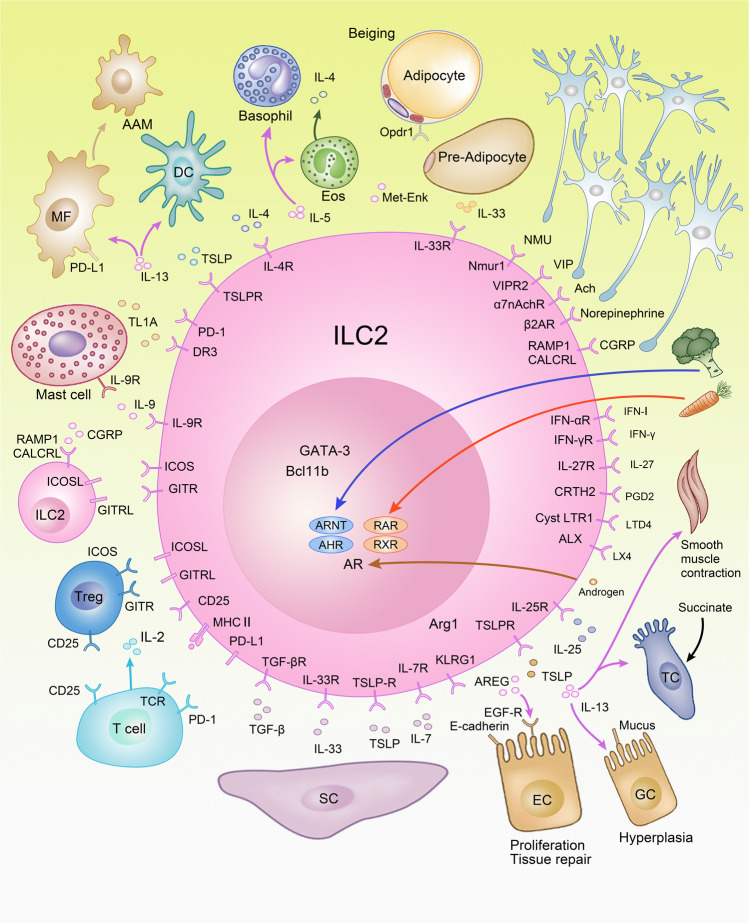
The multifaceted organization of the immune system involves not only patrolling lymphocytes that constantly monitor antigen-presenting cells in secondary lymphoid organs but also immune cells that establish permanent tissue-residency. The integration in the respective tissue and the adaption to the organ milieu enable tissue-resident cells to establish signaling circuits with parenchymal cells to coordinate immune responses and maintain tissue homeostasis. Innate lymphoid cells (ILCs) are tissue-resident innate immune cells that have a similar functional diversity to T cells including lineage-specifying transcription factors that drive certain effector programs. Since their formal discovery 10 years ago, it has become clear that ILCs are present in almost every tissue but strongly enriched at barrier surfaces, where they regulate immunity to infection, chronic inflammation, and tissue maintenance. In this context, recent research has identified ILCs as key in orchestrating tissue homeostasis through their ability to sustain bidirectional interactions with epithelial cells, neurons, stromal cells, adipocytes, and many other tissue-resident cells. In this review, we provide a comprehensive discussion of recent studies that define the development and heterogeneity of ILC populations and their impact on innate and adaptive immunity. Further, we discuss emerging research on the influence of the nervous system, circadian rhythm, and developmental plasticity on ILC function. Uncovering the signaling circuits that control development and function of ILCs will provide an integrated view on how immune responses in tissues are synchronized with functional relevance far beyond the classical view of the role of the immune system in discrimination between self/non-self and host defense.
免疫系统的多方面组织不仅涉及不断监测次级淋巴器官中抗原呈递细胞的巡逻淋巴细胞,还涉及建立永久组织驻留的免疫细胞。在各自组织中的整合和对器官环境的适应使组织驻留细胞能够与实质细胞建立信号通路,协调免疫反应并维持组织内稳态。固有淋巴细胞 (ILC) 是组织驻留的先天免疫细胞,具有与 T 细胞相似的功能多样性,包括驱动特定效应程序的谱系特异性转录因子。自 10 年前正式发现以来,人们已经清楚地认识到 ILC 几乎存在于所有组织中,但在屏障表面高度富集,在那里它们调节感染、慢性炎症和组织维持的免疫。在这种情况下,最近的研究表明,ILC 通过维持与上皮细胞、神经元、基质细胞、脂肪细胞和许多其他组织驻留细胞的双向相互作用的能力,在协调组织内稳态方面发挥着关键作用。在这篇综述中,我们全面讨论了最近的研究,这些研究定义了 ILC 群体的发育和异质性及其对先天和适应性免疫的影响。此外,我们还讨论了关于神经系统、昼夜节律和发育可塑性对 ILC 功能影响的新兴研究。揭示控制 ILC 发育和功能的信号通路将提供一个综合的观点,了解组织中的免疫反应如何与功能相关性同步,而不仅仅是传统的免疫系统在自我/非我区分和宿主防御中的作用观点。