The George Institute for Global Health, UNSW Sydney, Level 10, King George V Building, 83-117 Missenden Road, Camperdown, Sydney, NSW, 2050, Australia.
Department of Nephrology and Laboratory Medicine, Kanazawa University, Ishikawa, Japan.
Diabetologia. 2020 Aug;63(8):1637-1647. doi: 10.1007/s00125-020-05162-z. Epub 2020 May 8.
AIMS/HYPOTHESIS: This biomarker study aimed to quantify the association of essential and other plasma fatty acid biomarkers with macrovascular disease, microvascular disease and death in individuals with type 2 diabetes.
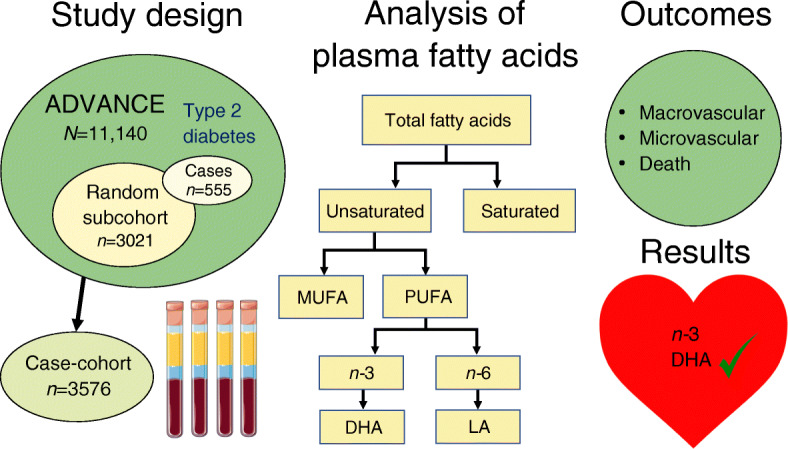
A case-cohort study (N = 3576), including 654 macrovascular events, 341 microvascular events and 631 deaths during 5 years of (median) follow-up, was undertaken as a secondary analysis of the Action in Diabetes and Vascular Disease: Preterax and Diamicron Modified-Release Controlled Evaluation (ADVANCE) study (full details of the study design and primary endpoints of the ADVANCE trial and its case-cohort have been published previously). This current study considers new data: fatty acids measured from baseline plasma samples by proton NMR analysis. The fatty acids measured were n-3, docosahexaenoic acid (DHA), n-6, linoleic acid, and polyunsaturated, monounsaturated and saturated fatty acids. HRs were modelled per SD higher (percentage) fatty acid. C statistics and continuous net reclassification improvement were used to test the added value of fatty acids compared with traditional cardiovascular risk factors.
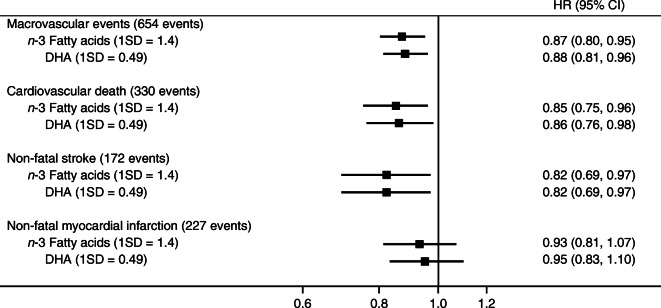
After adjustment for traditional cardiovascular risk factors, an inverse association was observed for n-3 fatty acids and DHA with the risk of macrovascular events (HR [95% CI]: 0.87 [0.80, 0.95] and 0.88 [0.81, 0.96], respectively, per 1 SD higher percentage), and for n-3 fatty acids with the risk of death (HR 0.91 [95% CI 0.84, 0.99] per 1 SD higher percentage). Such associations were also evident when investigating absolute levels of fatty acids. There were no statistically significant associations between any fatty acids and microvascular disease after adjustment. However, there was limited improvement in the predictive ability of models when any fatty acid was added.
CONCLUSIONS/INTERPRETATION: Plasma n-3 fatty acids and DHA were found to be inversely associated with macrovascular disease, while n-3 fatty acids were also inversely associated with death. These results support the cardioprotective effects of n-3 fatty acids and DHA and further merit testing the role of high-dose supplementation with n-3 fatty acids in individuals with type 2 diabetes.
ClinicalTrials.gov NCT00145925. Graphical abstract.
目的/假设:本生物标志物研究旨在定量评估 2 型糖尿病个体中必需和其他血浆脂肪酸生物标志物与大血管疾病、微血管疾病和死亡的相关性。
这是一项病例对照研究(N=3576),包括 654 例大血管事件、341 例微血管事件和 631 例死亡,随访时间为 5 年(中位数)。该研究是对糖尿病和血管疾病行动:培哚普利和二甲双胍缓释片疗效评价(ADVANCE)研究的二次分析(该研究的设计和主要终点以及 ADVANCE 病例对照研究已在之前发表)。本研究考虑了新数据:通过质子 NMR 分析从基线血浆样本中测量的脂肪酸。测量的脂肪酸包括 n-3、二十二碳六烯酸(DHA)、n-6、亚油酸以及多不饱和、单不饱和和饱和脂肪酸。每个标准差更高(百分比)的脂肪酸与 HR 相关。使用 C 统计量和连续净重新分类改善来测试与传统心血管危险因素相比,脂肪酸的附加值。
在调整传统心血管危险因素后,n-3 脂肪酸和 DHA 与大血管事件风险呈负相关(每 1 个标准差更高百分比的 HR [95%CI]:0.87 [0.80,0.95] 和 0.88 [0.81,0.96]),n-3 脂肪酸与死亡风险也呈负相关(每 1 个标准差更高百分比的 HR 0.91 [95%CI 0.84,0.99])。当研究脂肪酸的绝对水平时,也存在类似的相关性。调整后,任何脂肪酸与微血管疾病均无统计学显著相关性。然而,当添加任何脂肪酸时,模型的预测能力都没有显著提高。
结论/解释:血浆 n-3 脂肪酸和 DHA 与大血管疾病呈负相关,而 n-3 脂肪酸也与死亡呈负相关。这些结果支持 n-3 脂肪酸和 DHA 的心脏保护作用,进一步证明了高剂量补充 n-3 脂肪酸在 2 型糖尿病个体中的作用值得进一步研究。
ClinicalTrials.gov NCT00145925。图表摘要。