Institute for Global Health, University College London, London, UK; Africa Health Research Institute, Durban, South Africa.
Institute for Global Health, University College London, London, UK; Africa Health Research Institute, Durban, South Africa; MRC/Wits-Agincourt Unit, University of the Witwatersrand, Johannesburg, South Africa; Harvard Centre for Population and Development Studies, Harvard T H Chan School of Public Health, Boston, MA, USA.
Lancet Infect Dis. 2020 Jun;20(6):e142-e147. doi: 10.1016/S1473-3099(20)30136-5. Epub 2020 May 7.
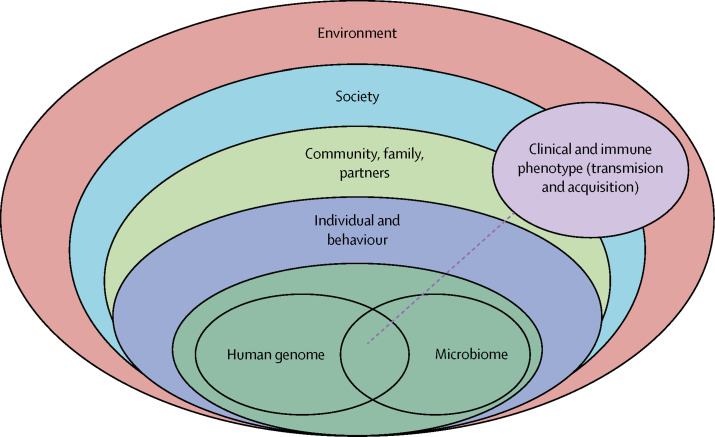
Chronic and emerging infectious diseases and antimicrobial resistance remain a substantial global health threat. Microbiota are increasingly recognised to play an important role in health. Infections also have a profound effect beyond health, especially on global and local economies. To maximise health improvements, the field of infectious disease epidemiology needs to derive learning from ecology and traditional epidemiology. New methodologies and tools are transforming understanding of these systems, from a better understanding of socioeconomic, environmental, and cultural drivers of infection, to improved methods to detect microorganisms, describe the immunome, and understand the role of human microbiota. However, exploiting the potential of novel methods to improve global health remains elusive. We argue that to exploit these advances a shift is required in the teaching of infectious disease epidemiology to ensure that students are well versed in a breadth of disciplines, while maintaining core epidemiological skills. We discuss the following key points using a series of teaching vignettes: (1) integrated training in classic and novel techniques is needed to develop future scientists and professionals who can work from the micro (interactions between pathogens, their cohabiting microbiota, and the host at a molecular and cellular level), with the meso (the affected communities), and to the macro (wider contextual drivers of disease); (2) teach students to use a team-science multidisciplinary approach to effectively integrate biological, clinical, epidemiological, and social tools into public health; and (3) develop the intellectual skills to critically engage with emerging technologies and resolve evolving ethical dilemmas. Finally, students should appreciate that the voices of communities affected by infection need to be kept at the heart of their work.
慢性和新兴传染病以及抗菌素耐药性仍然是全球卫生的重大威胁。越来越多的人认识到微生物群在健康中发挥着重要作用。感染对健康以外的领域也有深远的影响,尤其是对全球和地方经济。为了最大限度地提高健康水平,传染病流行病学领域需要从生态学和传统流行病学中吸取经验教训。新的方法和工具正在改变人们对这些系统的理解,从更好地理解感染的社会经济、环境和文化驱动因素,到改进检测微生物、描述免疫组和理解人类微生物群作用的方法。然而,利用新方法的潜力来改善全球健康仍然难以实现。我们认为,要利用这些进展,需要在传染病流行病学的教学中进行转变,以确保学生精通广泛的学科,同时保持核心流行病学技能。我们使用一系列教学事例来讨论以下要点:(1)需要对经典和新型技术进行综合培训,以培养未来的科学家和专业人员,他们能够从微观(病原体与其共生微生物群以及宿主在分子和细胞水平上的相互作用)、中观(受影响的社区)和宏观(疾病的更广泛背景驱动因素)层面开展工作;(2)教导学生使用团队科学的多学科方法,将生物、临床、流行病学和社会工具有效地整合到公共卫生中;(3)培养批判性地参与新兴技术和解决不断发展的伦理困境的智力技能。最后,学生应该意识到,受感染社区的声音需要始终是他们工作的核心。