Demekas Daphne, Parr Thomas, Friston Karl J
Department of Mathematics, University College London, London, United Kingdom.
Wellcome Trust Centre for Neuroimaging, University College London, London, United Kingdom.
Front Comput Neurosci. 2020 Apr 22;14:30. doi: 10.3389/fncom.2020.00030. eCollection 2020.
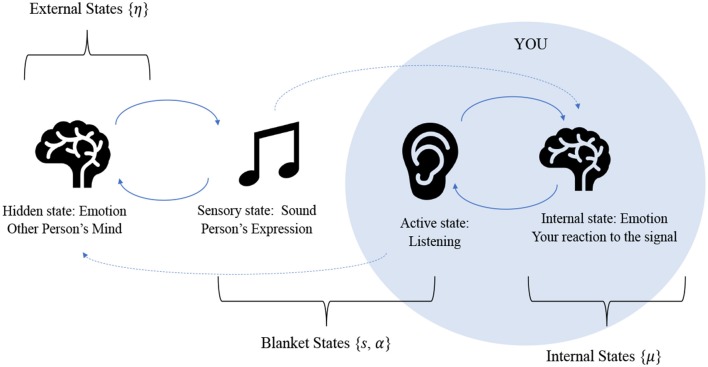
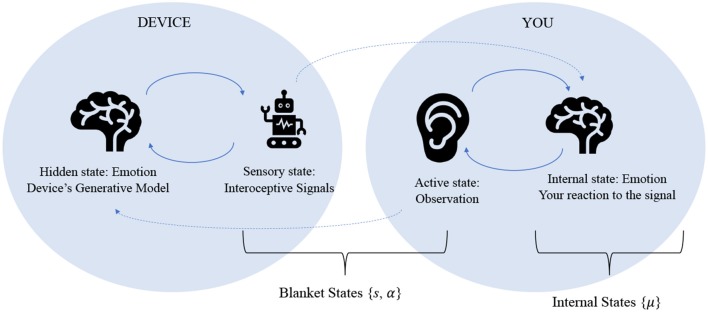
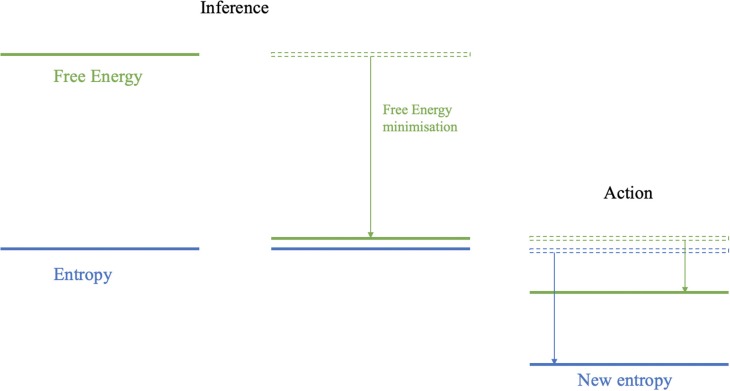
This paper offers a prospectus of what might be achievable in the development of emotional recognition devices. It provides a conceptual overview of the free energy principle; including Markov blankets, active inference, and-in particular-a discussion of selfhood and theory of mind, followed by a brief explanation of how these concepts can explain both neural and cultural models of emotional inference. The underlying hypothesis is that emotion recognition and inference devices will evolve from state-of-the-art deep learning models into active inference schemes that go beyond marketing applications and become adjunct to psychiatric practice. Specifically, this paper proposes that a second wave of emotion recognition devices will be equipped with an emotional lexicon (or the ability to epistemically search for one), allowing the device to resolve uncertainty about emotional states by actively eliciting responses from the user and learning from these responses. Following this, a third wave of emotional devices will converge upon the user's generative model, resulting in the machine and human engaging in a reciprocal, prosocial emotional interaction, i.e., sharing a generative model of emotional states.
本文提供了一份关于情感识别设备开发可能实现目标的计划书。它对自由能原理进行了概念性概述,包括马尔可夫覆盖、主动推理,特别是对自我和心理理论的讨论,随后简要解释了这些概念如何解释情感推理的神经和文化模型。潜在的假设是,情感识别和推理设备将从最先进的深度学习模型演变为超越营销应用并成为精神病学实践辅助手段的主动推理方案。具体而言,本文提出,第二代情感识别设备将配备情感词典(或具备认知搜索情感词典的能力),使设备能够通过积极引发用户反应并从这些反应中学习来解决情感状态的不确定性。在此之后,第三代情感设备将趋向于用户的生成模型,从而使机器和人类进行互惠的亲社会情感互动,即共享情感状态的生成模型。