Computational Health Informatics Program, Boston Children's Hospital, Boston, MA 02215, USA.
Department of Biomedical Informatics, Harvard Medical School, Boston, MA 02115, USA.
Aging (Albany NY). 2020 May 5;12(9):7626-7638. doi: 10.18632/aging.102900.
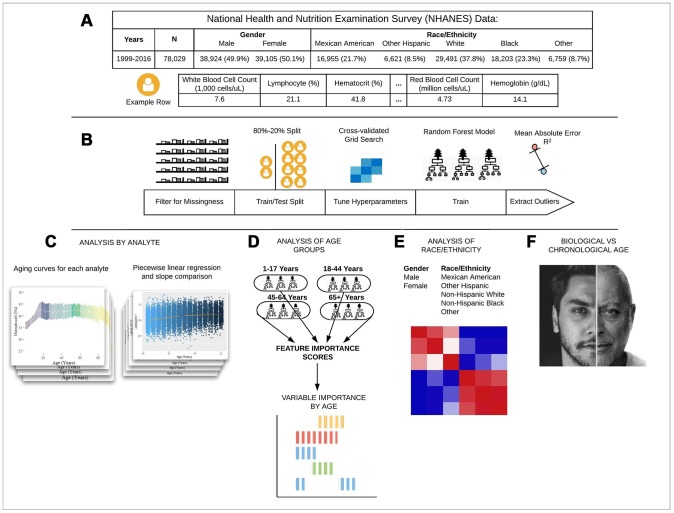
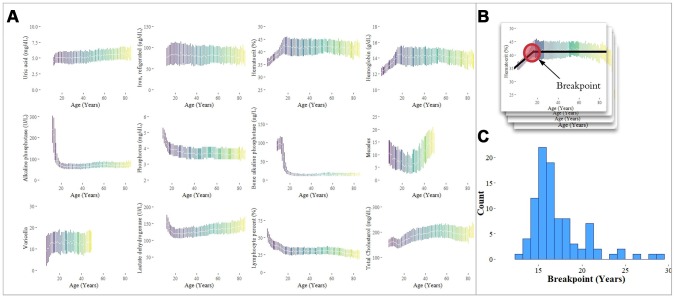
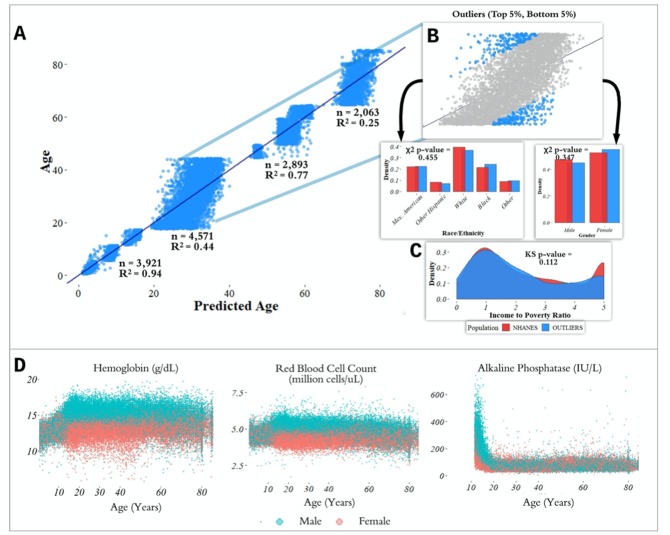
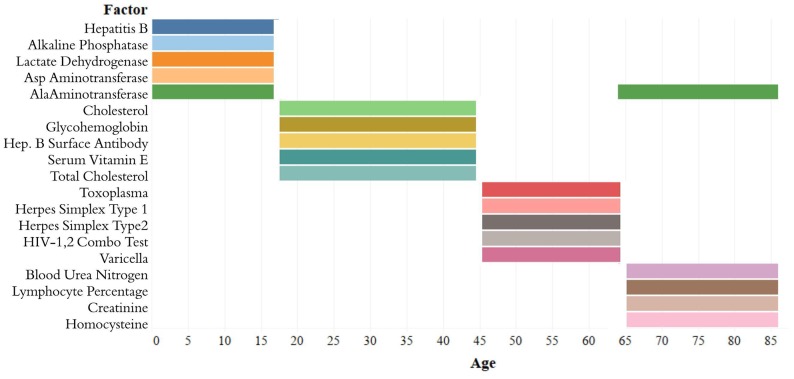
Aging has pronounced effects on blood laboratory biomarkers used in the clinic. Prior studies have largely investigated one biomarker or population at a time, limiting a comprehensive view of biomarker variation and aging across different populations. Here we develop a supervised machine learning approach to study aging using 356 blood biomarkers measured in 67,563 individuals across diverse populations. Our model predicts age with a mean absolute error (MAE), or average magnitude of prediction errors, in held-out data of 4.76 years and an R value of 0.92. Age prediction was highly accurate for the pediatric cohort (MAE = 0.87, R = 0.94) but inaccurate for ages 65+ (MAE = 4.30, R = 0.25). Variability was observed in which biomarkers carry predictive power across age groups, genders, and race/ethnicity groups, and novel candidate biomarkers of aging were identified for specific age ranges (e.g. Vitamin E, ages 18-44). We show that predictors for one age group may fail to generalize to other groups and investigate non-linearity in biomarkers near adulthood. As populations worldwide undergo major demographic changes, it is increasingly important to catalogue biomarker variation across age groups and discover new biomarkers to distinguish chronological and biological aging.
衰老是影响临床应用的血液实验室生物标志物的重要因素。先前的研究大多一次研究一个生物标志物或一个人群,限制了对不同人群中生物标志物变化和衰老的全面了解。在这里,我们使用来自不同人群的 67563 个人的 356 个血液生物标志物开发了一种有监督的机器学习方法来研究衰老。我们的模型使用在保留数据中预测误差的平均绝对值 (MAE),或平均预测误差幅度,预测年龄,MAE 为 4.76 岁,R 值为 0.92。对于儿科队列,年龄预测非常准确(MAE=0.87,R=0.94),但对于 65 岁以上的年龄(MAE=4.30,R=0.25)不准确。我们观察到,在不同年龄组、性别和种族/民族群体中,生物标志物的变异性具有预测能力,并且确定了特定年龄范围(例如,18-44 岁的维生素 E)的新的衰老候选生物标志物。我们表明,一个年龄组的预测因子可能无法推广到其他组,并且还研究了成年附近生物标志物的非线性。随着世界各国经历重大人口结构变化,越来越需要对不同年龄组的生物标志物变化进行编目,并发现新的生物标志物来区分时间和生物衰老。