Department of Neurology, Qingdao Municipal Hospital, Qingdao University, Qingdao, China.
Department of Neurology, Dalian Medical University, Dalian, China.
Alzheimers Res Ther. 2020 May 11;12(1):55. doi: 10.1186/s13195-020-00621-6.
Models of Alzheimer's disease (AD) pathophysiology posit that amyloidosis [A] precedes and accelerates tau pathology [T] that leads to neurodegeneration [N]. Besides this A-T-N sequence, other biomarker sequences are possible. This current work investigates and compares the longitudinal trajectories of Alzheimer's ATN biomarker profiles in non-demented elderly adults from the Alzheimer's Disease Neuroimaging Initiative (ADNI) cohort.
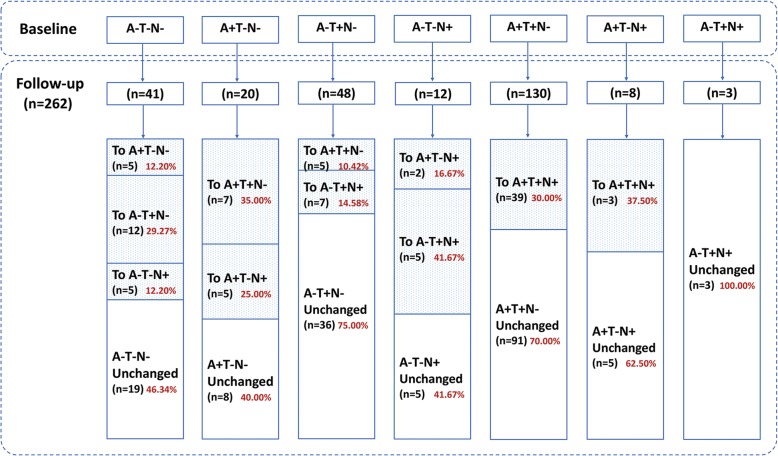
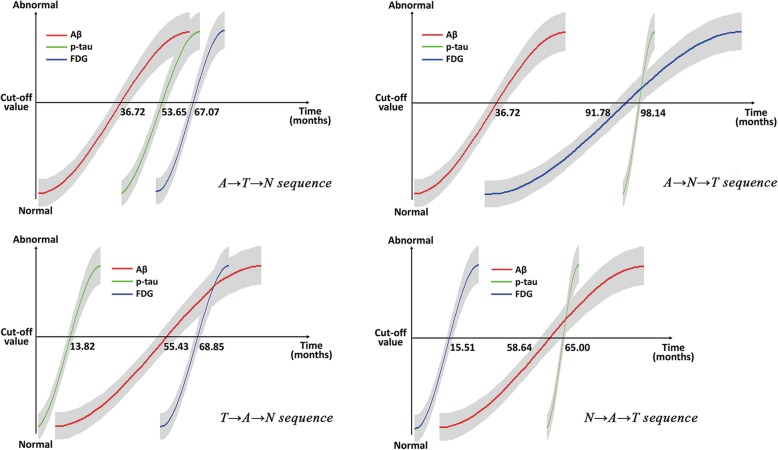
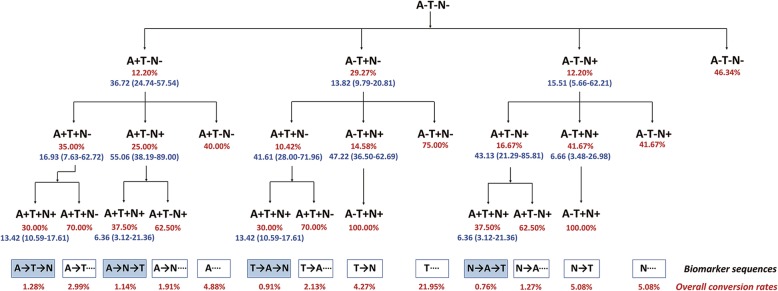
Based on the ATN classification system, 262 individuals were identified before dementia diagnosis and accompanied by baseline and follow-up data of ATN biomarkers (CSF Aβ42, p-tau, and FDG-PET). We recorded the conversion processes in ATN biomarkers during follow-up, then analyzed the possible longitudinal trajectories and estimated the conversion rate and temporal evolution of biomarker changes. To evaluate how biomarkers changed over time, we used linear mixed-effects models.
During a 6-120-month follow-up period, there were four patterns of longitudinal changes in Alzheimer's ATN biomarker profiles, from all negative to positive through the course of the disease. The most common pattern is that A pathology biomarker first emerges. As well as the classical A-T-N sequence, other "A-first," "T-first," and "N-first" biomarker pathways were found. The N-A-T sequence had the fastest rate of pathological progression (mean 65.00 months), followed by A-T-N (mean 67.07 months), T-A-N (mean 68.85 months), and A-N-T sequences (mean 98.14 months).
Our current work presents a comprehensive analysis of longitudinal trajectories of Alzheimer's ATN biomarkers in non-demented elderly adults. Stratifying disease into subtypes depending on the temporal evolution of biomarkers will benefit the early recognition and treatment.
阿尔茨海默病(AD)病理生理学模型假设淀粉样蛋白沉积[A]先于并加速导致神经退行性变[N]的 tau 病理学[T]。除了 A-T-N 序列外,还有其他可能的生物标志物序列。本研究旨在探讨和比较来自阿尔茨海默病神经影像学倡议(ADNI)队列的非痴呆老年人中阿尔茨海默病 ATN 生物标志物谱的纵向轨迹。
根据 ATN 分类系统,在痴呆诊断前确定了 262 名个体,并伴有 ATN 生物标志物(CSF Aβ42、p-tau 和 FDG-PET)的基线和随访数据。我们记录了随访过程中 ATN 生物标志物的转化过程,然后分析了可能的纵向轨迹,并估计了生物标志物变化的转化率和时间演变。为了评估生物标志物随时间的变化,我们使用了线性混合效应模型。
在 6-120 个月的随访期间,阿尔茨海默病 ATN 生物标志物谱存在四种纵向变化模式,从疾病过程中的所有阴性到阳性。最常见的模式是 A 病理学生物标志物首先出现。除了经典的 A-T-N 序列外,还发现了其他“ A 首先”、“ T 首先”和“ N 首先”的生物标志物途径。N-A-T 序列的病理进展速度最快(平均 65.00 个月),其次是 A-T-N(平均 67.07 个月)、T-A-N(平均 68.85 个月)和 A-N-T 序列(平均 98.14 个月)。
本研究全面分析了非痴呆老年人阿尔茨海默病 ATN 生物标志物的纵向轨迹。根据生物标志物的时间演变将疾病分为亚型将有助于早期识别和治疗。