Department of Genetics, Yale School of Medicine, New Haven, CT, USA.
Salk Institute for Biological Studies, La Jolla, CA, USA.
Nat Metab. 2019 Dec;1(12):1209-1218. doi: 10.1038/s42255-019-0150-8. Epub 2019 Dec 9.
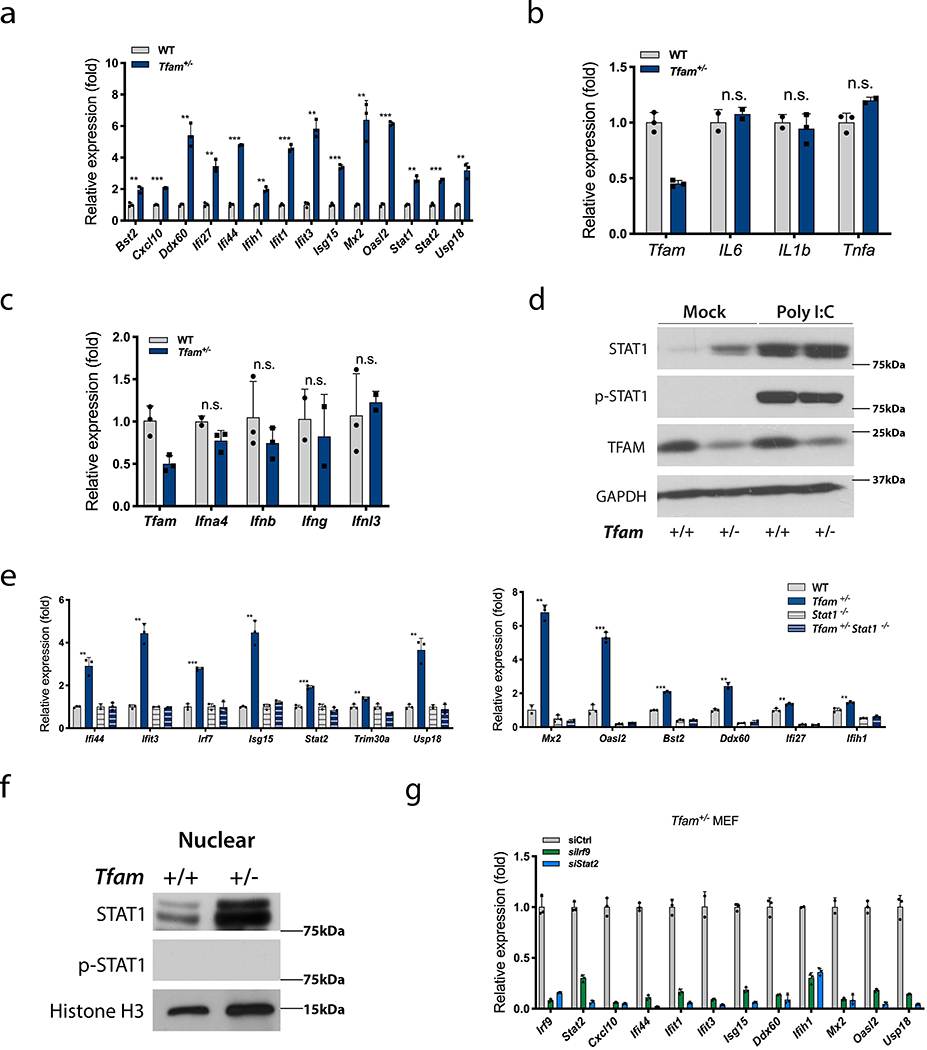
The mammalian genome comprises nuclear DNA (nDNA) derived from both parents and mitochondrial DNA (mtDNA) that is maternally inherited and encodes essential proteins required for oxidative phosphorylation. Thousands of copies of the circular mtDNA are present in most cell types that are packaged by TFAM into higher-order structures called nucleoids1. Mitochondria are also platforms for antiviral signalling2 and, due to their bacterial origin, mtDNA and other mitochondrial components trigger innate immune responses and inflammatory pathology. We showed previously that instability and cytoplasmic release of mtDNA activates the cGAS-STING-TBK1 pathway resulting in interferon stimulated gene (ISG) expression that promotes antiviral immunity4. Here, we find that persistent mtDNA stress is not associated with basally activated NF-κB signalling or interferon gene expression typical of an acute antiviral response. Instead, a specific subset of ISGs, that includes , remains activated by the unphosphorylated form of ISGF3 (U-ISGF3) that enhances nDNA damage and repair responses. In cultured primary fibroblasts and cancer cells, the chemotherapeutic drug doxorubicin causes mtDNA damage and release, which leads to cGAS-STING-dependent ISG activation. In addition, mtDNA stress in TFAM-deficient mouse melanoma cells produces tumours that are more resistant to doxorubicin . Finally, mice exposed to ionizing radiation exhibit enhanced nDNA repair responses in spleen. Therefore, we propose that damage to and subsequent release of mtDNA elicits a protective signalling response that enhances nDNA repair in cells and tissues, suggesting mtDNA is a genotoxic stress sentinel.
哺乳动物基因组包括来自父母双方的核 DNA(nDNA)和母系遗传的线粒体 DNA(mtDNA),后者编码氧化磷酸化所需的必需蛋白质。大多数细胞类型中都存在数千个圆形 mtDNA 拷贝,这些拷贝由 TFAM 包装成称为核小体的高级结构 1。线粒体也是抗病毒信号的平台 2,并且由于其细菌起源,mtDNA 和其他线粒体成分会引发先天免疫反应和炎症病理。我们之前曾表明,mtDNA 的不稳定性和细胞质释放会激活 cGAS-STING-TBK1 途径,从而导致干扰素刺激基因(ISG)的表达,从而促进抗病毒免疫 4。在这里,我们发现持续的 mtDNA 应激与 NF-κB 信号的基础激活无关,也与典型的急性抗病毒反应中干扰素基因表达无关。相反,一组特定的 ISGs,包括 ,仍然被未磷酸化形式的 ISGF3(U-ISGF3)激活,U-ISGF3 增强了 nDNA 损伤和修复反应。在培养的原代成纤维细胞和癌细胞中,化疗药物阿霉素会导致 mtDNA 损伤和释放,从而导致 cGAS-STING 依赖性 ISG 激活。此外,TFAM 缺陷型小鼠黑色素瘤细胞中的 mtDNA 应激会产生对阿霉素更具抗性的肿瘤 。最后,暴露于电离辐射的 小鼠在脾脏中表现出增强的 nDNA 修复反应。因此,我们提出 mtDNA 的损伤和随后的释放会引发保护性信号反应,从而增强细胞和组织中的 nDNA 修复,这表明 mtDNA 是一种遗传毒性应激哨兵。