Aula Dei Experimental Station (EEAD-CSIC), Avda. Montañana 1005, E-50059, Zaragoza, Spain.
Centre for Agriculture Research (ATK), Martonvásár, H-2462, Hungary.
BMC Plant Biol. 2020 May 12;20(1):207. doi: 10.1186/s12870-020-02416-1.
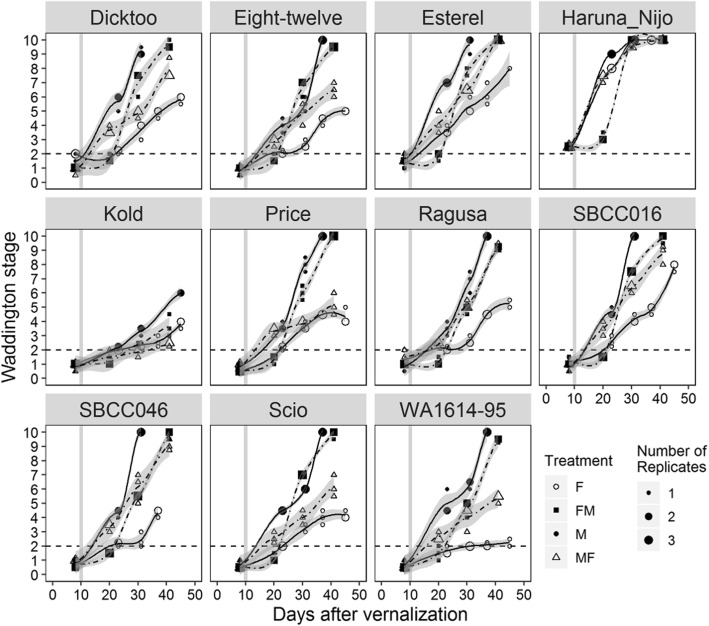
Plants use light wavelength, intensity, direction and duration to predict imminent seasonal changes and to determine when to initiate physiological and developmental processes. Among them, crop responses to light are not fully understood. Here, we study how light quality affects barley development, using two broad-spectrum light sources, metal halide (M) and fluorescent (F) lamps. Eleven varieties with known allelic variants for the major flowering time genes were evaluated under controlled conditions (long days, same light intensity). Two experiments were carried out with fully-vernalized plants: 1) control treatments (M, F); 2) shifting chambers 10 days after the start of the experiment (MF, FM).
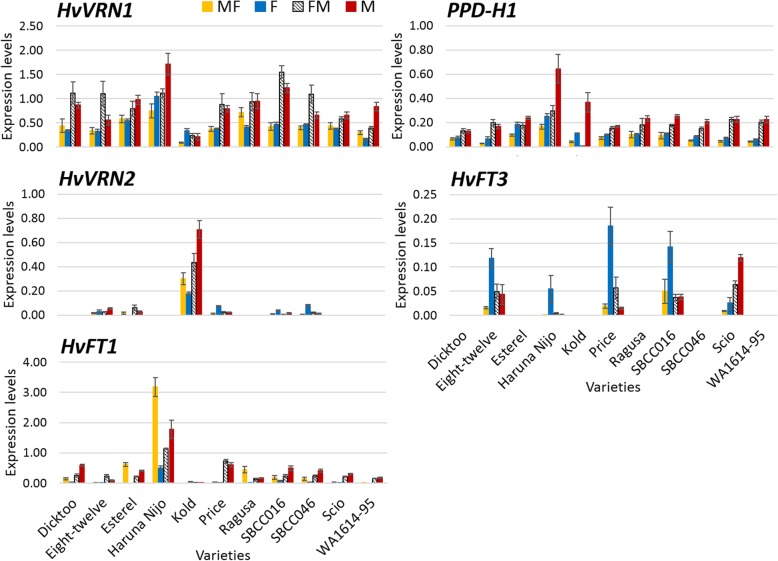
In general, varieties developed faster under longer exposure to M conditions. The greatest differences were due to a delay promoted by F light bulbs, especially in the time to first node appearance and until the onset of stem elongation. Yield related-traits as the number of seeds were also affected by the conditions experienced. However, not each variety responded equally, and they could be classified in insensitive and sensitive to light quality. Expression levels of flowering time genes HvVRN1, HvFT1 and PPD-H1 were high in M, while HvFT3 and HvVRN2 were higher under F conditions. The expression under shift treatments revealed also a high correlation between HvVRN1 and PPD-H1 transcript levels.
The characterization of light quality effects has highlighted the important influence of the spectrum on early developmental stages, affecting the moment of onset of stem elongation, and further consequences on the morphology of the plant and yield components. We suggest that light spectra control the vernalization and photoperiod genes probably through the regulation of upstream elements of signalling pathways. The players behind the different responses to light spectra found deserve further research, which could help to optimize breeding strategies.
植物利用光的波长、强度、方向和持续时间来预测即将发生的季节变化,并确定何时启动生理和发育过程。其中,作物对光的反应尚未完全了解。在这里,我们使用两种广谱光源,金属卤化物(M)和荧光灯(F),研究了光质如何影响大麦的发育。在控制条件下(长日、相同光照强度),对 11 个具有主要开花时间基因等位变体的品种进行了评估。进行了两项完全春化植物的实验:1)对照处理(M、F);2)实验开始后 10 天转移室(MF、FM)。
一般来说,M 条件下暴露时间更长的品种发育更快。最大的差异是由于 F 灯泡延迟引起的,尤其是在第一节点出现和茎伸长开始之间的时间。与产量相关的性状,如种子数量,也受到所经历条件的影响。然而,并非每个品种的反应都相同,它们可以分为对光质不敏感和敏感的品种。开花时间基因 HvVRN1、HvFT1 和 PPD-H1 的表达水平在 M 下较高,而 HvFT3 和 HvVRN2 在 F 条件下较高。在转换处理下的表达也揭示了 HvVRN1 和 PPD-H1 转录水平之间的高度相关性。
光质效应的特征强调了光谱对早期发育阶段的重要影响,影响茎伸长开始的时刻,进一步影响植物的形态和产量组成。我们认为,光光谱通过调控信号通路的上游元件来控制春化和光周期基因。对不同光质反应背后的参与者值得进一步研究,这有助于优化育种策略。