Rising Camella J, Jensen Roxanne E, Moser Richard P, Oh April
Health Communication and Informatics Research Branch, Behavioral Research Program, Division of Cancer Control and Population Sciences, National Cancer Institute, Rockville, MD, United States.
Outcomes Research Branch, Healthcare Delivery Research Program, Division of Cancer Control and Population Sciences, National Cancer Institute, Rockville, MD, United States.
J Med Internet Res. 2020 May 14;22(5):e16299. doi: 10.2196/16299.
Multiple types of mobile health (mHealth) technologies are available, such as smartphone health apps, fitness trackers, and digital medical devices. However, despite their availability, some individuals do not own, do not realize they own, or own but do not use these technologies. Others may use mHealth devices, but their use varies in tracking health, behaviors, and goals. Examining patterns of mHealth use at the population level can advance our understanding of technology use for health and behavioral tracking. Moreover, investigating sociodemographic and health-related correlates of these patterns can provide direction to researchers about how to target mHealth interventions for diverse audiences.
The aim of this study was to identify patterns of mHealth use for health and behavioral tracking in the US adult population and to characterize the population according to those patterns.
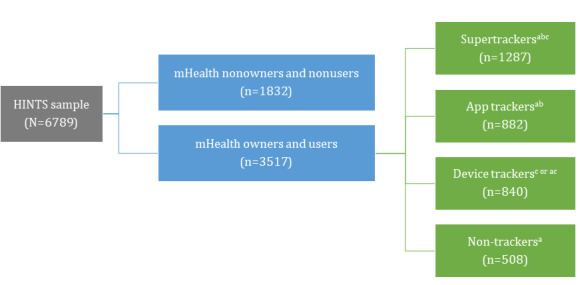
We combined data from the 2017 and 2018 National Cancer Institute Health Information National Trends Survey (N=6789) to characterize respondents according to 5 mutually exclusive reported patterns of mHealth use for health and behavioral tracking: (1) mHealth nonowners and nonusers report not owning or using devices to track health, behaviors, or goals; (2) supertrackers track health or behaviors and goals using a smartphone or tablet plus other devices (eg, Fitbit); (3) app trackers use only a smartphone or tablet; (4) device trackers use only nonsmartphone or nontablet devices and do not track goals; and (5) nontrackers report having smartphone or tablet health apps but do not track health, behaviors, or goals.
Being in the mHealth nonowners and nonusers category (vs all mHealth owners and users) is associated with males, older age, lower income, and not being a health information seeker. Among mHealth owners and users, characteristics of device trackers and supertrackers were most distinctive. Compared with supertrackers, device trackers have higher odds of being male (odds ratio [OR] 2.22, 95% CI 1.55-3.19), older age (vs 18-34 years; 50-64 years: OR 2.83, 95% CI 1.52-5.30; 65+ years: OR 6.28, 95% CI 3.35-11.79), have an annual household income of US $20,000 to US $49,999 (vs US $75,000+: OR 2.31, 95% CI 1.36-3.91), and have a chronic condition (OR 1.69, 95% CI 1.14-2.49). Device trackers also have higher odds of not being health information seekers than supertrackers (OR 2.98, 95% CI 1.66-5.33).
Findings revealed distinctive sociodemographic and health-related characteristics of the population by pattern of mHealth use, with notable contrasts between those who do and do not use devices to track goals. Several characteristics of individuals who track health or behaviors but not goals (device trackers) are similar to those of mHealth nonowners and nonusers. Our results suggest patterns of mHealth use may inform how to target mHealth interventions to enhance reach and facilitate healthy behaviors.
多种类型的移动健康(mHealth)技术可供使用,如智能手机健康应用程序、健身追踪器和数字医疗设备。然而,尽管有这些技术,一些人并不拥有、没有意识到自己拥有或拥有但不使用这些技术。其他人可能使用移动健康设备,但他们在追踪健康、行为和目标方面的使用情况各不相同。在人群层面研究移动健康的使用模式可以增进我们对健康和行为追踪技术使用的理解。此外,调查这些模式的社会人口统计学和健康相关关联因素可以为研究人员提供方向,指导他们如何针对不同受众开展移动健康干预措施。
本研究的目的是识别美国成年人群中用于健康和行为追踪的移动健康使用模式,并根据这些模式对人群进行特征描述。
我们将2017年和2018年美国国立癌症研究所健康信息全国趋势调查的数据(N = 6789)相结合,根据报告的5种相互排斥的移动健康用于健康和行为追踪的模式对受访者进行特征描述:(1)移动健康非拥有者和非使用者报告不拥有或不使用设备来追踪健康、行为或目标;(2)超级追踪者使用智能手机或平板电脑以及其他设备(如Fitbit)来追踪健康、行为和目标;(3)应用程序追踪者仅使用智能手机或平板电脑;(4)设备追踪者仅使用非智能手机或非平板电脑设备且不追踪目标;(5)非追踪者报告拥有智能手机或平板电脑健康应用程序,但不追踪健康、行为或目标。
处于移动健康非拥有者和非使用者类别(与所有移动健康拥有者和使用者相比)与男性、年龄较大、收入较低以及不是健康信息寻求者相关。在移动健康拥有者和使用者中,设备追踪者和超级追踪者的特征最为独特。与超级追踪者相比,设备追踪者为男性的几率更高(优势比[OR] 2.22,95%置信区间1.55 - 3.19),年龄较大(与18 - 34岁相比;50 - 64岁:OR 2.83,95%置信区间1.52 - 5.30;65岁及以上:OR 6.28,95%置信区间3.35 - 11.79),家庭年收入为20,000美元至49,999美元(与75,000美元及以上相比:OR 2.31,95%置信区间1.36 - 3.91),并且患有慢性病(OR 1.69,95%置信区间1.14 - 2.49)。设备追踪者不是健康信息寻求者的几率也比超级追踪者更高(OR 2.98,95%置信区间1.66 - 5.33)。
研究结果揭示了按移动健康使用模式划分的人群在社会人口统计学和健康相关方面的独特特征,在使用设备追踪目标和不使用设备追踪目标的人群之间存在显著差异。追踪健康或行为但不追踪目标的个体(设备追踪者)的几个特征与移动健康非拥有者和非使用者相似。我们的结果表明,移动健康使用模式可能为如何针对性地开展移动健康干预措施以扩大覆盖范围并促进健康行为提供参考。
