Department of Maternal and Child Health, School of Public Health, Sun Yat-sen University, Guangzhou, Guangdong, China (mainland).
Department of School Health, Center for Disease Control and Prevention, Shenzhen, Guangdong, China (mainland).
Med Sci Monit. 2020 May 15;26:e921617. doi: 10.12659/MSM.921617.
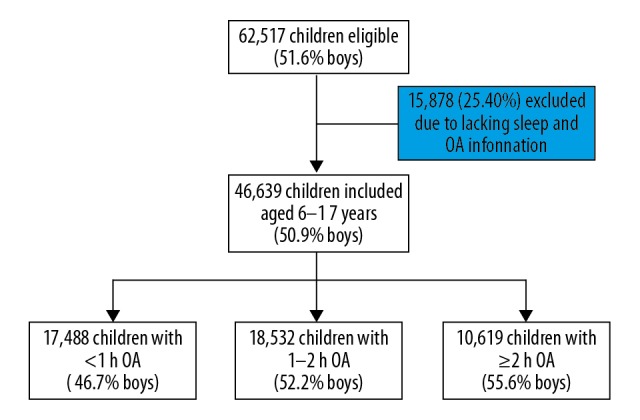
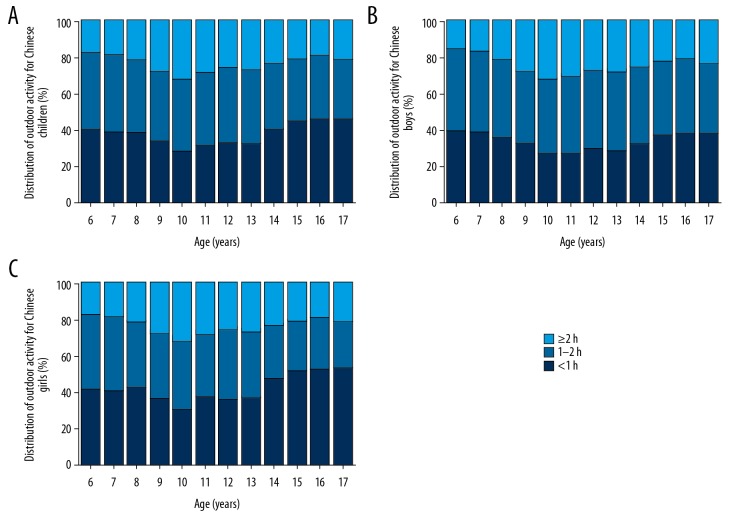
BACKGROUND The aim of this study was to explore the relationship between outdoor activity (OA) and insufficient sleep duration (ISD) among Chinese children and to assess the potential age- and gender-specific effects. MATERIAL AND METHODS A national sample of 62 517 children aged 6-17 years were recruited from 7 provinces of China in the autumn of 2013. Children and their caregivers reported daily sleep duration (<7 h, 7-9 h and ≥9 h), daily OA time (<1 h, 1-2 h, and ≥2 h), and other behavior and demographic information by standardized questionnaire. ISD was defined as <9 h/day. Logistic regression analysis was used to evaluate the relationship between ISD and OA. RESULTS In total, 46 639 children (50.9% boys) completed this survey. The prevalence of ISD was 74.9% (73.7% in boys and 76.1% in girls). Stratified by age, compared with <1 h OA, the odds ratios for ISD were 0.67 (95% confidence interval: 0.62-0.72, aged 6-13 years) and 0.69 (0.49-0.98, 14-17 years) in the ≥2 h OA group; 0.91 (0.85-0.97, 6-13 years) and 0.73 (0.54-0.97, 14-17 years) in the 1-2 h OA group. Further stratified by gender, we found similar trends for both boys and girls in each age group, although some results became non-significant. CONCLUSIONS Adequate OA time per day is associated with decreased risks for ISD among children aged 6-17 years, but age and gender can modify the association.
本研究旨在探讨中国儿童户外活动(OA)与睡眠不足(ISD)之间的关系,并评估潜在的年龄和性别特异性影响。
本研究采用多阶段分层整群随机抽样方法,于 2013 年秋季从中国 7 个省的 62517 名 6-17 岁儿童中收集数据。儿童及其照料者通过标准化问卷报告每日睡眠时长(<7 小时、7-9 小时和≥9 小时)、每日 OA 时间(<1 小时、1-2 小时和≥2 小时)和其他行为及人口统计学信息。ISD 定义为<9 小时/天。采用 logistic 回归分析评估 ISD 与 OA 之间的关系。
共 46639 名儿童(50.9%为男孩)完成了本项调查。ISD 的患病率为 74.9%(男孩为 73.7%,女孩为 76.1%)。按年龄分层,与<1 小时 OA 相比,≥2 小时 OA 组 ISD 的比值比(OR)分别为 0.67(95%置信区间:0.62-0.72,6-13 岁)和 0.69(0.49-0.98,14-17 岁);1-2 小时 OA 组 OR 分别为 0.91(0.85-0.97,6-13 岁)和 0.73(0.54-0.97,14-17 岁)。进一步按性别分层,我们发现每个年龄组的男孩和女孩均存在类似趋势,但一些结果变得不显著。
对于 6-17 岁儿童,每天进行适量的 OA 与降低 ISD 风险相关,但年龄和性别会影响这种关联。