Neurobiology Laboratory, Cerebrovascular Unit, Fondazione IRCCS Istituto Neurologico Carlo Besta, 20133 Milan, Italy.
Cerebrovascular Unit, Fondazione IRCCS Istituto Neurologico Carlo Besta, 20133 Milan, Italy.
Int J Mol Sci. 2020 May 13;21(10):3435. doi: 10.3390/ijms21103435.
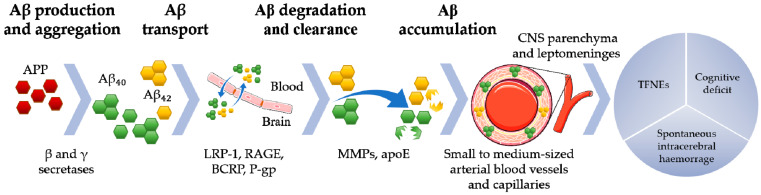
Cerebral amyloid angiopathy (CAA), one of the main types of cerebral small vessel disease, is a major cause of spontaneous intracerebral haemorrhage and an important contributor to cognitive decline in elderly patients. Despite the number of experimental in vitro studies and animal models, the pathophysiology of CAA is still largely unknown. Although several pathogenic mechanisms including an unbalance between production and clearance of amyloid beta (Aβ) protein as well as 'the prion hypothesis' have been invoked as possible disease triggers, they do not explain completely the disease pathogenesis. This incomplete disease knowledge limits the implementation of treatments able to prevent or halt the clinical progression. The continuous increase of CAA patients makes imperative the development of suitable experimental in vitro or animal models to identify disease biomarkers and new pharmacological treatments that could be administered in the early disease stages to prevent irreversible changes and disease progression.
脑淀粉样血管病(Cerebral amyloid angiopathy,CAA)是脑小血管病的主要类型之一,是自发性脑出血的主要原因,也是老年患者认知能力下降的重要原因。尽管有大量的体外实验研究和动物模型,但 CAA 的病理生理学仍知之甚少。尽管已经提出了几种可能的致病机制,包括淀粉样β(Aβ)蛋白产生和清除之间的失衡以及“朊病毒假说”,但这些机制并不能完全解释疾病的发病机制。这种不完全的疾病知识限制了能够预防或阻止临床进展的治疗方法的实施。CAA 患者的不断增加,使得开发合适的体外实验或动物模型来识别疾病生物标志物和新的药理学治疗方法变得尤为必要,这些方法可以在疾病早期应用,以防止不可逆转的变化和疾病进展。