Department of Chemical Sciences, University of Napoli Federico II, Via Cintia 4, I-80126 Naples, Italy.
Associazione Italiana per la Promozione delle Ricerche su Ambiente e Salute umana, Via Campellone 50, 82030 Dugenta (BN), Italy.
Molecules. 2020 May 13;25(10):2294. doi: 10.3390/molecules25102294.
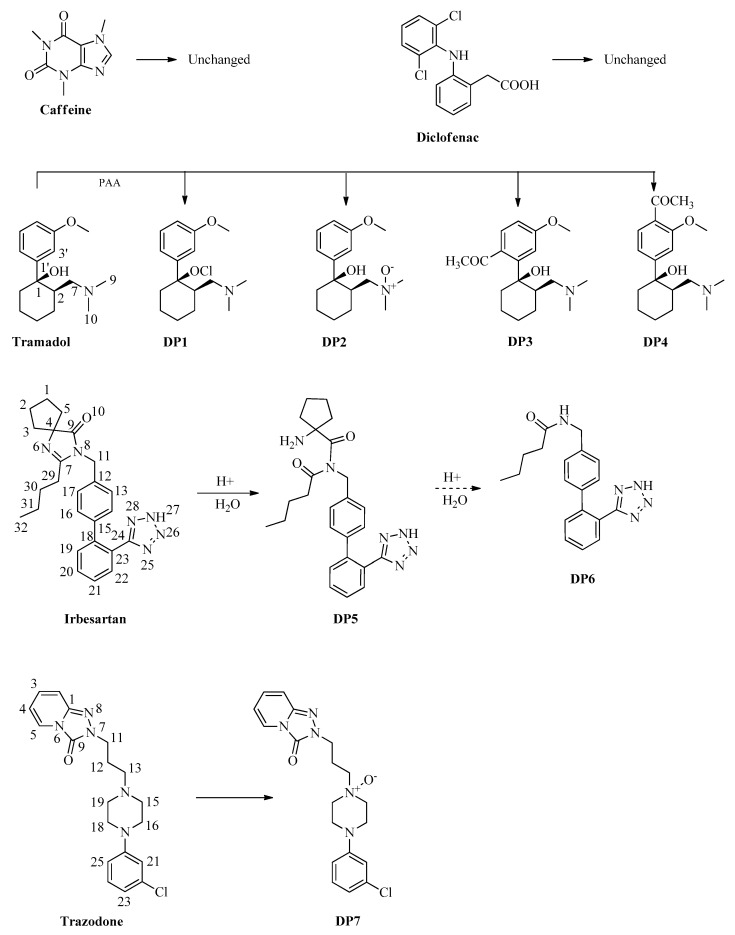
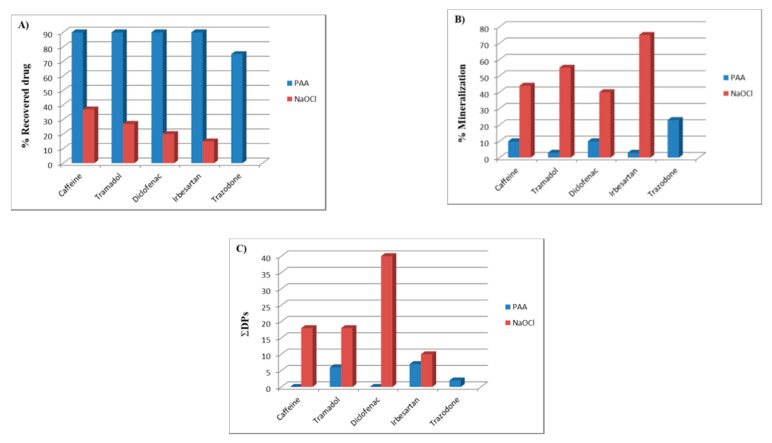
Numerous substances from different chemical sectors, from the pharmaceutical industry to the many consumer products available for everyday usage, can find their way into water intended for human consumption and wastewater, and can have adverse effects on the environment and human health. Thus, the disinfection process is an essential stage in water and wastewater treatment plants to destroy pathogenic microorganisms but it can form degradation byproducts. Sodium hypochlorite is the most common disinfectant, but the most important drawback associated with this kind of compound is the generation of toxic disinfection byproducts. Many studies have been carried out to identify alternative disinfectants, and in the last few years, peracetic acid has been highlighted as a feasible solution, particularly in wastewater treatment. This study compares the transformations of five emerging pollutants (caffeine, tramadol, irbesartan, diclofenac, trazodone) treated with peracetic acid, to evaluate their degradation and the possible formation of byproducts with those obtained with sodium hypochlorite. Although peracetic acid has many advantages, including a wide field of use against microorganisms and a low toxicity towards animal and plant organisms, it is not as effective in the degradation of the considered pollutants. These ones are recovered substantially and are unchanged quantitatively, producing a very low number of byproducts.
许多来自不同化学领域的物质,从制药行业到许多日常使用的消费品,都可能进入供人类饮用的水和废水,并对环境和人类健康产生不利影响。因此,消毒过程是水处理厂和废水处理厂的一个重要阶段,用于消灭致病微生物,但它也会形成降解副产物。次氯酸钠是最常用的消毒剂,但这种化合物最重要的缺点是会产生有毒的消毒副产物。许多研究都致力于寻找替代消毒剂,近年来,过氧乙酸已被认为是一种可行的解决方案,特别是在废水处理中。本研究比较了用过氧乙酸处理的五种新兴污染物(咖啡因、曲马多、厄贝沙坦、双氯芬酸、曲唑酮)的转化,以评估它们的降解情况和可能形成的副产物与次氯酸钠相比。虽然过氧乙酸有许多优点,包括对微生物有广泛的应用领域和对动物和植物组织的低毒性,但它在降解所考虑的污染物方面效果并不理想。这些污染物大量回收且数量没有变化,只产生了很少的副产物。