Bruck de Souza Letiele, Leitão Gindri Amanda, de Andrade Fortes Thainara, Felli Kubiça Thais, Enderle Jefferson, Roehrs Rafael, Moura E Silva Sidnei, Manfredini Vanusa, Gasparotto Denardin Elton Luís
Laboratório Estudos Físico-Químico e Produtos Naturais (LEFQPN), Federal University of Pampa (UNIPAMPA), P. Box 118, Uruguaiana, RS 97501-970, Brazil.
Laboratório de Plantas Medicinais, Universidade Regional Integrada do Alto Uruguai e Das Missões, Santiago, RS, Brazil.
Adv Pharmacol Pharm Sci. 2020 May 1;2020:3260745. doi: 10.1155/2020/3260745. eCollection 2020.
This work was to evaluate the chemical constitution of the hydromethanolic (30/70 methanol-water) macerating extract obtained from the leaves of , as well as to study the antioxidant, antimicrobial, cytotoxic, and genotoxic activity of the species. . Phytochemical screening, antioxidant activity (total phenolic, total flavonoid, condensed tannins content, DPPH radical, and FRAP), antibacterial activity ( (clinical isolate), (clinical isolate), (clinical isolate), (clinical isolate)), and oxidative stress parameters (TBARS, carbonyl protein, and DCFH) were analyzed according to the literature. Toxicity of was evaluated using an alternative method, , as well as a locomotor assay.
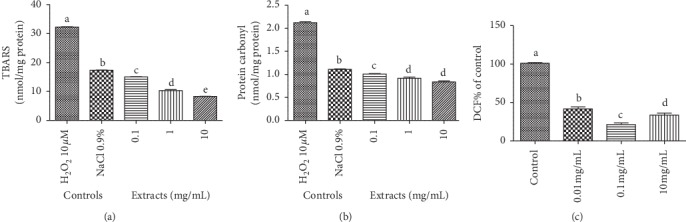
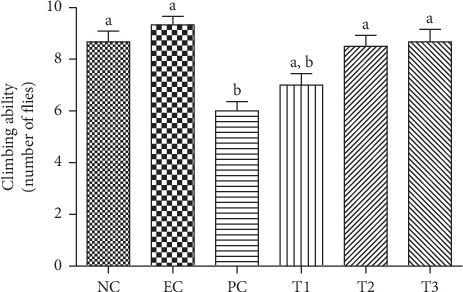
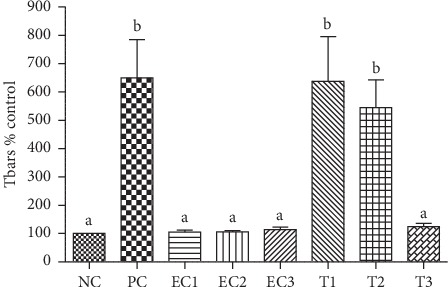
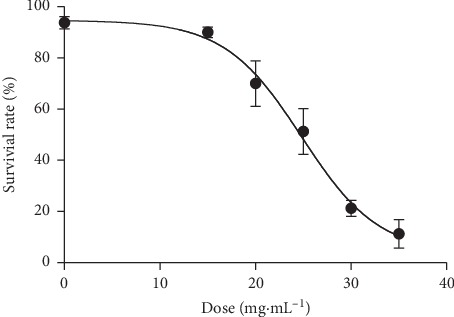
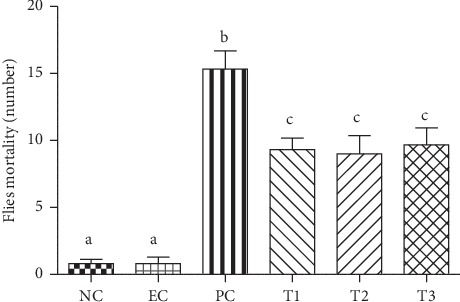
The phytochemical screening test of methanolic leaves extract revealed the presence of alkaloids, coumarins, quaternary bases, phenolics, flavonoids, tannins, and free steroids. A quantitative phytochemical study indicated the total phenol (30.17 ± 1.44 mg/g), flavonoid (21.64 ± 0.66 mg/g), and condensed tannins (9.58 ± 0.99 mg/g). DPPH (345.41 ± 5.35 g/mL) and FRAP (379.98 ± 39.25 M FeSO4/mg sample) show to extract of leaves an intermediate value, indicating moderate antioxidant activity of the extract. Antibacterial results revealed only a positive result (antimicrobial activity) for the hexane fraction which significantly inhibited the microorganisms , and at a concentration of 1000 g/mL. TBARS, carbonyl protein, and DCFH demonstrate that the extract has the ability to protect the cell from protein and lipid damage, as well as the inhibition of oxygen-derived radicals at the three concentrations tested: 0.1, 1, and 10 mg/mL. Regarding the toxicity of extract against , it was found that until the concentration of 15 mg/mL, the extract showed no toxicity and that the LC obtained was 24 mg/mL. Results show that the extract leaves used to prevent PQ damage were effective in reducing flies' mortality and improving locomotor capacity.
Our studies demonstrated for the first time that crude leaf extract has high antioxidant capacity both in vitro and in vivo through different analysis techniques. These results make it possible to infer future applications in the pharmacological area, evidenced by the low toxicity observed in D. melanogatser, as well as the ability to neutralize different sources of RONS.
本研究旨在评估从[植物名称]叶片中获得的氢甲醇(30/70甲醇 - 水)浸渍提取物的化学成分,并研究该植物的抗氧化、抗菌、细胞毒性和遗传毒性活性。根据文献分析进行植物化学筛选、抗氧化活性(总酚、总黄酮、缩合单宁含量、DPPH自由基和FRAP)、抗菌活性([临床分离株1]、[临床分离株2]、[临床分离株3]、[临床分离株4])以及氧化应激参数(TBARS、羰基蛋白和DCFH)。使用替代方法[具体方法名称]以及运动试验评估[植物名称]的毒性。
甲醇叶提取物的植物化学筛选试验表明存在生物碱、香豆素、季铵碱、酚类、黄酮类、单宁和游离甾体。定量植物化学研究表明总酚含量为(30.17 ± 1.44mg/g),黄酮含量为(21.64 ± 0.66mg/g),缩合单宁含量为(9.58 ± 0.99mg/g)。DPPH(345.41 ± 5.35g/mL)和FRAP(379.98 ± 39.25μM FeSO4/mg样品)显示[植物名称]叶提取物具有中间值,表明提取物具有中等抗氧化活性。抗菌结果显示仅己烷馏分有阳性结果(抗菌活性),在浓度为1000μg/mL时能显著抑制[微生物名称1]和[微生物名称2]。TBARS、羰基蛋白和DCFH表明提取物在0.1、1和10mg/mL这三个测试浓度下具有保护细胞免受蛋白质和脂质损伤的能力,以及抑制氧衍生自由基的能力。关于[植物名称]提取物对[受试生物名称]的毒性,发现直到浓度为15mg/mL时,提取物均无毒性,获得的LC50为24mg/mL。结果表明,用于预防百草枯损伤的[植物名称]叶提取物能有效降低果蝇死亡率并提高运动能力。
我们的研究首次通过不同分析技术证明[植物名称]粗叶提取物在体外和体内均具有高抗氧化能力。这些结果使得可以推断其在药理学领域的未来应用,这在黑腹果蝇中观察到的低毒性以及中和不同来源活性氧氮物种的能力中得到了证明。