Tri-institutional Center for Translational Research in Neuroimaging and Data Science (TReNDS), Georgia State University, Georgia Institute of Technology, Emory University, Atlanta, GA, 30303, USA.
Department of Psychiatry, University of New Mexico, Albuquerque, NM, 87131, USA.
Transl Psychiatry. 2020 May 18;10(1):149. doi: 10.1038/s41398-020-0834-6.
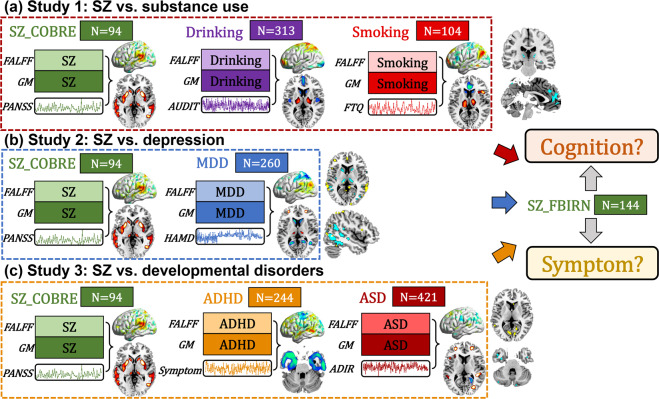
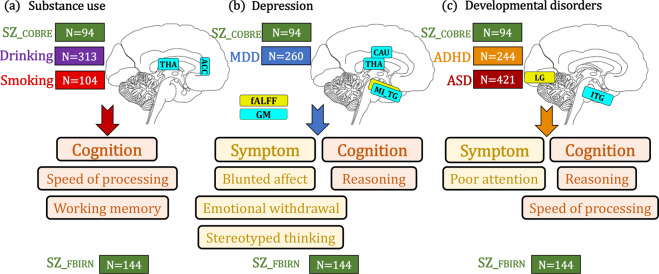
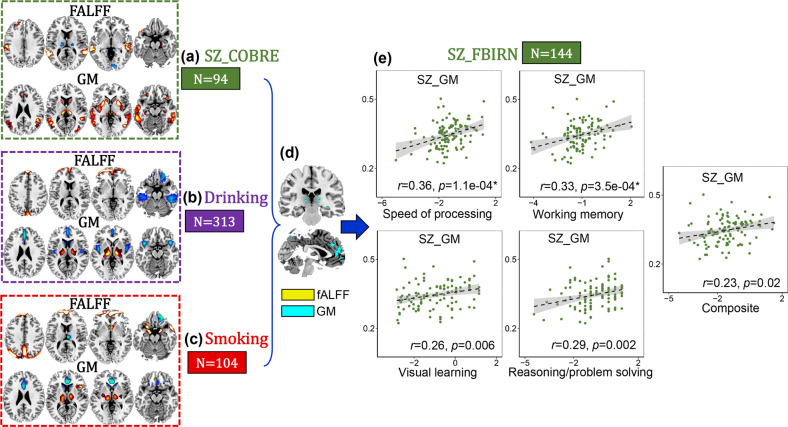
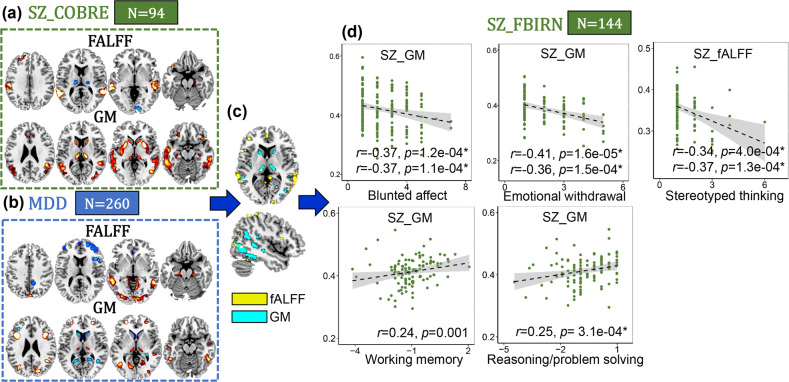
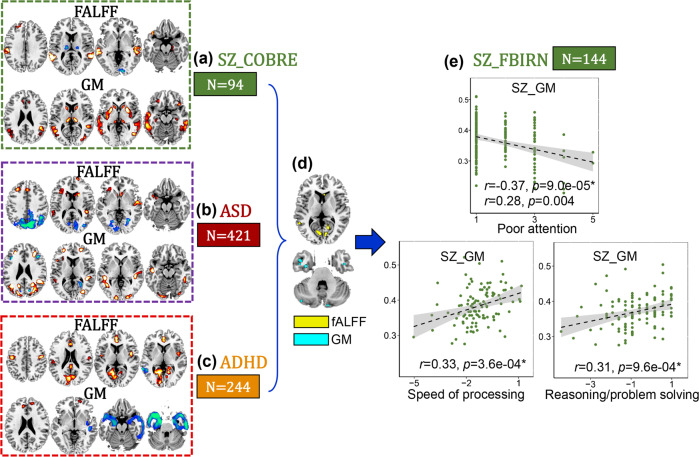
Schizophrenia (SZ) is frequently concurrent with substance use, depressive symptoms, social communication and attention deficits. However, the relationship between common brain networks (e.g., SZ vs. substance use, SZ vs. depression, SZ vs. developmental disorders) with SZ on specific symptoms and cognition is unclear. Symptom scores were used as a reference to guide fMRI-sMRI fusion for SZ (n = 94), substance use with drinking (n = 313), smoking (n = 104), major depressive disorder (MDD, n = 260), developmental disorders with autism spectrum disorder (ASD, n = 421) and attention-deficit/hyperactivity disorder (ADHD, n = 244) respectively. Common brain regions were determined by overlapping the symptom-related components between SZ and these other groups. Correlation between the identified common brain regions and cognition/symptoms in an independent SZ dataset (n = 144) was also performed. Results show that (1): substance use was related with cognitive deficits in schizophrenia through gray matter volume (GMV) in anterior cingulate cortex and thalamus; (2) depression was linked to PANSS negative dimensions and reasoning in SZ through a network involving caudate-thalamus-middle/inferior temporal gyrus in GMV; (3) developmental disorders pattern was correlated with poor attention, speed of processing and reasoning in SZ through inferior temporal gyrus in GMV. This study reveals symptom driven transdiagnostic shared networks between SZ and other mental disorders via multi-group data mining, indicating that some potential common underlying brain networks associated with schizophrenia differently with respect to symptoms and cognition. These results have heuristic value and advocate specific approaches to refine available treatment strategies for comorbid conditions in schizophrenia.
精神分裂症(SZ)常并发物质使用、抑郁症状、社会交流和注意力缺陷。然而,常见脑网络(如 SZ 与物质使用、SZ 与抑郁、SZ 与发育障碍)与 SZ 特定症状和认知之间的关系尚不清楚。症状评分被用作参考,指导 SZ(n=94)、物质使用(饮酒 n=313、吸烟 n=104)、重度抑郁症(MDD,n=260)、发育障碍(自闭症谱系障碍 n=421)和注意力缺陷/多动障碍(ADHD,n=244)的 fMRI-sMRI 融合。通过重叠 SZ 与这些其他组之间的症状相关成分来确定常见脑区。还对独立的 SZ 数据集(n=144)中识别的常见脑区与认知/症状之间的相关性进行了分析。结果表明:(1)物质使用通过前扣带回皮质和丘脑的灰质体积(GMV)与 SZ 的认知缺陷有关;(2)抑郁与 SZ 的 PANSS 阴性维度和推理有关,涉及 GMV 中的尾状核-丘脑-中/下颞叶网络;(3)发育障碍模式与 SZ 的注意力、处理速度和推理能力差有关,涉及 GMV 中的下颞叶。这项研究通过多组数据挖掘揭示了 SZ 与其他精神障碍之间的症状驱动的跨诊断共享网络,表明一些潜在的与 SZ 相关的共同潜在脑网络在症状和认知方面存在差异。这些结果具有启发价值,并提倡采用特定方法来完善 SZ 共病的现有治疗策略。