Department of Chemical Engineering, Ariel University, Kyriat-ha-Mada, Ariel 4070000, Israel.
Int J Mol Sci. 2020 May 15;21(10):3512. doi: 10.3390/ijms21103512.
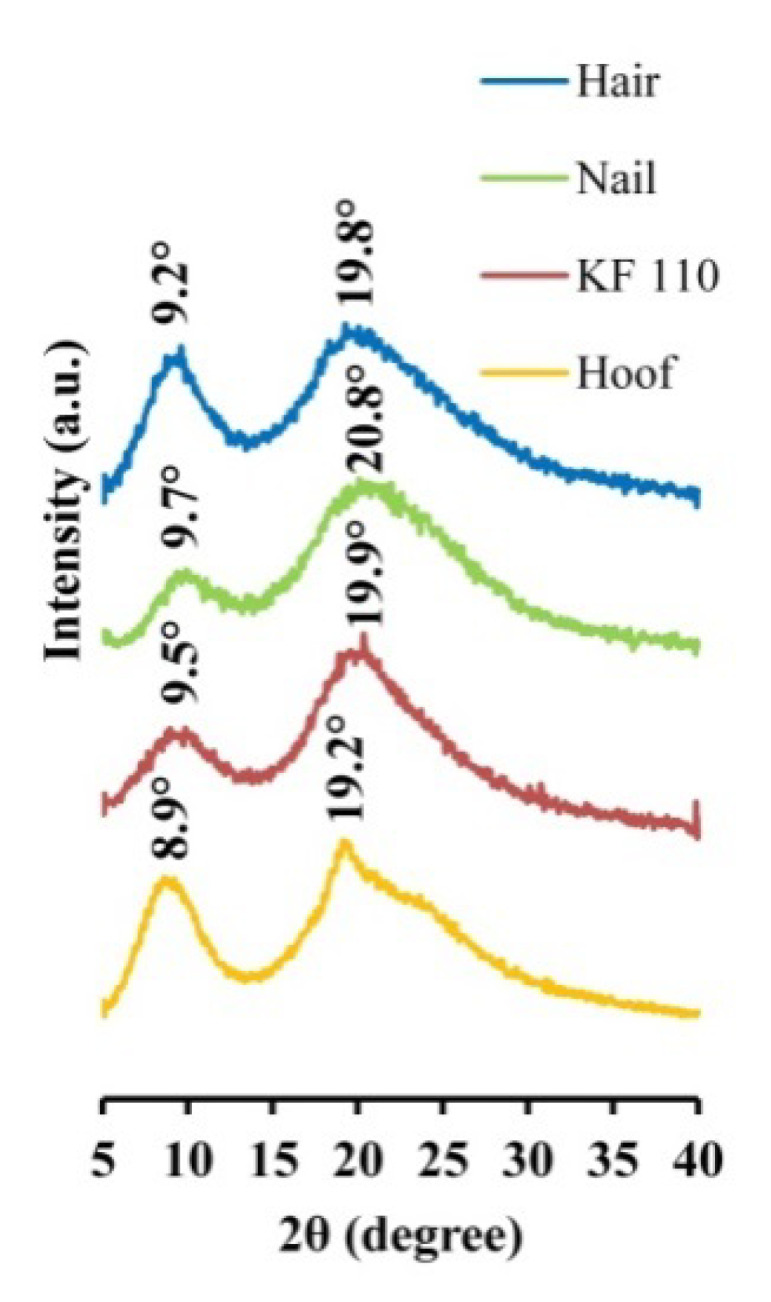
Difficulties in obtaining human nails that are large enough for examining the penetration of drug formulations led us to produce keratin films regenerated from human hair. We assume that these films can simulate human nail plates in drug penetration and permeation tests and can serve as a biological model for studying onychomycosis. The films were formed from keratin extracted from human hair using dithiothreitol, urea and thiourea. The obtained keratin extract was dispensed into Teflon rings and dried at 40 °C and then cured at 110 °C. The structure, surface morphology, chemical characterization and thermal stability of the films were characterized and were compared to those of human nail, hair and bovine hoof samples using SDS-electrophoresis, scanning electron microscopy (SEM), X-ray diffraction analysis (XRD), Fourier transform infrared spectroscopy (FTIR) and thermogravimetric analysis (TGA). The structure of the obtained films was found to be closer to human nails than to hair or bovine hooves. The keratin films were infected with and were proven to be appropriate for serving as a model for studying onychomycosis.
由于难以获得足够大的人指甲来检测药物制剂的渗透情况,我们制作了从人发再生的角蛋白薄膜。我们假设这些薄膜可以模拟人指甲板在药物渗透和渗透测试中的情况,并可以作为研究甲真菌病的生物模型。这些薄膜是用人发中的角蛋白用二硫苏糖醇、尿素和硫脲制成的。将得到的角蛋白提取物分注到聚四氟乙烯环中,在 40°C 下干燥,然后在 110°C 下固化。使用 SDS-电泳、扫描电子显微镜 (SEM)、X 射线衍射分析 (XRD)、傅里叶变换红外光谱 (FTIR) 和热重分析 (TGA) 对薄膜的结构、表面形貌、化学特性和热稳定性进行了表征,并与人类指甲、头发和牛蹄样本进行了比较。结果发现,所得到的薄膜的结构与人指甲更接近,而不是头发或牛蹄。角蛋白薄膜被 感染,并被证明适合用作研究甲真菌病的模型。