Uceda-Rodríguez Manuel, López-García Ana B, Moreno-Maroto José Manuel, Cobo-Ceacero Carlos Javier, Cotes-Palomino María Teresa, Martínez García Carmen
Department of Chemical, Environmental and Materials Engineering, Higher Polytechnic School of Linares, University of Jaen, Scientific and Technological Campus of Linares, 23700 Linares (Jaén), Spain.
Materials (Basel). 2020 May 20;13(10):2351. doi: 10.3390/ma13102351.
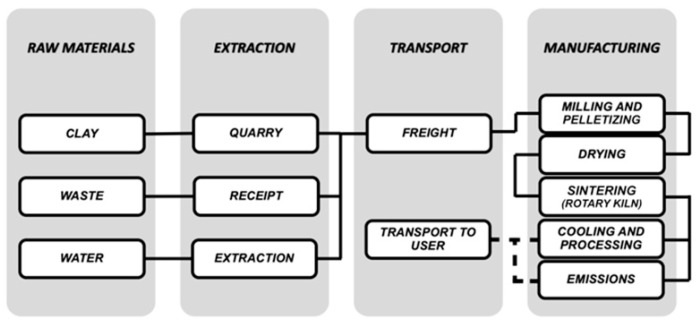
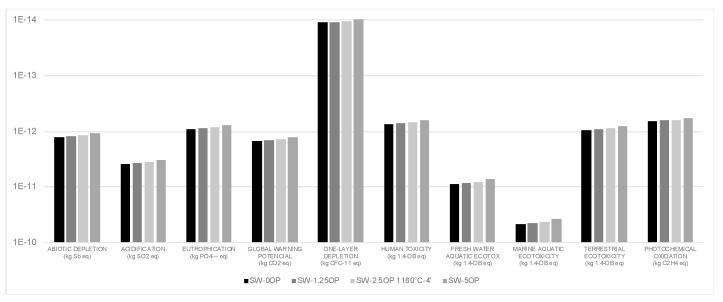
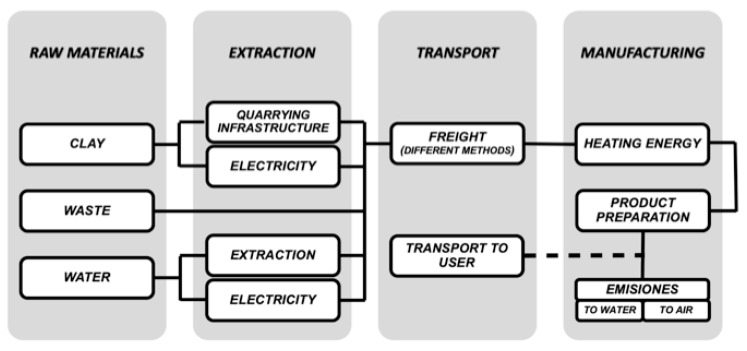
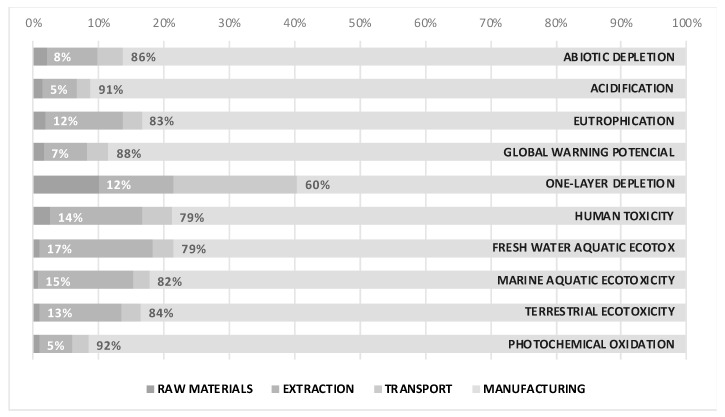
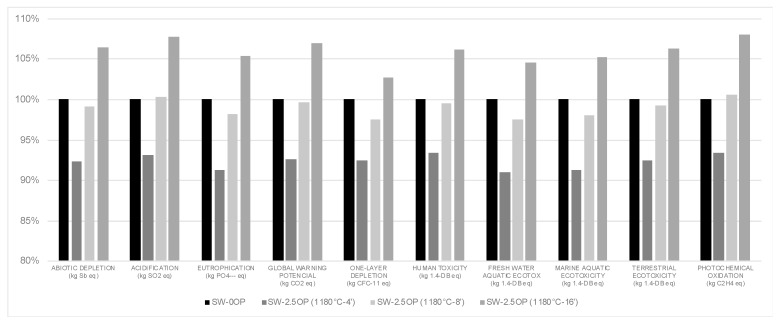
A Life Cycle Assessment (LCA) using SimaPro software has been carried out concerning the manufacture of artificial lightweight aggregates (LWAs). The study aims to evaluate the changes in the environmental impact when an additive of residual origin, specifically olive pomace (OP), is added following the principles of the Circular Economy. This residue (commonly known as alperujo) was used as a substitute for clay in 1.25, 2.5 and 5 wt%. The environmental impact related to the use of olive pomace in the mixture was estimated using the CML 2000 methodology, yielding improvements of 3.8%, 7.7% and 15.3% for 1.25, 2.5 and 5 wt% OP added, respectively. Optimum addition results are in the range of 1.25 and 2.5 wt% OP. In this way, the reduction of emissions associated with LWA manufacture would be favored without negatively affecting the technological properties of the resulting material.
已使用SimaPro软件对人造轻骨料(LWA)的制造进行了生命周期评估(LCA)。该研究旨在根据循环经济原则,评估添加残余物来源的添加剂(特别是橄榄果渣(OP))时环境影响的变化。这种残余物(通常称为alperujo)以1.25%、2.5%和5%的重量百分比用作粘土的替代品。使用CML 2000方法估算了混合物中使用橄榄果渣的环境影响,添加1.25%、2.5%和5%重量百分比的OP时,环境影响分别改善了3.8%、7.7%和15.3%。最佳添加量结果在1.25%和2.5%重量百分比的OP范围内。通过这种方式,有利于减少与LWA制造相关的排放,而不会对所得材料的技术性能产生负面影响。