Department of Physiology and Biochemistry, University School of Physical Education, 51-612 Wroclaw, Poland.
Department of Pharmaceutical Biochemistry, Medical University, 50-556 Wroclaw, Poland.
Int J Environ Res Public Health. 2020 May 20;17(10):3589. doi: 10.3390/ijerph17103589.
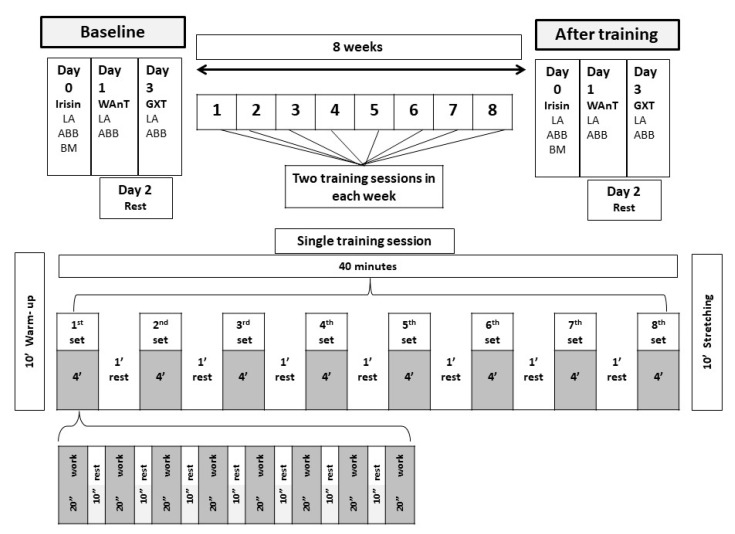
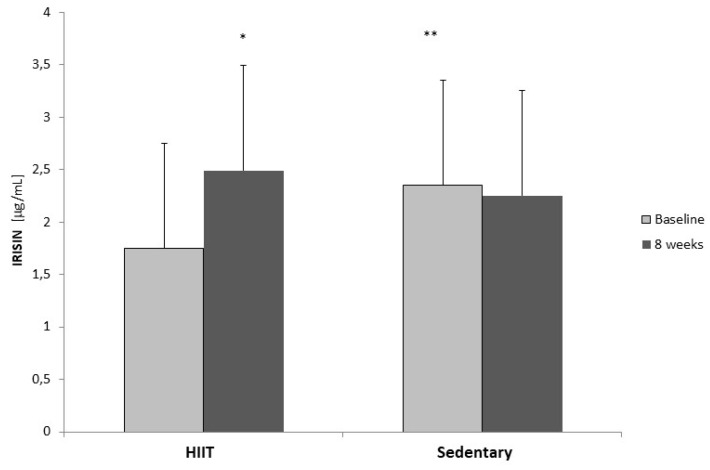
High-intensity interval training (HIIT) is frequently utilized as a method to reduce body mass. Its intensity of work results in a number of beneficial adaptive changes in a relatively short period of time. Irisin is a myokine and adipokine secreted to the blood during exercise and it takes part in the regulation of energy metabolism. It is a vital issue from the prophylaxis point of view as well as treatment through exercise of different diseases (e.g., obesity, type-2 diabetes). The aim of this study was to evaluate changes in irisin concentration, body composition, and aerobic and anaerobic performance in men after HIIT. Eight weeks of HIIT following the Tabata protocol was applied in the training group (HT) ( = 15), while a sedentary group (SED) ( = 10) did not participate in fitness activities within the same time period. Changes of irisin, body composition, and aerobic and anaerobic performance were evaluated after graded exercise test (GXT) and Wingate anaerobic test (WAnT) before and after eight weeks of training. Training resulted in an increased of blood irisin concentration (by 29.7%) < 0.05), VO increase (PRE: 44.86 ± 5.74 mL·kg·min; POST: 50.16 ± 5.80 mL kg·min; < 0.05), reduction in percent body fat (PRE: 14.44 ± 3.33%; POST: 13.61 ± 3.16%; < 0.05), and increase of WAnT parameters ( < 0.05) in the HT group. No changes were observed in the SED group. HIIT resulted in beneficial effects in the increase in blood irisin concentration, physical performance, and reduced fat content. The HIIT may indicate an acceleration of base metabolism. This effect can be utilized in the prevention or treatment of obesity.
高强度间歇训练(HIIT)常被用于减轻体重。其工作强度可在相对较短的时间内引起许多有益的适应性变化。鸢尾素是一种运动时分泌到血液中的肌因子和脂肪因子,参与能量代谢的调节。它是一个重要的问题,从预防的角度来看,以及通过运动治疗不同的疾病(如肥胖、2 型糖尿病)。本研究旨在评估 HIIT 后男性鸢尾素浓度、身体成分、有氧和无氧表现的变化。15 名男性接受了 Tabata 方案的 8 周 HIIT(HT)训练,而 10 名久坐不动的男性(SED)在同一时间段内不参加健身活动。在 8 周训练前后,通过递增运动试验(GXT)和瓦格纳无氧测试(WAnT)评估了鸢尾素、身体成分和有氧无氧表现的变化。训练导致血液鸢尾素浓度增加(增加 29.7%)<0.05),VO 增加(PRE:44.86 ± 5.74 mL·kg·min;POST:50.16 ± 5.80 mL·kg·min;<0.05),体脂百分比降低(PRE:14.44 ± 3.33%;POST:13.61 ± 3.16%;<0.05),和 WAnT 参数增加(<0.05)在 HT 组。SED 组没有观察到变化。HIIT 导致血液鸢尾素浓度增加、身体表现提高和脂肪含量减少等有益效果。HIIT 可能表明基础代谢加速。这种效果可用于肥胖的预防或治疗。