
陆地行走与水上行走干预对老年人有氧适能的影响。
Land-walking vs. water-walking interventions in older adults: Effects on aerobic fitness.
机构信息
School of Human Sciences (Exercise and Sport Science), The University of Western Australia, Perth, WA 6009, Australia.
School of Physiotherapy and Exercise Science, Curtin University, Perth, WA 6102, Australia.
出版信息
J Sport Health Sci. 2020 May;9(3):274-282. doi: 10.1016/j.jshs.2019.11.005. Epub 2019 Dec 23.
BACKGROUND
Low cardiorespiratory fitness is an independent predictor of all-cause and cardiovascular mortality, and interventions that increase fitness reduce risk. Water-walking decreases musculoskeletal impact and risk of falls in older individuals, but it is unclear whether water-walking improves aerobic fitness in the same way as weight-dependent land-walking. This randomized controlled trial involved 3 intervention groups-a no-exercise control group (CG), a land-walking (LW) group, and a water-walking (WW) group-to investigate the comparative impacts of LW and WW to CG on fitness.
METHODS
Both exercise groups attended individually tailored, center-based, intensity-matched 3 × weekly sessions for 24 weeks, which progressed to 150 min of exercise per week. This was followed by a 24-week no-intervention period. Maximal graded exercise tests were performed on a treadmill at Weeks 0, 24, and 48.
RESULTS
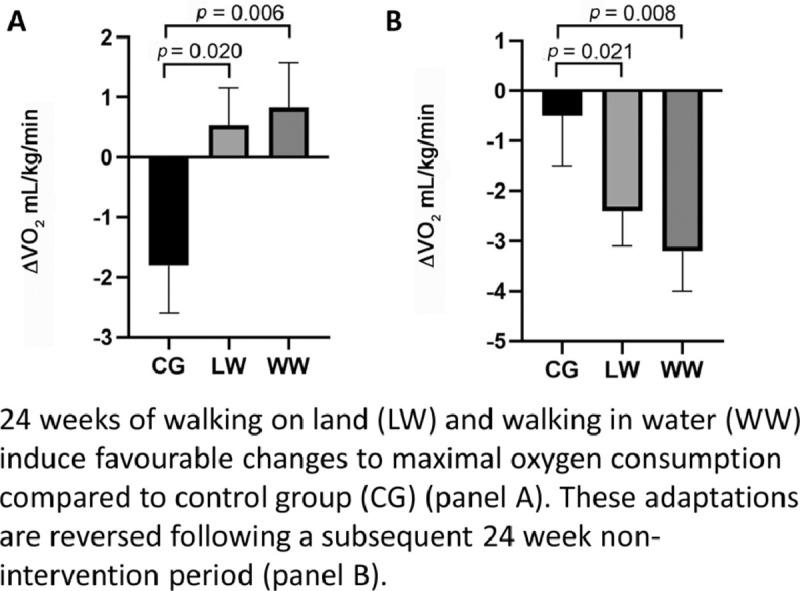
Maximal oxygen uptake increased from Week 0 to Week 24 in both exercise groups (0.57 ± 0.62 mL/kg/min, 0.03 ± 0.04 L/min for LW; 0.93 ± 0.75 mL/kg/min, 0.06 ± 0.06 L/min for WW, mean ± SE) compared to the CG (-1.75 ± 0.78 mL/kg/min, -0.16 ± 0.05 L/min) (group × time, p < 0.05). Time to exhaustion increased significantly following LW only (123.4 ± 25.5 s), which was significantly greater (p = 0.001) than the CG (24.3 ± 18.5 s). By Week 48, the training-induced adaptations in the exercise groups returned to near baseline levels.
CONCLUSION
Our study supports current physical-activity recommendations that 150 min/week of moderate-intensity exercise produces improvements in fitness in previously sedentary older individuals. Also, LW and WW elicit similar improvements in fitness if conducted at the same relative intensities. Exercise-naïve older individuals can benefit from the lower impact forces and decreased risk of falls associated with WW without compromising improvements in cardiorespiratory fitness.
背景
低心肺适能是全因和心血管死亡率的独立预测因子,而提高适能的干预措施可降低风险。水中行走可降低老年人的肌肉骨骼冲击和跌倒风险,但尚不清楚水中行走是否能像依赖陆地行走那样提高有氧适能。本随机对照试验涉及 3 个干预组,即无运动对照组(CG)、陆地行走组(LW)和水中行走组(WW),以研究 LW 和 WW 对 CG 在适能方面的比较影响。
方法
两组运动组均参加个性化、以中心为基础、强度匹配的每周 3 次,每次 24 周,每周增加 150 分钟的运动。随后是 24 周的无干预期。在 0、24 和 48 周时在跑步机上进行最大分级运动测试。
结果
在两组运动组中,最大摄氧量从第 0 周增加到第 24 周(LW:0.57±0.62 mL/kg/min,0.03±0.04 L/min;WW:0.93±0.75 mL/kg/min,0.06±0.06 L/min),与 CG 相比(-1.75±0.78 mL/kg/min,-0.16±0.05 L/min)(组×时间,p<0.05)。仅 LW 后,力竭时间显著增加(123.4±25.5 s),显著高于 CG(24.3±18.5 s)(p=0.001)。到第 48 周时,运动组的训练适应性恢复到接近基线水平。
结论
我们的研究支持目前的身体活动建议,即每周 150 分钟的中等强度运动可改善先前久坐的老年人的健康状况。此外,如果以相同的相对强度进行,LW 和 WW 可产生类似的适应性提高。无运动经验的老年人可以从 WW 相关的较低冲击力和跌倒风险中受益,而不会影响心肺适能的改善。


 Zotero 插件