Center of Excellence on Mood Disorders, Department of Psychiatry and Behavioral Sciences, McGovern Medical School, The University of Texas Health Science Center at Houston (UTHealth), Houston, TX, USA.
IMPACT - the Institute for Mental and Physical Health and Clinical Translation, School of Medicine, Barwon Health, Deakin University, Geelong, Australia.
Transl Psychiatry. 2020 May 24;10(1):162. doi: 10.1038/s41398-020-0836-4.
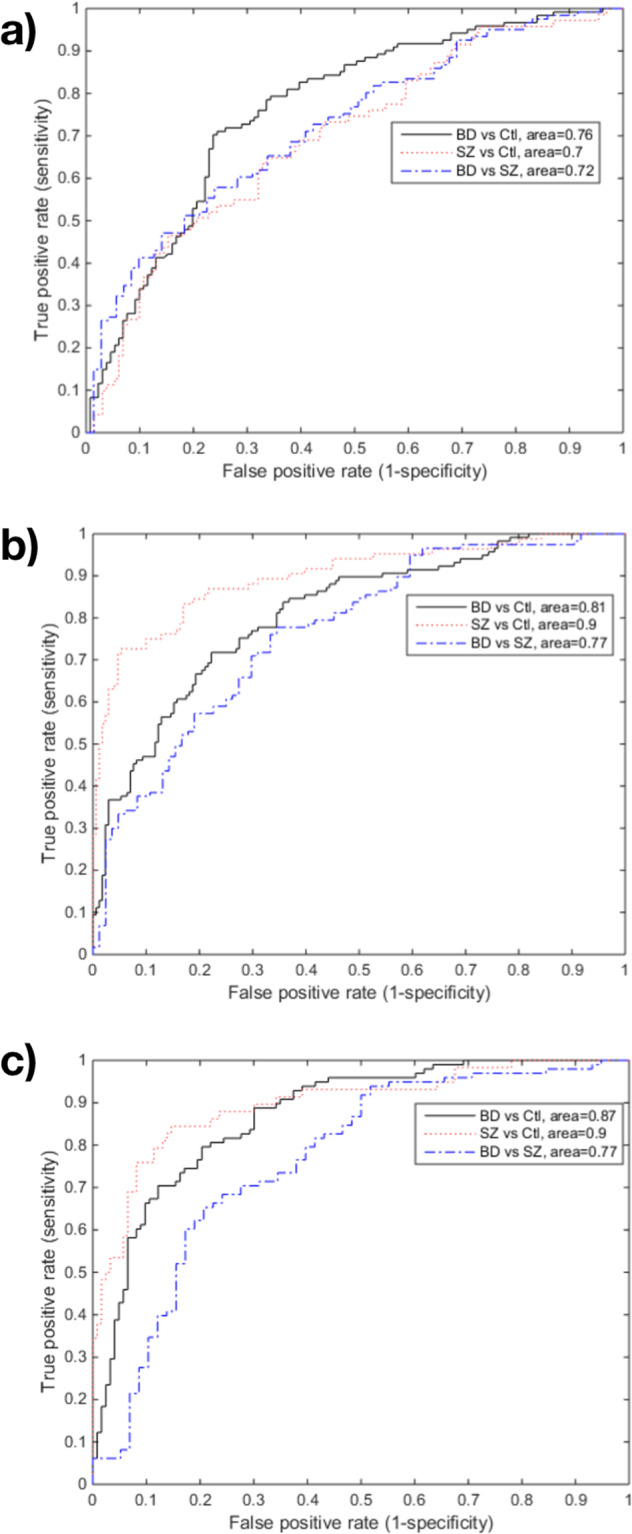
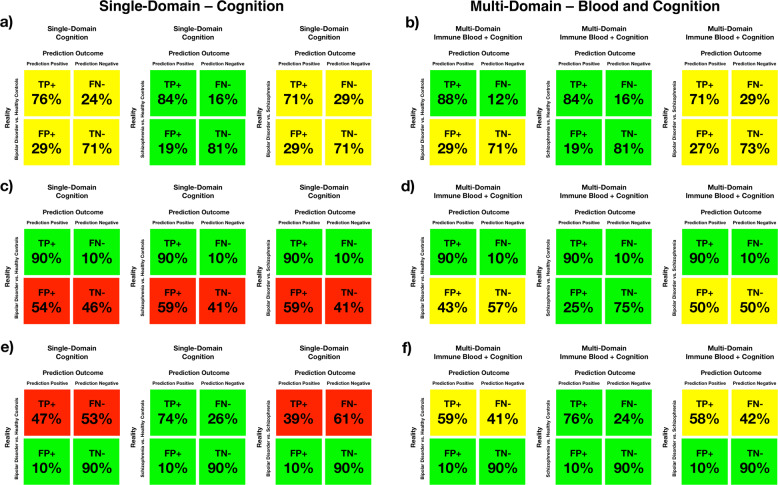
Precision psychiatry is attracting increasing attention lately as a recognized priority. One of the goals of precision psychiatry is to develop tools capable of aiding a clinically informed psychiatric diagnosis objectively. Cognitive, inflammatory and immunological factors are altered in both bipolar disorder (BD) and schizophrenia (SZ), however, most of these alterations do not respect diagnostic boundaries from a phenomenological perspective and possess great variability in different individuals with the same phenotypic diagnosis and, consequently, none so far has proven to have the ability of reliably aiding in the differential diagnosis of BD and SZ. We developed a probabilistic multi-domain data integration model consisting of immune and inflammatory biomarkers in peripheral blood and cognitive biomarkers using machine learning to predict diagnosis of BD and SZ. A total of 416 participants, being 323, 372, and 279 subjects for blood, cognition and combined biomarkers analysis, respectively. Our multi-domain model performances for the BD vs. control (sensitivity 80% and specificity 71%) and for the SZ vs. control (sensitivity 84% and specificity 81%) pairs were high in general, however, our multi-domain model had only moderate performance for the differential diagnosis of BD and SZ (sensitivity 71% and specificity 73%). In conclusion, our results show that the diagnosis of BD and of SZ, and that the differential diagnosis of BD and SZ can be predicted with possible clinical utility by a computational machine learning algorithm employing blood and cognitive biomarkers, and that their integration in a multi-domain outperforms algorithms based in only one domain. Independent studies are needed to validate these findings.
精准精神病学作为公认的重点领域,近来受到越来越多的关注。精准精神病学的目标之一是开发能够客观辅助临床知情精神诊断的工具。双相情感障碍 (BD) 和精神分裂症 (SZ) 中存在认知、炎症和免疫因素的改变,然而,从现象学的角度来看,这些改变大多不符合诊断界限,且在具有相同表型诊断的不同个体中存在很大的变异性,因此迄今为止,没有任何一个改变能够可靠地辅助 BD 和 SZ 的鉴别诊断。我们开发了一种概率多领域数据整合模型,该模型由外周血中的免疫和炎症生物标志物以及认知生物标志物组成,使用机器学习来预测 BD 和 SZ 的诊断。共有 416 名参与者,分别为血液、认知和联合生物标志物分析的 323、372 和 279 名受试者。我们的多领域模型对 BD 与对照组(敏感性 80%,特异性 71%)和 SZ 与对照组(敏感性 84%,特异性 81%)的性能总体较高,但对 BD 和 SZ 的鉴别诊断仅具有中等性能(敏感性 71%,特异性 73%)。总之,我们的研究结果表明,BD 和 SZ 的诊断以及 BD 和 SZ 的鉴别诊断可以通过使用血液和认知生物标志物的计算机器学习算法来预测,具有可能的临床应用价值,并且它们在多领域的整合优于仅基于一个领域的算法。需要进行独立研究来验证这些发现。