Institute for Population Health, Weill Cornell Medicine, Education City-Qatar Foundation, Doha, Qatar.
J Evid Based Med. 2020 Aug;13(3):192-198. doi: 10.1111/jebm.12394. Epub 2020 May 24.
In the Middle East and North Africa (MENA), data are produced in languages other than English and available through gray literature sources. We assessed the comprehensiveness of literature search strategies of systematic reviews (SRs) reporting population health primary data on MENA.
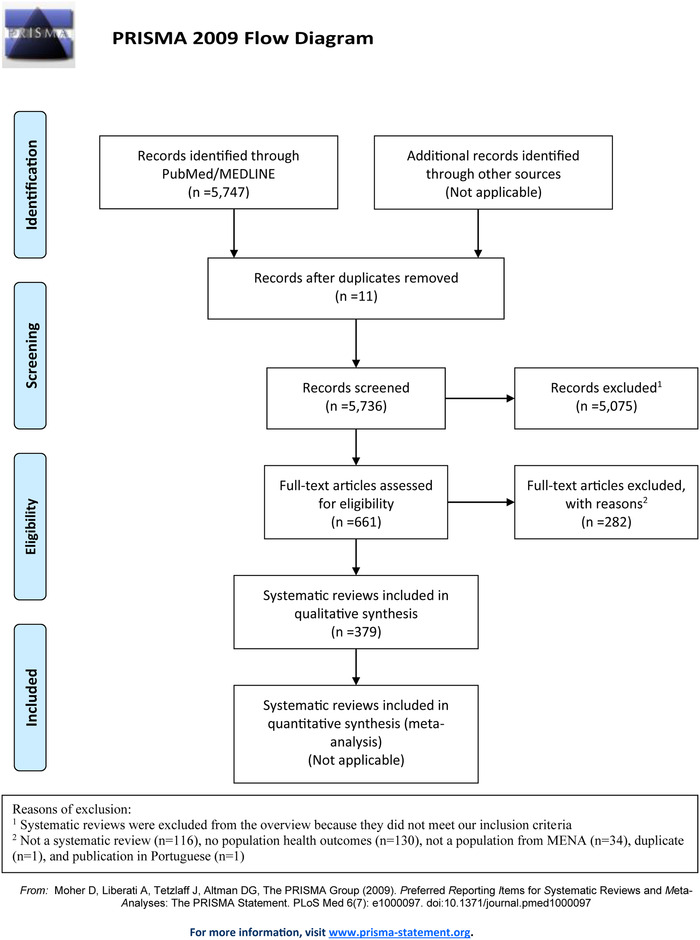
Utilizing the registered protocol (PROSPERO CRD42017076736), we conducted a meta-research analysis on a cohort of SRs (systematic PubMed search: from 2008 to 2016) and evaluated their search strategies following AMSTAR recommendations.
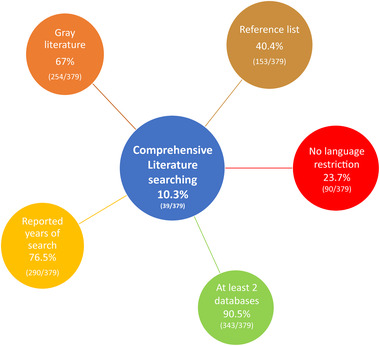
A total of 379 SRs were included. Few SRs (10.3%, n = 39) conducted a comprehensive literature search including at least two databases, reference lists of included primary studies, gray literature sources, and no language restriction. Nevertheless, 90.5% (n = 343) searched at least two databases and 67.0% (n = 254) searched gray literature sources. Authors from MENA searched statistically more for gray literature than authors from Western countries (P = 0.022). Reference lists of the included studies were searched in 40.4% (n = 153) of the SRs. Searching the reference lists was positively associated with searching for gray literature (P < 0.001). Only 38.8% (n = 147) of the SRs had no language restriction or searched in English and in at least one language relevant to MENA, whereas 27.2% (n = 103) did not report this information.
Literature searches for SRs reporting population health data on MENA were limited in reporting quality, language restrictions, and lack of reference list searches. This was probably due to lack of adherence to the reporting guidelines. To ensure compilation of optimum evidence, expanding literature searches to reference list search and for additional languages relevant to MENA are required.
在中东和北非(MENA)地区,数据以英语以外的其他语言产生,并可通过灰色文献来源获取。我们评估了报告 MENA 人口健康原始数据的系统评价(SR)文献检索策略的全面性。
利用已注册的方案(PROSPERO CRD42017076736),我们对一组 SR(系统PubMed 检索:2008 年至 2016 年)进行了元研究分析,并根据 AMSTAR 建议评估了它们的检索策略。
共纳入 379 项 SR。少数 SR(10.3%,n=39)进行了全面的文献检索,包括至少两个数据库、纳入原始研究的参考文献列表、灰色文献来源,并且没有语言限制。尽管如此,90.5%(n=343)检索了至少两个数据库,67.0%(n=254)检索了灰色文献来源。来自 MENA 的作者比来自西方国家的作者更倾向于检索灰色文献(P=0.022)。纳入研究的参考文献列表在 40.4%(n=153)的 SR 中被检索。检索参考文献列表与检索灰色文献呈正相关(P<0.001)。只有 38.8%(n=147)的 SR 没有语言限制或仅检索英语和至少一种与 MENA 相关的语言,而 27.2%(n=103)未报告此信息。
报告 MENA 人口健康数据的 SR 文献检索在报告质量、语言限制和缺乏参考文献检索方面受到限制。这可能是由于缺乏对报告指南的遵守。为了确保最佳证据的编纂,需要将文献检索扩展到参考文献检索和与 MENA 相关的其他语言。