Royal National Orthopaedic Hospital NHS Foundation Trust & National Institute for Health Research (NIHR), Brockley Hill Road, Stanmore, Middlesex, HA7 4LP, UK.
School of Nursing & Research Centre "Centre for Health Technology and Services Research / ESEP -CINTESIS", Porto, Portugal.
BMC Palliat Care. 2020 May 25;19(1):73. doi: 10.1186/s12904-020-00583-4.
Family caregivers play an important role supporting their relatives with advanced progressive disease to live at home. There is limited research to understand family caregiver needs over time, particularly outside of high-income settings. The aim of this study was to explore family caregivers' experiences of caring for a relative living with advanced progressive disease at home, and their perceptions of met and unmet care needs over time.
An ethnographic study comprising observations and interviews. A purposive sample of 10 family caregivers and 10 relatives was recruited within a rural area in the north of Portugal. Data were collected between 2014 and 16 using serial participant observations (n = 33) and in-depth interviews (n = 11). Thematic content analysis was used to analyse the data.
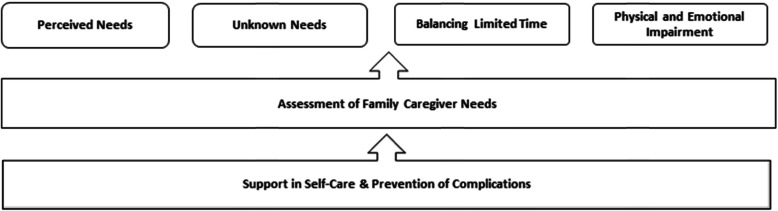
Five overarching themes were yielded: (1) provision of care towards independence and prevention of complications; (2) perceived and (3) unknown caregiver needs; (4) caregivers' physical and emotional impairments; and (5) balancing limited time. An imbalance towards any one of these aspects may lead to reduced capability and performance of the family caregiver, with increased risk of complications for their relative. However, with balance, family caregivers embraced their role over time.
These findings enhance understanding around the needs of family caregivers, which are optimally met when professionals and family caregivers work together with a collaborative approach over time. Patients and their families should be seen as equal partners. Family-focused care would enhance nursing practice in this context and this research can inform nursing training and educational programs.
家庭照顾者在支持其患有晚期进行性疾病的亲属在家中生活方面发挥着重要作用。但是,在高收入环境之外,关于家庭照顾者随时间推移的需求的研究很少。本研究旨在探讨家庭照顾者在照顾家中患有晚期进行性疾病的亲属时的体验,以及他们对随时间推移的满足和未满足的护理需求的看法。
一项包括观察和访谈的民族志研究。在葡萄牙北部的一个农村地区,通过目的性抽样,招募了 10 名家庭照顾者和 10 名亲属。在 2014 年至 16 年期间,通过连续的参与者观察(n=33)和深入访谈(n=11)收集了数据。使用主题内容分析对数据进行分析。
产生了五个总体主题:(1)提供护理以实现独立性和预防并发症;(2)感知到的和(3)未知的照顾者需求;(4)照顾者的身体和情绪损伤;以及(5)平衡有限的时间。任何一个方面的不平衡都可能导致家庭照顾者能力和表现下降,增加其亲属发生并发症的风险。但是,通过平衡,家庭照顾者随着时间的推移逐渐接受了自己的角色。
这些发现增强了对家庭照顾者需求的理解,当专业人员和家庭照顾者随着时间的推移以协作方式共同满足需求时,这些需求就能得到最佳满足。患者及其家属应被视为平等的合作伙伴。以家庭为中心的护理将增强这一背景下的护理实践,本研究可以为护理培训和教育计划提供信息。