Department of Anesthesiology, Second Affiliated Hospital, Army Medical University, Chongqing, China.
PLoS One. 2020 May 26;15(5):e0233412. doi: 10.1371/journal.pone.0233412. eCollection 2020.
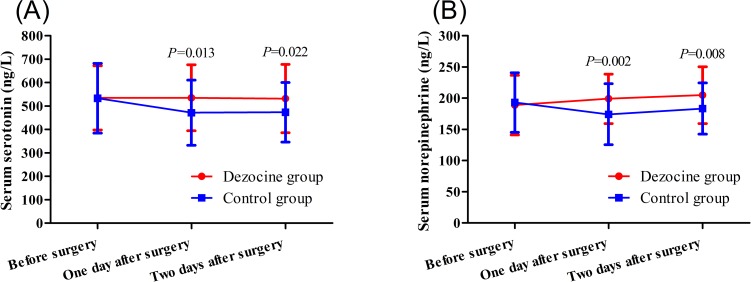
Postoperative depression is one of the most common mental disorders in patients undergoing cancer surgery and it often delays postoperative recovery. We investigated whether dezocine, an analgesic with inhibitory effect on the serotonin and norepinephrine reuptake, could relieve postoperative depressive symptoms in patients undergoing colorectal cancer surgery.
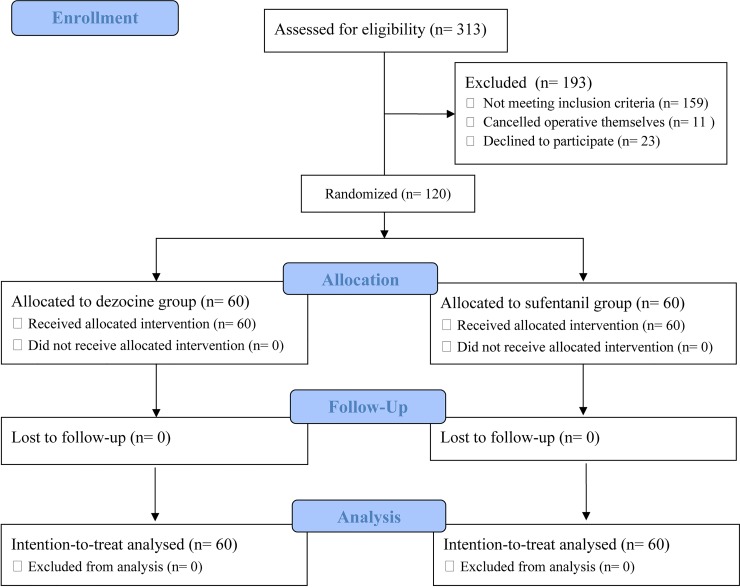
This randomized, controlled, single-center, double-blind trial was performed in the Second Affiliated Hospital of the Army Medical University. A total of 120 patients were randomly assigned to receive either sufentanil (1.3 μg/kg) with dezocine (1 mg/kg) (dezocine group; n = 60) or only sufentanil (2.3 μg/kg) (control group; n = 60) for patient-controlled intravenous analgesia after colorectal cancer surgery. The primary outcome was the Beck Depression Inventory score at 2 days after surgery. The secondary outcomes included the Beck Anxiety Inventory, sleep quality, and quality of recovery scores.
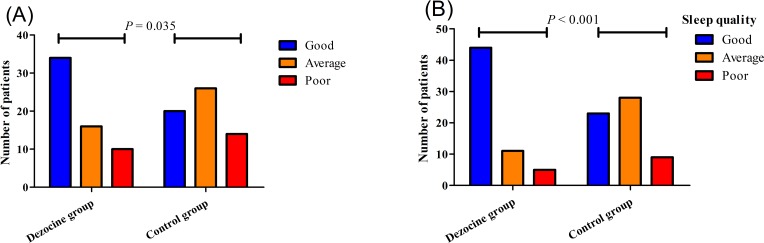
Compared with those in the control group, patients in the dezocine group had lower depression scores (7.3±3.4 vs. 9.9±3.5, mean difference 2.6, 95% CI: 1.4-3.9; P<0.001) at 2 days after surgery and better night sleep quality at the day of surgery (P = 0.010) and at 1 day after the surgery (P<0.001). No significant difference was found in other outcomes between the two groups.
Intravenous analgesia using dezocine can relieve postoperative depression symptoms and improve sleep quality in patients undergoing colorectal cancer surgery.
术后抑郁是癌症手术患者中最常见的精神障碍之一,它常导致术后恢复延迟。我们研究了具有抑制 5-羟色胺和去甲肾上腺素再摄取作用的阿扎司琼是否能缓解结直肠癌手术患者的术后抑郁症状。
这是一项在陆军军医大学第二附属医院进行的随机、对照、单中心、双盲试验。共纳入 120 例患者,随机分为舒芬太尼联合地佐辛(1 mg/kg)(地佐辛组,n=60)或仅舒芬太尼(2.3 μg/kg)(对照组,n=60)行术后患者自控静脉镇痛。主要结局为术后 2 天贝克抑郁量表评分。次要结局包括贝克焦虑量表、睡眠质量和恢复质量评分。
与对照组相比,地佐辛组患者术后 2 天抑郁评分更低(7.3±3.4 比 9.9±3.5,差值 2.6,95%CI:1.4-3.9;P<0.001),且手术当天(P=0.010)和术后 1 天(P<0.001)的夜间睡眠质量更好。两组间其他结局无显著差异。
结直肠癌手术患者静脉镇痛使用地佐辛可缓解术后抑郁症状,改善睡眠质量。