Hebei Women and Children's Health Center, Shijiazhuang, 050000, Hebei, China.
Department of Obstetrics and Gynecology, Hebei General Hospital, No. 348 Heping Road, Shijiazhuang, 050051, Hebei, China.
BMC Public Health. 2020 May 27;20(1):789. doi: 10.1186/s12889-020-08799-y.
The One-Child Policy led to the imbalance of the sex ratio at birth (SRB) in China. After that, Two-Child Policy was introduced and gradually liberalized at three stages. If both the husband and wife of one couple were the only child of their parents, they were allowed to have two children in policy (BTCP). If only one of them was the only child, they were allowed to have two children in policy (OTCP). The Universal Two-Child Policy (UTCP) allowed every couple to have two children. The objective of this study was to explore the changing trend of SRB at the stages of Two-Child Policy, to analyze the effect of population policy on SRB in terms of maternal age, delivery mode, parity, maternal education, delivery hospital, and to figure out what factors have greater impact on the SRB.
The data of the study came from Hebei Province Maternal Near Miss Surveillance System, covered the parturients delivered at 28 gestation weeks or more in 22 hospitals from January 1, 2013 to December 31, 2017. We compared the SRB at different policy stages, analyzed the relationship between the SRB and population policy by logistic regression analysis.
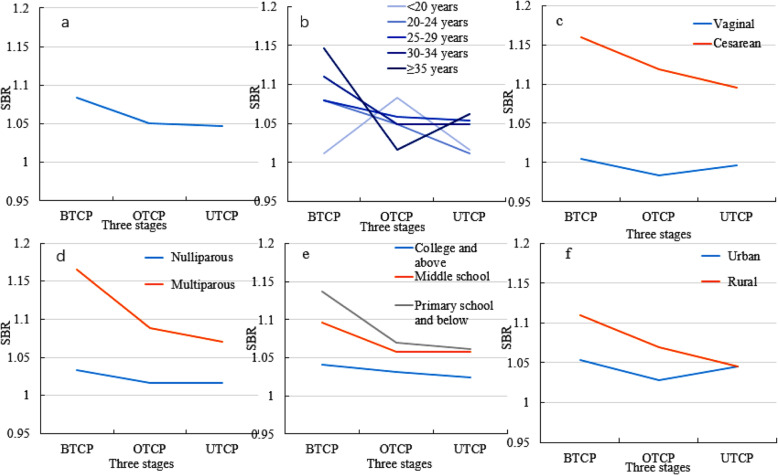
Total 270,878 singleton deliveries were analyzed. The SRB, 1.084 at BTCP, 1.050 at OTCP, 1.047 at UTCP, declined rapidly (χ = 15.97, P < 0.01). With the introduction of Two-Child Policy, the percentage of parturients who were 30-34, ≥35 years old rose significantly, and the percentage of multiparous women increased significantly (40.7, 47.2, 56.6%). The neonatal mortality declined significantly (8.4‰, 6.7‰, 5.9‰, χ = 44.49, P < 0.01), the mortality rate of female infant gradually declined (48.2, 43.7, 43.9%). The logistic regression analysis showed the SRB was correlated to the three population policy stages in terms of maternal age, delivery mode, parity, maternal education, delivery hospital.
The SRB has declined to normal level with the gradually liberalizing of Two-Child Policy in China. Advanced maternal age, cesarean delivery, multiparous women, middle level education, rural hospital are the main factors of effect on the decline of the SRB.
独生子女政策导致中国出生性别比(SRB)失衡。此后,二孩政策分三个阶段逐步放宽。如果一对夫妇的丈夫和妻子都是父母的独生子女,他们可以在政策中生育两个孩子(BTCP)。如果只有一方是独生子女,他们可以在政策中生育两个孩子(OTCP)。普遍二孩政策(UTCP)允许每对夫妇生育两个孩子。本研究旨在探讨二孩政策阶段 SRB 的变化趋势,从产妇年龄、分娩方式、胎次、产妇教育、分娩医院等方面分析人口政策对 SRB 的影响,并找出哪些因素对 SRB 的影响更大。
本研究数据来自河北省孕产妇危急重症监测系统,涵盖了 2013 年 1 月 1 日至 2017 年 12 月 31 日期间在 22 家医院分娩的 28 孕周及以上的产妇。我们比较了不同政策阶段的 SRB,通过 logistic 回归分析人口政策与 SRB 的关系。
共分析了 270878 例单胎分娩。SRB 在 BTCP 为 1.084,OTCP 为 1.050,UTCP 为 1.047,呈快速下降趋势(χ=15.97,P<0.01)。随着二孩政策的实施,30-34 岁、≥35 岁产妇比例显著上升,多产妇比例显著上升(40.7%、47.2%、56.6%)。新生儿死亡率显著下降(8.4‰、6.7‰、5.9‰,χ=44.49,P<0.01),女婴死亡率逐渐下降(48.2%、43.7%、43.9%)。logistic 回归分析显示,产妇年龄、分娩方式、胎次、产妇教育、分娩医院与人口政策三个阶段均呈相关关系。
随着中国二孩政策的逐步放宽,SRB 已降至正常水平。高龄产妇、剖宫产、多产妇、中等教育水平、农村医院是影响 SRB 下降的主要因素。