McConkey Roy, Cassin Marie-Therese, McNaughton Rosie
Institute of Nursing and Health Research, Ulster University, Newtownabbey BT37 0QB, UK.
Cedar Foundation, Belfast BT6 8RB, UK.
Brain Sci. 2020 May 25;10(5):318. doi: 10.3390/brainsci10050318.
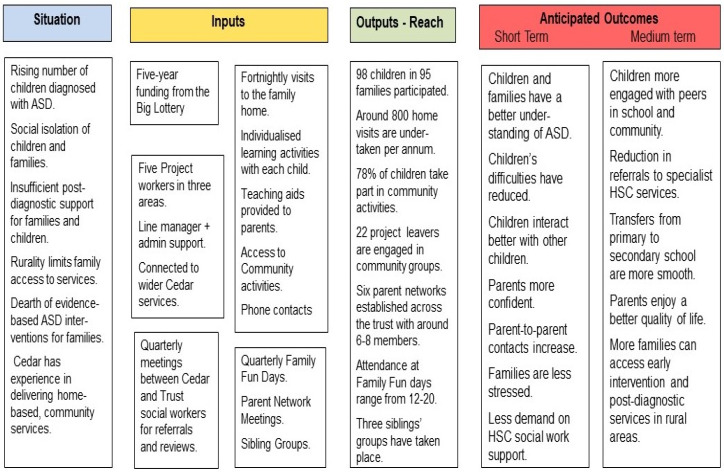
The social isolation of children with autism spectrum disorder (ASD) is well documented. Their dearth of friends outside of the family and their lack of engagement in community activities places extra strains on the family. A project in Northern Ireland provided post-diagnostic support to nearly 100 families and children aged from 3 to 11 years. An experienced ASD practitioner visited the child and family at home fortnightly in the late afternoon into the evening over a 12-month period. Most children had difficulty in relating to other children, coping with change, awareness of dangers, and joining in community activities. Likewise, up to two-thirds of parents identified managing the child's behaviour, having time to spend with other children, and taking the child out of the house as further issues of concern to them. The project worker implemented a family-centred plan that introduced the child to various community activities in line with their learning targets and wishes. Quantitative and qualitative data showed improvements in the children's social and communication skills, their personal safety, and participation in community activities. Likewise, the practical and emotional support provided to parents boosted their confidence and reduced stress within the family. The opportunities for parents and siblings to join in fun activities with the child with ASD strengthened their relationships. This project underscores the need for, and the success of family-based, post-diagnostic support to address the social isolation of children with ASD and their families.
自闭症谱系障碍(ASD)儿童的社会隔离现象有充分的文献记载。他们在家庭之外缺少朋友,且不参与社区活动,这给家庭带来了额外的压力。北爱尔兰的一个项目为近100个家庭以及3至11岁的儿童提供了诊断后的支持。在为期12个月的时间里,一位经验丰富的自闭症谱系障碍从业者会在傍晚至晚上的时段,每两周一次到孩子和家庭的住所进行探访。大多数儿童在与其他孩子交往、应对变化、意识到危险以及参与社区活动方面存在困难。同样,多达三分之二的家长认为,管理孩子的行为、有时间陪伴其他孩子以及带孩子出门是他们进一步关注的问题。项目工作人员实施了一项以家庭为中心的计划,根据孩子的学习目标和意愿,让他们参与各种社区活动。定量和定性数据显示,孩子们的社交和沟通技能、个人安全以及参与社区活动的情况都有所改善。同样,为家长提供的实际支持和情感支持增强了他们的信心,减轻了家庭内部的压力。家长和兄弟姐妹与自闭症谱系障碍儿童一起参与有趣活动的机会,加强了他们之间的关系。这个项目强调了基于家庭的诊断后支持对于解决自闭症谱系障碍儿童及其家庭的社会隔离问题的必要性和成功之处。