Ranmuthu Chanuka D S, Ranmuthu Charindu K I, Russell Jodie C, Singhania Disha, Khan Wasim S
Cambridge Clinical School, University of Cambridge, Cambridge, United Kingdom.
Division of Trauma and Orthopaedics, Department of Surgery, Addenbrooke's Hospital, University of Cambridge, Cambridge, United Kingdom.
Front Bioeng Biotechnol. 2020 May 14;8:430. doi: 10.3389/fbioe.2020.00430. eCollection 2020.
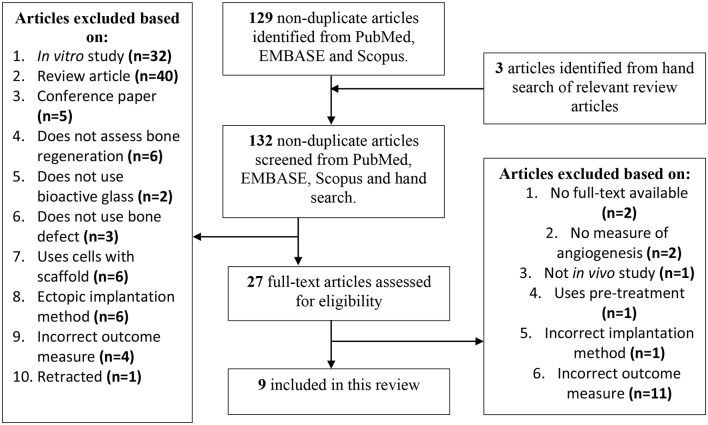
The use of bone scaffolds to replace injured or diseased bone has many advantages over the currently used autologous and allogeneic options in clinical practice. This systematic review evaluates the current evidence for non-cellular scaffolds containing bioactive glass on osteogenesis and angiogenesis in animal bone defect models. Studies that reported results of osteogenesis via micro-CT and results of angiogenesis via Microfil perfusion or immunohistochemistry were included in the review. A literature search of PubMed, EMBASE and Scopus was carried out in November 2019 from which nine studies met the inclusion and exclusion criteria. Despite the significant heterogeneity in the composition of the scaffolds used in each study, it could be concluded that scaffolds containing bioactive glass improve bone regeneration in these models, both by osteogenic and angiogenic measures. Incorporation of additional elements into the glass network, using additives, and using biochemical factors generally had a beneficial effect. Comparing the different compositions of non-cellular bioactive glass containing scaffolds is however difficult due to the heterogeneity in bioactive glass compositions, fabrication methods and biochemical additives used.
在临床实践中,使用骨支架替代受损或患病骨骼相较于目前使用的自体和异体选项具有诸多优势。本系统评价评估了含生物活性玻璃的无细胞支架在动物骨缺损模型中对成骨和血管生成作用的现有证据。本评价纳入了通过微型计算机断层扫描(micro-CT)报告成骨结果以及通过微丝灌注或免疫组织化学报告血管生成结果的研究。2019年11月对PubMed、EMBASE和Scopus进行了文献检索,从中筛选出9项符合纳入和排除标准的研究。尽管每项研究中使用的支架成分存在显著异质性,但可以得出结论,含生物活性玻璃的支架通过成骨和血管生成措施改善了这些模型中的骨再生。使用添加剂将其他元素纳入玻璃网络以及使用生化因子通常具有有益效果。然而,由于生物活性玻璃成分、制造方法和所用生化添加剂的异质性,比较含无细胞生物活性玻璃支架的不同成分存在困难。