Gaudreault Natasha N, Madden Daniel W, Wilson William C, Trujillo Jessie D, Richt Juergen A
Department of Diagnostic Medicine/Pathobiology, College of Veterinary Medicine, Kansas State University, Manhattan, KS, United States.
Arthropod Borne Animal Diseases Research Unit, Agricultural Research Service, United States Department of Agriculture, Manhattan, KS, United States.
Front Vet Sci. 2020 May 13;7:215. doi: 10.3389/fvets.2020.00215. eCollection 2020.
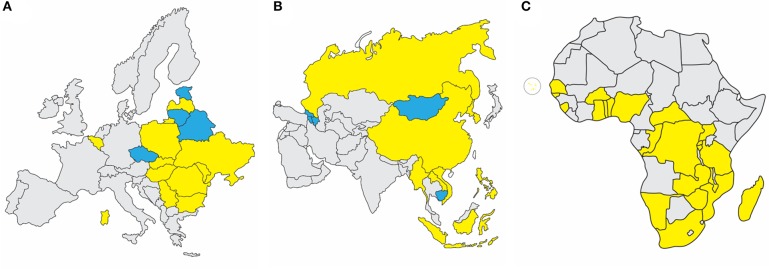
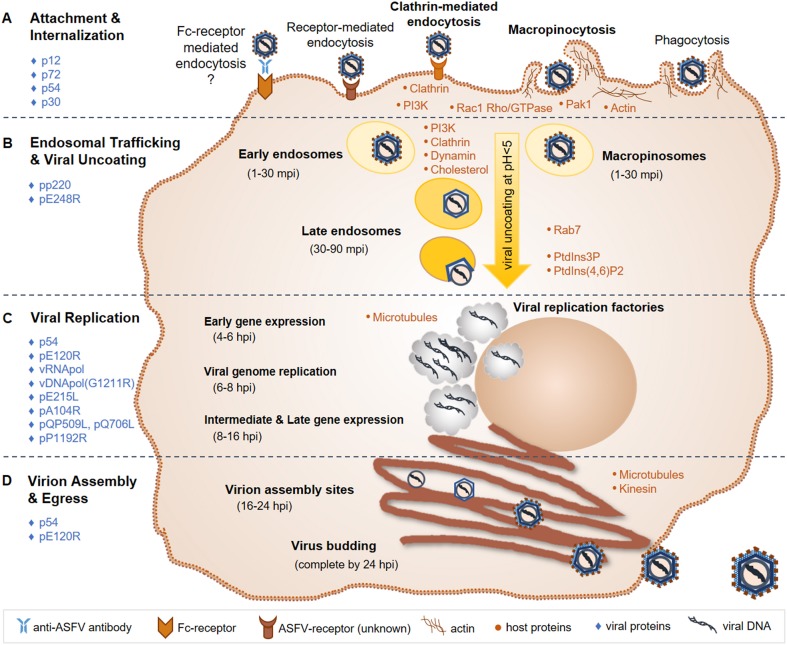
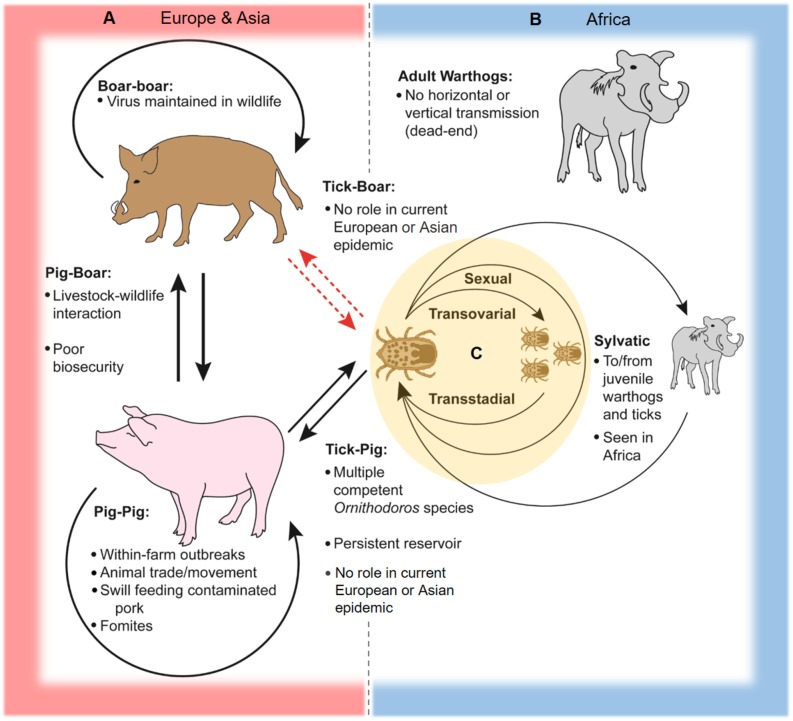
African swine fever virus (ASFV) is the sole member of the family , and the only known DNA arbovirus. Since its identification in Kenya in 1921, ASFV has remained endemic in Africa, maintained in a sylvatic cycle between soft ticks and warthogs () which do not develop clinical disease with ASFV infection. However, ASFV causes a devastating and economically significant disease of domestic ( and feral () swine. There is no ASFV vaccine available, and current control measures consist of strict animal quarantine and culling procedures. The virus is highly stable and easily spreads by infected swine, contaminated pork products and fomites, or via transmission by the vector. Competent argasid soft tick vectors are known to exist not only in Africa, but also in parts of Europe and the Americas. Once ASFV is established in the argasid soft tick vector, eradication can be difficult due to the long lifespan of ticks and their proclivity to inhabit the burrows of warthogs or pens and shelters of domestic pigs. Establishment of endemic ASFV infections in wild boar populations further complicates the control of ASF. Between the late 1950s and early 1980s, ASFV emerged in Europe, Russia and South America, but was mostly eradicated by the mid-1990s. In 2007, a highly virulent genotype II ASFV strain emerged in the Caucasus region and subsequently spread into the Russian Federation and Europe, where it has continued to circulate and spread. Most recently, ASFV emerged in China and has now spread to several neighboring countries in Southeast Asia. The high morbidity and mortality associated with ASFV, the lack of an efficacious vaccine, and the complex makeup of the ASFV virion and genome as well as its lifecycle, make this pathogen a serious threat to the global swine industry and national economies. Topics covered by this review include factors important for ASFV infection, replication, maintenance, and transmission, with attention to the role of the argasid tick vector and the sylvatic transmission cycle, current and future control strategies for ASF, and knowledge gaps regarding the virus itself, its vector and host species.
非洲猪瘟病毒(ASFV)是该病毒科的唯一成员,也是唯一已知的DNA虫媒病毒。自1921年在肯尼亚被发现以来,ASFV在非洲一直呈地方流行状态,在软蜱和疣猪之间以野生动物循环方式维持传播,疣猪感染ASFV后不会出现临床疾病。然而,ASFV会在家猪(和野猪)中引发毁灭性且具有重大经济影响的疾病。目前尚无ASFV疫苗,现行防控措施包括严格的动物检疫和扑杀程序。该病毒高度稳定,可通过感染的猪、受污染的猪肉产品和污染物轻易传播,或通过媒介传播。已知有能力传播ASFV的锐缘蜱不仅存在于非洲,还存在于欧洲和美洲的部分地区。一旦ASFV在锐缘蜱媒介中定殖,由于蜱的寿命长且倾向于栖息在疣猪洞穴或家猪的猪圈及庇护所中,根除就会变得困难。野猪群体中地方性ASFV感染的出现进一步使非洲猪瘟的防控复杂化。在20世纪50年代末至80年代初,ASFV在欧洲、俄罗斯和南美洲出现,但到20世纪90年代中期大多已被根除。2007年,一种高致病性II型ASFV毒株在高加索地区出现,随后传播至俄罗斯联邦和欧洲,并在那里持续传播扩散。最近,ASFV在中国出现,现已传播到东南亚的几个邻国。ASFV相关的高发病率和死亡率、缺乏有效的疫苗,以及ASFV病毒粒子和基因组的复杂构成及其生命周期,使这种病原体对全球养猪业和国家经济构成严重威胁。本综述涵盖的主题包括对ASFV感染、复制、维持和传播重要的因素,重点关注锐缘蜱媒介和野生动物传播循环的作用、非洲猪瘟的当前和未来防控策略,以及关于该病毒本身、其媒介和宿主物种的知识空白。