Tang Yaohui, Tong Xinming, Conrad Bogdan, Yang Fan
Department of Orthopaedic Surgery, Stanford University School of Medicine, Stanford, CA, 94305, USA.
Program of Stem Cell Biology and Regenerative Medicine, Stanford University School of Medicine, 300 Pasteur Dr., Edwards R105, Stanford, CA, 94305, USA.
Theranostics. 2020 May 15;10(13):6035-6047. doi: 10.7150/thno.41096. eCollection 2020.
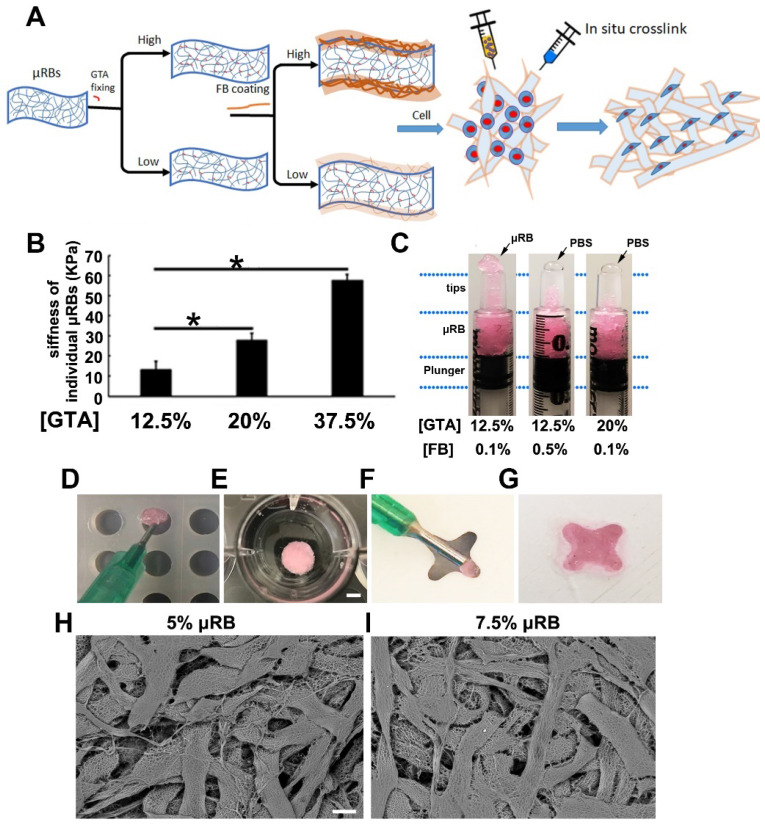
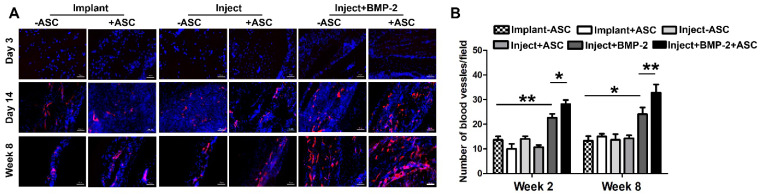
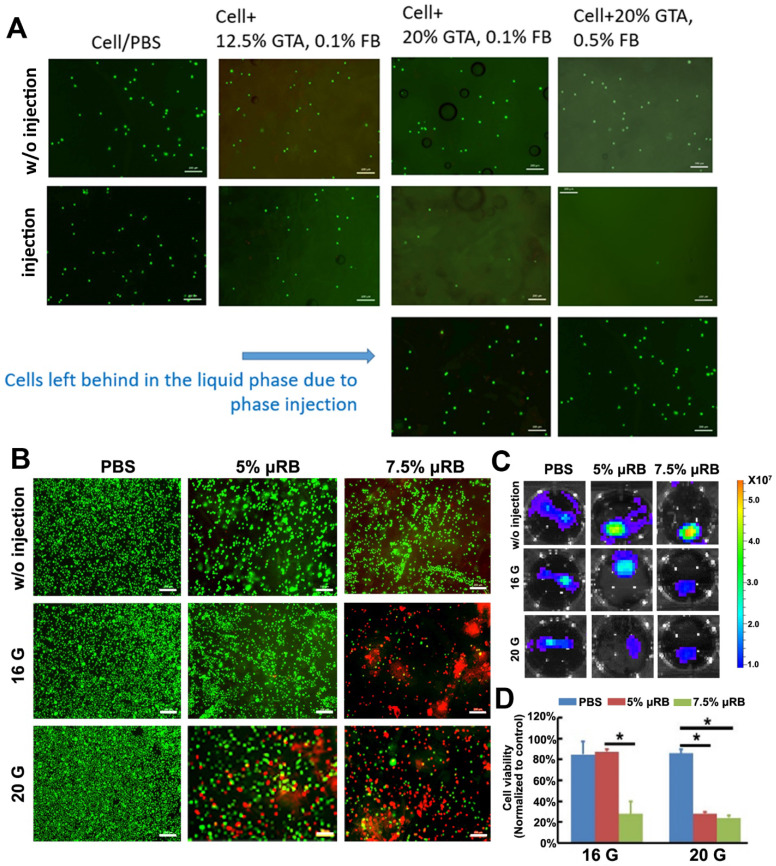
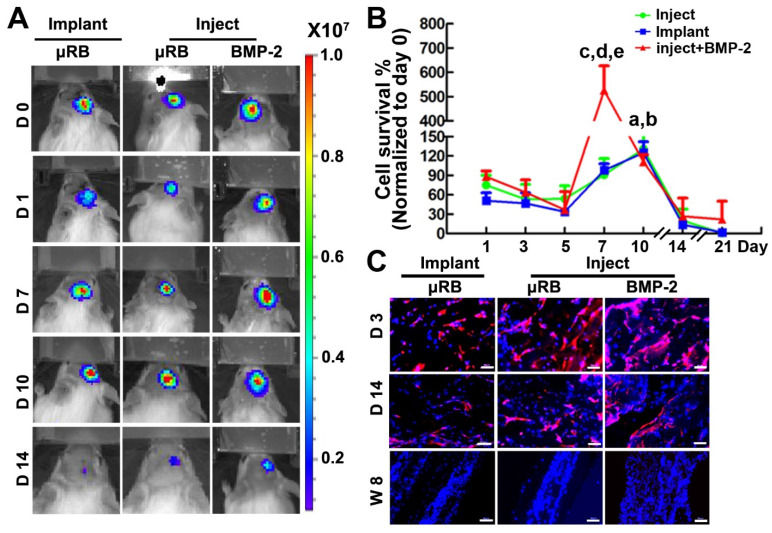
: Injectable matrices are highly desirable for stem cell delivery. Previous research has highlighted the benefit of scaffold macroporosity in enhancing stem cell survival and bone regeneration in vivo. However, there remains a lack of injectable and in situ crosslinkable macroporous matrices for stem cell delivery to achieve fast bone regeneration in immunocompetent animal model. The goal of this study is to develop an injectable gelatin-based μRB hydrogel supporting direct cell encapsulation that is available in clinics as macroporous matrices to enhance adipose-derived stromal cell (ASC) survival, engraftment and accelerate bone formation in craniofacial defect mouse. : Injectable and in situ crosslinkable gelatin microribbon (μRB)-based macroporous hydrogels were developed by wet-spinning. Injectability was optimized by varying concentration of glutaraldehyde for intracrosslinking of μRB shape, and fibrinogen coating. The efficacy of injectable μRBs to support ASCs delivery and bone regeneration were further assessed in vivo using an immunocompetent mouse cranial defect model. ASCs survival was evaluated by bioluminescent imaging and bone regeneration was assessed by micro-CT. The degradation and biocompatibility were determined by histological analysis. : We first optimized injectability by varying concentration of glutaraldehyde used to fix gelatin μRBs. The injectable μRB formulation were subsequently coated with fibrinogen, which allows in situ crosslinking by thrombin. Fluorescence imaging and histology showed majority of μRBs degraded by the end of 3 weeks. Injectable μRBs supported comparable level of ASC proliferation and bone regeneration as implantable prefabricated μRB controls. Adding low dosage of BMP2 (100 ng per scaffold) with ASCs substantially accelerated the speed of mineralized bone regeneration, with 90% of the bone defect refilled by week 8. Immunostaining showed M1 (pro-inflammatory) macrophages were recruited to the defect at day 3, and was replaced by M2 (anti-inflammatory) macrophages by week 2. Adding μRBs or BMP2 did not alter macrophage response. Injectable µRBs supported vascularization, and BMP-2 further enhanced vascularization. : Our results demonstrated that µRB-based scaffolds enhanced ASC survival and accelerated bone regeneration after injection into critical sized cranial defect mouse. Such injectable µRB-based scaffold can provide a versatile biomaterial for delivering various stem cell types and enhancing tissue regeneration.
可注射基质对于干细胞递送非常理想。先前的研究强调了支架大孔隙率在提高体内干细胞存活率和骨再生方面的益处。然而,仍然缺乏用于干细胞递送的可注射且可原位交联的大孔基质,以在免疫活性动物模型中实现快速骨再生。本研究的目标是开发一种基于明胶的可注射μRB水凝胶,支持直接细胞封装,该水凝胶可作为大孔基质用于临床,以提高脂肪来源的基质细胞(ASC)的存活率、植入率,并加速颅面缺损小鼠的骨形成。
通过湿纺法制备了基于可注射且可原位交联的明胶微带(μRB)的大孔水凝胶。通过改变戊二醛浓度以进行μRB形状的内部交联以及纤维蛋白原包被来优化可注射性。使用免疫活性小鼠颅骨缺损模型在体内进一步评估可注射μRB支持ASC递送和骨再生的功效。通过生物发光成像评估ASC存活率,通过微型计算机断层扫描评估骨再生。通过组织学分析确定降解和生物相容性。
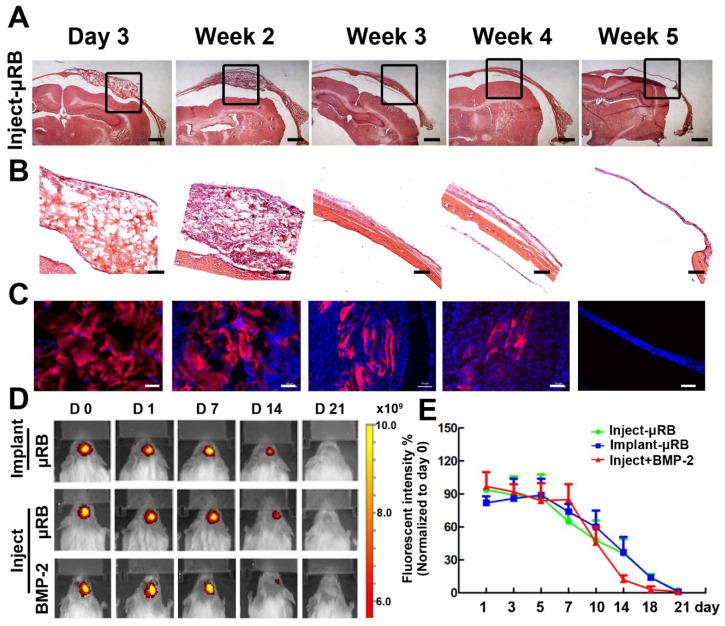
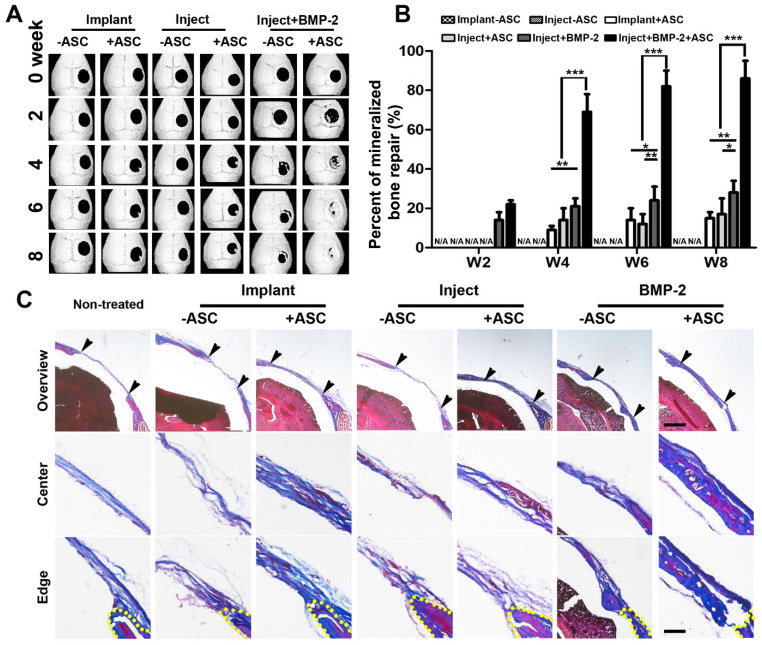
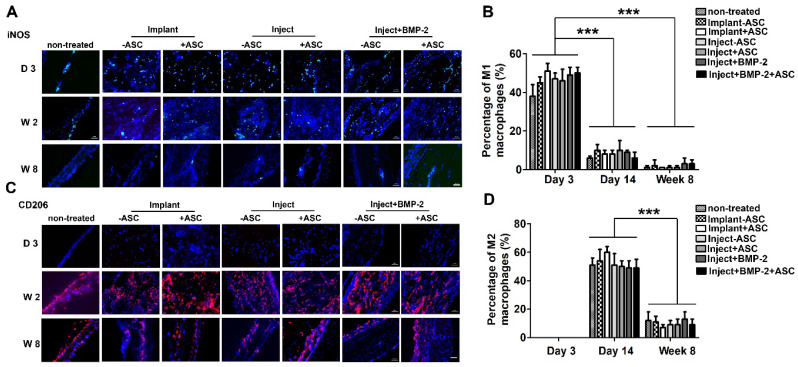
我们首先通过改变用于固定明胶μRB的戊二醛浓度来优化可注射性。随后将可注射的μRB制剂用纤维蛋白原包被,这允许通过凝血酶进行原位交联。荧光成像和组织学显示大多数μRB在3周结束时降解。可注射μRB支持与可植入预制μRB对照相当水平的ASC增殖和骨再生。将低剂量的骨形态发生蛋白2(BMP2,每个支架100纳克)与ASC一起添加可显著加速矿化骨再生的速度,到第8周时90%的骨缺损被填充。免疫染色显示M1(促炎)巨噬细胞在第3天被募集到缺损处,并在第2周被M2(抗炎)巨噬细胞取代。添加μRB或BMP2不会改变巨噬细胞反应。可注射μRB支持血管生成,并且BMP-2进一步增强血管生成。
我们的结果表明,基于μRB的支架在注射到临界尺寸的颅骨缺损小鼠体内后可提高ASC存活率并加速骨再生。这种基于可注射μRB的支架可为递送各种类型的干细胞和促进组织再生提供一种通用的生物材料。