Programa de Pós-Graduação em Medicina Interna, Universidade Federal do Paraná, Curitiba, PR, Brazil.
Hospital de Clínicas, Universidade Federal do Paraná, Curitiba, PR, Brazil.
J Bras Pneumol. 2020;46(4):e20180237. doi: 10.36416/1806-3756/e20180237. Epub 2020 Jun 1.
To translate the Richards-Campbell Sleep Questionnaire (RCSQ) and Sleep in the Intensive Care Unit Questionnaire (SICUQ) to Portuguese, making the appropriate cross-cultural adaptations for their use in Brazil, as well as to determine the interobserver reliability of the instruments.
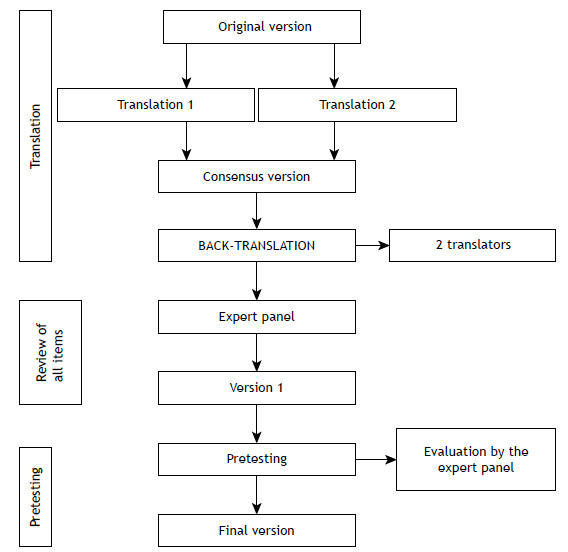
In this study, we evaluated medical and surgical patients admitted to the adult ICU of the Federal University of Paraná Hospital de Clínicas, in the city of Curitiba, Brazil, between June of 2017 and January of 2018. The translation and cross-cultural adaptation of the questionnaires involved the following steps: translation, synthesis, back-translation, revision by an expert panel, approval of the back-translation by the original authors, pretesting, and creation of the final versions. Two researchers applied the Portuguese-language versions in the evaluation of critically ill patients. Interobserver reliability was assessed by calculating the intraclass correlation coefficient (ICC) and 95% CI.
The sample comprised 50 patients, of whom 27 (54%) were women. The mean age was 47.7 ± 17.5 years. The main reason for ICU admission, in 10 patients (20%), was cancer. The interobserver reliability of the questionnaires ranged from good to excellent. For the RCSQ, the ICC was 0.84 (95% CI: 0.71-0.90). For SICUQ domains 1-5 (sleep quality and daytime sleepiness), the ICC was 0.75 (95% CI: 0.55-0.86), whereas it was 0.86 (95% CI: 0.76-0.92) for SICUQ domains 6 and 7 (causes of sleep disruption).
The cross-culturally adapted, Portuguese-language versions of the RCSQ and SICUQ appear to have good interobserver reliability.
将 Richards-Campbell 睡眠问卷(RCSQ)和重症监护病房睡眠问卷(SICUQ)翻译为葡萄牙语,并进行适当的跨文化调适,以便在巴西使用,同时确定这些工具的观察者间信度。
本研究评估了 2017 年 6 月至 2018 年 1 月期间在巴西库里蒂巴市联邦大学临床医院成人 ICU 住院的内科和外科患者。问卷的翻译和跨文化调适包括以下步骤:翻译、综合、回译、专家小组修订、原作者回译认可、预测试和最终版本的制定。两名研究人员在评估危重症患者时使用了葡萄牙语版本。观察者间信度通过计算组内相关系数(ICC)和 95%置信区间(CI)来评估。
样本包括 50 名患者,其中 27 名(54%)为女性。平均年龄为 47.7±17.5 岁。10 名患者(20%)入 ICU 的主要原因是癌症。问卷的观察者间信度从良好到极好不等。对于 RCSQ,ICC 为 0.84(95%CI:0.71-0.90)。对于 SICUQ 的 1-5 个领域(睡眠质量和白天嗜睡),ICC 为 0.75(95%CI:0.55-0.86),而对于 SICUQ 的 6 和 7 个领域(睡眠中断的原因),ICC 为 0.86(95%CI:0.76-0.92)。
经跨文化调适的葡萄牙语版 RCSQ 和 SICUQ 似乎具有良好的观察者间信度。