Turci Aline Mendonça, Bevilaqua-Grossi Débora, Pinheiro Carina Ferreira, Bragatto Marcela Mendes, Chaves Thais Cristina
Ribeirão Preto Medical School, University of São Paulo (USP), Ribeirão Preto, SP, Brazil.
Post Graduate Program in Rehabilitation and Functional Performance, USP, Ribeirão Preto, SP, Brazil.
BMC Musculoskelet Disord. 2015 Feb 25;16:41. doi: 10.1186/s12891-015-0497-2.
Complaints of the arm, neck, and shoulders (CANS) have a multifactorial etiology, and, therefore, their assessment should consider both work-related ergonomic and psychosocial aspects. The Maastricht Upper Extremity Questionnaire (MUEQ) is one of a few specific tools available to evaluate the nature and occurrence of CANS in computer-office workers and the impact of psychosocial and ergonomic aspects on work conditions. The purpose of the present study was to perform a translation and cross-cultural adaptation of the MUEQ to Brazilian Portuguese and verify the reliability, internal consistency, and structural validity of the MUEQ in Brazilian computer-office workers.
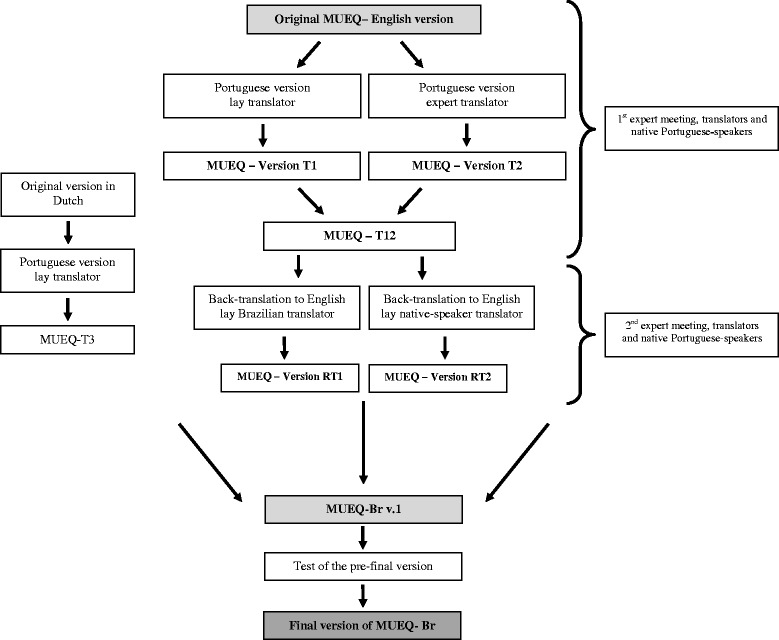
The cross-cultural adaptation consisted of five stages (forward translation of the MUEQ to Brazilian Portuguese, synthesis of the translation, back-translation, expert committee meeting, and the pre-final-version test). In the pre-final-version test, 55 computer-office workers participated. For reproducibility, a sample of 50 workers completed the questionnaire twice within a one-week interval. A sample of 386 workers from the University of São Paulo (mean age = 37.44 years; 95% confidence interval: 36.50-38.38; 216 women and 170 men) participated on the structural validation and internal consistency analysis. Intraclass correlation coefficient was used for the statistical analysis of reproducibility, Cronbach's alpha was used for internal consistency, and confirmatory factor analysis was used for structural validity.
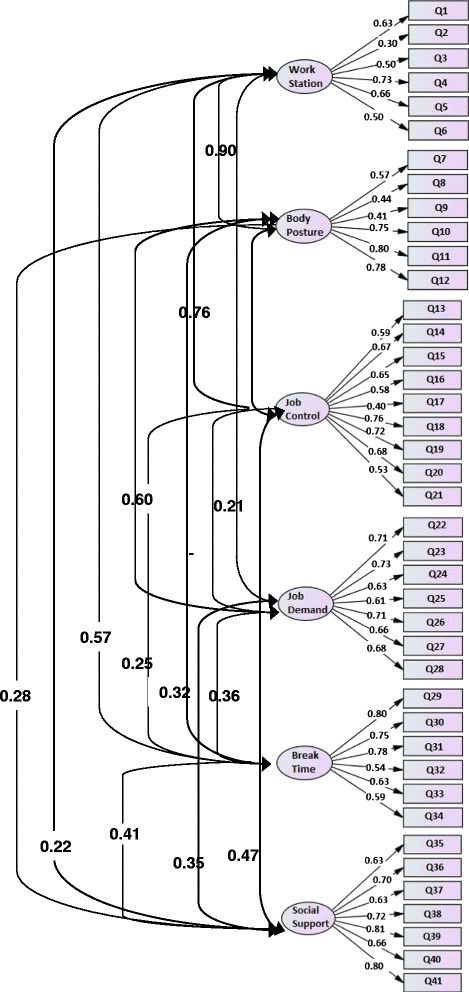
The calculation of internal consistency, reproducibility, and cross validation provided evidence of reliability and lack of redundancy. The psychometric properties of the modified MUEQ-Br revised were assessed using confirmatory factor analysis, which revealed 6 factors and 41 questions. For this model, the comparative fit index (CFI), goodness-of-fit index (GFI), and non-normed fit index (NNFI) each achieved 0.90, and the consistent Akaike information criterion (CAIC), chi-square, expected cross-validation index (ECIV), and root mean square error of approximation (RMSEA) demonstrated better values.
The results provide a basis for using the 41-item MUEQ-Br revised for the assessment of computer-office workers' perceptions of the psychosocial and ergonomic aspects of CANS and musculoskeletal-complaint characterization.
手臂、颈部和肩部不适(CANS)具有多因素病因,因此,对其评估应同时考虑与工作相关的人体工程学和社会心理因素。马斯特里赫特上肢问卷(MUEQ)是少数可用于评估计算机办公人员中CANS的性质和发生情况以及社会心理和人体工程学因素对工作条件影响的特定工具之一。本研究的目的是将MUEQ翻译成巴西葡萄牙语并进行跨文化适应,同时验证MUEQ在巴西计算机办公人员中的信度、内部一致性和结构效度。
跨文化适应包括五个阶段(将MUEQ正向翻译成巴西葡萄牙语、翻译合成、回译、专家委员会会议以及最终版本前测试)。在最终版本前测试中,55名计算机办公人员参与。为评估可重复性,50名工作人员的样本在一周间隔内完成问卷两次。来自圣保罗大学的386名工作人员(平均年龄 = 37.44岁;95%置信区间:36.50 - 38.38;216名女性和170名男性)参与了结构效度和内部一致性分析。组内相关系数用于可重复性的统计分析,Cronbach's α用于内部一致性分析,验证性因素分析用于结构效度分析。
内部一致性、可重复性和交叉验证的计算提供了信度和无冗余的证据。使用验证性因素分析评估修订后的MUEQ - Br的心理测量特性,结果显示有6个因素和41个问题。对于该模型,比较拟合指数(CFI)、拟合优度指数(GFI)和非规范拟合指数(NNFI)均达到0.90,一致性赤池信息准则(CAIC)、卡方、预期交叉验证指数(ECIV)和近似均方根误差(RMSEA)显示出更好的值。
研究结果为使用修订后的41项MUEQ - Br评估计算机办公人员对CANS的社会心理和人体工程学方面的认知以及肌肉骨骼不适特征提供了依据。